ADAPTING ASIAN FOLKLORE AS A BASIS FOR
CHILDREN’S AND YA LITERATURE
Introduction
 If you take a close look at children’s
books, many are based on fairy tales (either in terms of the plot/sub-plot or it
contains an idea, or a motif from an ancient source). Fairy tales themselves
spring from folklore. Not surprising as these stories are rooted in
the society and culture they come from. I also believe that almost all folk
tales are based on real life; events which have etched themselves into the
collective memory of a group of people. Of course they have been embellished
over the years and centuries through numerous retelling but it is the nature of
oral traditions that a story gets altered by the story teller to become
relevant for the time and place they are being retold. Stories became fixed
only when publishing and printing became available.
If you take a close look at children’s
books, many are based on fairy tales (either in terms of the plot/sub-plot or it
contains an idea, or a motif from an ancient source). Fairy tales themselves
spring from folklore. Not surprising as these stories are rooted in
the society and culture they come from. I also believe that almost all folk
tales are based on real life; events which have etched themselves into the
collective memory of a group of people. Of course they have been embellished
over the years and centuries through numerous retelling but it is the nature of
oral traditions that a story gets altered by the story teller to become
relevant for the time and place they are being retold. Stories became fixed
only when publishing and printing became available.
Slide 2.1: Illustration of Sembilan of the Rice Fields, from Timeless Tales of Malaysia
- Dressing Old Tales in New Clothes
*The
Owl Service, (1967) by Alan Garner
 An excellent example of a book based on an
old myth is Alan Garner’s The Owl Service.
This award-winning book in a sense relives an old legend dressed in modern
clothes. Garner’s book is about three teenagers who are thrown together by
circumstance and became caught up in a love triangle from an ancient Welsh
legend – of Lleu Llaw Gyffes, and his wife Blodeuwedd, a woman made from the
flowers of broom, meadowsweet and oak. She was conjured from the essence of
these flowers by Lleu’s uncle, the wizard Gwydion. Later, she fell in love with
Gronw Pebr, and together, they conspired
to murder Lleu. Gronw mortally wounded Lleu with a spear but he escaped death
by turning into an eagle. Lleu’s uncle, Gwydion tracked the eagle down and
healed him. Lleu demanded revenge and by
magic, he and Gronw exchanged places. Lleu killed Gronw by throwing a spear
with such force that it went through a rock behind which Gronw was hiding. For
her part in her husband’s murder, Blodeuwedd was turned into an owl by Gwydion,
a fate ‘worse than death’ we are told. In
The Owl Service, Alison is Bloduewedd,
Gwyn is Lleu and Roger is Gronw. We learn that Gwyn’s ancient ancestors
probably owned the valley even though his mother works as housekeeper for Alison’s
mother and her stepfather, Clive Bradley (Roger’s father).
An excellent example of a book based on an
old myth is Alan Garner’s The Owl Service.
This award-winning book in a sense relives an old legend dressed in modern
clothes. Garner’s book is about three teenagers who are thrown together by
circumstance and became caught up in a love triangle from an ancient Welsh
legend – of Lleu Llaw Gyffes, and his wife Blodeuwedd, a woman made from the
flowers of broom, meadowsweet and oak. She was conjured from the essence of
these flowers by Lleu’s uncle, the wizard Gwydion. Later, she fell in love with
Gronw Pebr, and together, they conspired
to murder Lleu. Gronw mortally wounded Lleu with a spear but he escaped death
by turning into an eagle. Lleu’s uncle, Gwydion tracked the eagle down and
healed him. Lleu demanded revenge and by
magic, he and Gronw exchanged places. Lleu killed Gronw by throwing a spear
with such force that it went through a rock behind which Gronw was hiding. For
her part in her husband’s murder, Blodeuwedd was turned into an owl by Gwydion,
a fate ‘worse than death’ we are told. In
The Owl Service, Alison is Bloduewedd,
Gwyn is Lleu and Roger is Gronw. We learn that Gwyn’s ancient ancestors
probably owned the valley even though his mother works as housekeeper for Alison’s
mother and her stepfather, Clive Bradley (Roger’s father).
- Using Folktales as an Integral Part of the Plot
This
brings us to three books called the Chronicles of Old Japan by Australian author,
Ruth Manley. I believe she would have written more books but unfortunately, she
passed away in 1986, so we are left with only three wonderful books.
- The Plum Rain Scroll, 1978
- The Dragon Stone, 1982
- The Peony Lantern, 1987
Ruth
Manley’s books are steeped in Japanese folklore and extremely entertaining to
read. They peopled by eccentric lords and ladies, samurai and ninja and also
creatures from Japanese folklore such as nishu, baku, onni etc. Manley
incorporates characters, ideas and storylines taken from Japanese folklore
directly into her stories. According to a commentary I read on her books, Manley’s
books most closely resembles Llyod Alexander’s Chronicles of Prydain, which are
based on Welsh folklore.
Slide 5.1: Cover of old
Plum Rain Scroll
 The
Plum Rain Scroll is a magical scroll which is
written in the ‘old language’. It contains three great magic – the secret of
immortality; the secret of turning baser metal into gold (similar to the
philosopher’s stone) but most important of all, the ‘unanswerable word’ - word
with the power to render all who hear it powerless to resist. The main
protagonist is an odd-job boy called Taro, a foundling who helped his Aunt Piety
to run an Inn called the Tachibana-ya. Aunt Piety is actually a fox-woman who has
magical powers, she is also married to Uncle Thunder, an eccentric and
absent-minded inventor who could be one of the Emperor’s son. Taro is thrown
into the fray when the evil warlord, Lord Marishoten, and his Black Warriors
attempted to capture Aunt Piety, she being the only person in the land who can
still read the ‘old language’. Along the way to rescue his aunt, Taro meets up
and form allegiances with a motley crew of friends including Prince Hachi, the
legendary prince eight-thousand spears; a travelling troupe whose members
include Oboro, the Cherry Blossom Princess; the ghost of a young samurai called
Hiroshi (who was murdered by Marishoten); and Mouse also known as Lord Sweet
Potato, a high-born nobleman who has a dream-eater called Baku, for a pet and
so on. In the first book, Ruth Manley throws in almost every imaginable
creature you could encounter in Japanese folklore into her book including the
Tengu of Vast Supernatural Wisdom! Taro and his friends race against Marishoten
and his henchmen to locate the Plum Rain Scroll, with only an old riddle to
guide them. Towards the end, Taro discovers that Oboro was a real princess.
The
Plum Rain Scroll is a magical scroll which is
written in the ‘old language’. It contains three great magic – the secret of
immortality; the secret of turning baser metal into gold (similar to the
philosopher’s stone) but most important of all, the ‘unanswerable word’ - word
with the power to render all who hear it powerless to resist. The main
protagonist is an odd-job boy called Taro, a foundling who helped his Aunt Piety
to run an Inn called the Tachibana-ya. Aunt Piety is actually a fox-woman who has
magical powers, she is also married to Uncle Thunder, an eccentric and
absent-minded inventor who could be one of the Emperor’s son. Taro is thrown
into the fray when the evil warlord, Lord Marishoten, and his Black Warriors
attempted to capture Aunt Piety, she being the only person in the land who can
still read the ‘old language’. Along the way to rescue his aunt, Taro meets up
and form allegiances with a motley crew of friends including Prince Hachi, the
legendary prince eight-thousand spears; a travelling troupe whose members
include Oboro, the Cherry Blossom Princess; the ghost of a young samurai called
Hiroshi (who was murdered by Marishoten); and Mouse also known as Lord Sweet
Potato, a high-born nobleman who has a dream-eater called Baku, for a pet and
so on. In the first book, Ruth Manley throws in almost every imaginable
creature you could encounter in Japanese folklore into her book including the
Tengu of Vast Supernatural Wisdom! Taro and his friends race against Marishoten
and his henchmen to locate the Plum Rain Scroll, with only an old riddle to
guide them. Towards the end, Taro discovers that Oboro was a real princess.
Slide 6.1: Cover of new
Plum Rain Scroll
 The
Dragon Stone – Another antagonist emerges in the
second book. She is the Jewel Maid and it turns out that Lord Marishoten is
actually her servant. The Jewel Maid is based on an old Japanese legend – that
of Tamano, a beautiful and ancient nine-tailed fox demon. In folklore, Tamano bewitched the Emperor and sought
to destroy the Imperial line until her true identity was discovered and she was
driven out. She sought refuge in a black stone which came to be known as the
Death Stone. In the book, the Dragon Stone has the power to bend the will of
people; it was created by the Jewel Maid. Manley incorporates an iconic
Japanese folktale, the Taketori
Monogatari into this book. To
summarise: A poor bamboo cutter finds a shining child (and nuggets of gold) in
the stump of a large bamboo. He takes her home to his wife and they raise her
as their own child. She is known as Kaguyahime and grows up into an
accomplished and amazing beauty. Her five most illustrious suitors are each
given an impossible task to win her hand. In The
Dragon Stone, Kaguyahime is sent to earth for the express purpose of
locating the Dragon Stome to prevent it from falling into the hands of the
Jewel Maid again. As in the folktale, Otomo no Miyuki was given the task of
obtaining the Dragon Stone. In this he succeeds but he falls under the stone’s influence
and triggers off the Genpei Wars (a real historical event). It falls to Taro,
Oboro and friends including Prince Hachi to locate and unmake the Dragon Stone,
again guided by a riddle.
The
Dragon Stone – Another antagonist emerges in the
second book. She is the Jewel Maid and it turns out that Lord Marishoten is
actually her servant. The Jewel Maid is based on an old Japanese legend – that
of Tamano, a beautiful and ancient nine-tailed fox demon. In folklore, Tamano bewitched the Emperor and sought
to destroy the Imperial line until her true identity was discovered and she was
driven out. She sought refuge in a black stone which came to be known as the
Death Stone. In the book, the Dragon Stone has the power to bend the will of
people; it was created by the Jewel Maid. Manley incorporates an iconic
Japanese folktale, the Taketori
Monogatari into this book. To
summarise: A poor bamboo cutter finds a shining child (and nuggets of gold) in
the stump of a large bamboo. He takes her home to his wife and they raise her
as their own child. She is known as Kaguyahime and grows up into an
accomplished and amazing beauty. Her five most illustrious suitors are each
given an impossible task to win her hand. In The
Dragon Stone, Kaguyahime is sent to earth for the express purpose of
locating the Dragon Stome to prevent it from falling into the hands of the
Jewel Maid again. As in the folktale, Otomo no Miyuki was given the task of
obtaining the Dragon Stone. In this he succeeds but he falls under the stone’s influence
and triggers off the Genpei Wars (a real historical event). It falls to Taro,
Oboro and friends including Prince Hachi to locate and unmake the Dragon Stone,
again guided by a riddle.
 The
Peony Lantern incorporates several legends and
myths into its storyline. Even the title of the book refers to an eerie
Japanese ghost story. A central subplot is the story of Ho-Wori and the
Princess of the Sea (this is a myth I retold in my book ‘Eight Treasures of the Dragon’ as ‘Ho-Wori and the Princess of the
Sea’). It is the story of two brothers Ho-Wori (Prince Fire Fade) and Ho-Deri (Prince
Fire Flash) who are bitter rivals. One day, Ho-Wori gets lost at sea and is
taken to the place of the Sea king. He falls in love with the sea king’s
daughter and marries her. After what seems only a few weeks, he is overcome
with homesickness and decides to return home. He is given a treasure chest and
two magical pearls as gifts by the sea king. In the book, The Jewel Maid and Lord
Marishoten reemerge, but this time they are seeking the objects of power known
as the windflowers. No one actually knew what the windflowers were until the
emperor suddenly remembered his youth and his visit to the kingdom of the sea (he
was actually Ho-Wori or Prince Fire Fade). In any case, he realised that the windflowers
were actually the two pearls – the tide-ebbing and the tide-flowing pearls - which
had been given to him by the sea king. Unfortunately, the Jewel Maid had cast a
spell on him and he had fallen into a deep sleep and is unable to convey his
knowledge to anyone. Meanwhile, The Jewel Maid kidnaps Oboro, believing that
she has the windflowers. Ruth Manley successfully incorporated this old myth
into an integral part of the story.
The
Peony Lantern incorporates several legends and
myths into its storyline. Even the title of the book refers to an eerie
Japanese ghost story. A central subplot is the story of Ho-Wori and the
Princess of the Sea (this is a myth I retold in my book ‘Eight Treasures of the Dragon’ as ‘Ho-Wori and the Princess of the
Sea’). It is the story of two brothers Ho-Wori (Prince Fire Fade) and Ho-Deri (Prince
Fire Flash) who are bitter rivals. One day, Ho-Wori gets lost at sea and is
taken to the place of the Sea king. He falls in love with the sea king’s
daughter and marries her. After what seems only a few weeks, he is overcome
with homesickness and decides to return home. He is given a treasure chest and
two magical pearls as gifts by the sea king. In the book, The Jewel Maid and Lord
Marishoten reemerge, but this time they are seeking the objects of power known
as the windflowers. No one actually knew what the windflowers were until the
emperor suddenly remembered his youth and his visit to the kingdom of the sea (he
was actually Ho-Wori or Prince Fire Fade). In any case, he realised that the windflowers
were actually the two pearls – the tide-ebbing and the tide-flowing pearls - which
had been given to him by the sea king. Unfortunately, the Jewel Maid had cast a
spell on him and he had fallen into a deep sleep and is unable to convey his
knowledge to anyone. Meanwhile, The Jewel Maid kidnaps Oboro, believing that
she has the windflowers. Ruth Manley successfully incorporated this old myth
into an integral part of the story.
- Using a Quest or a Journey to retell Folktales
and Construct a Story
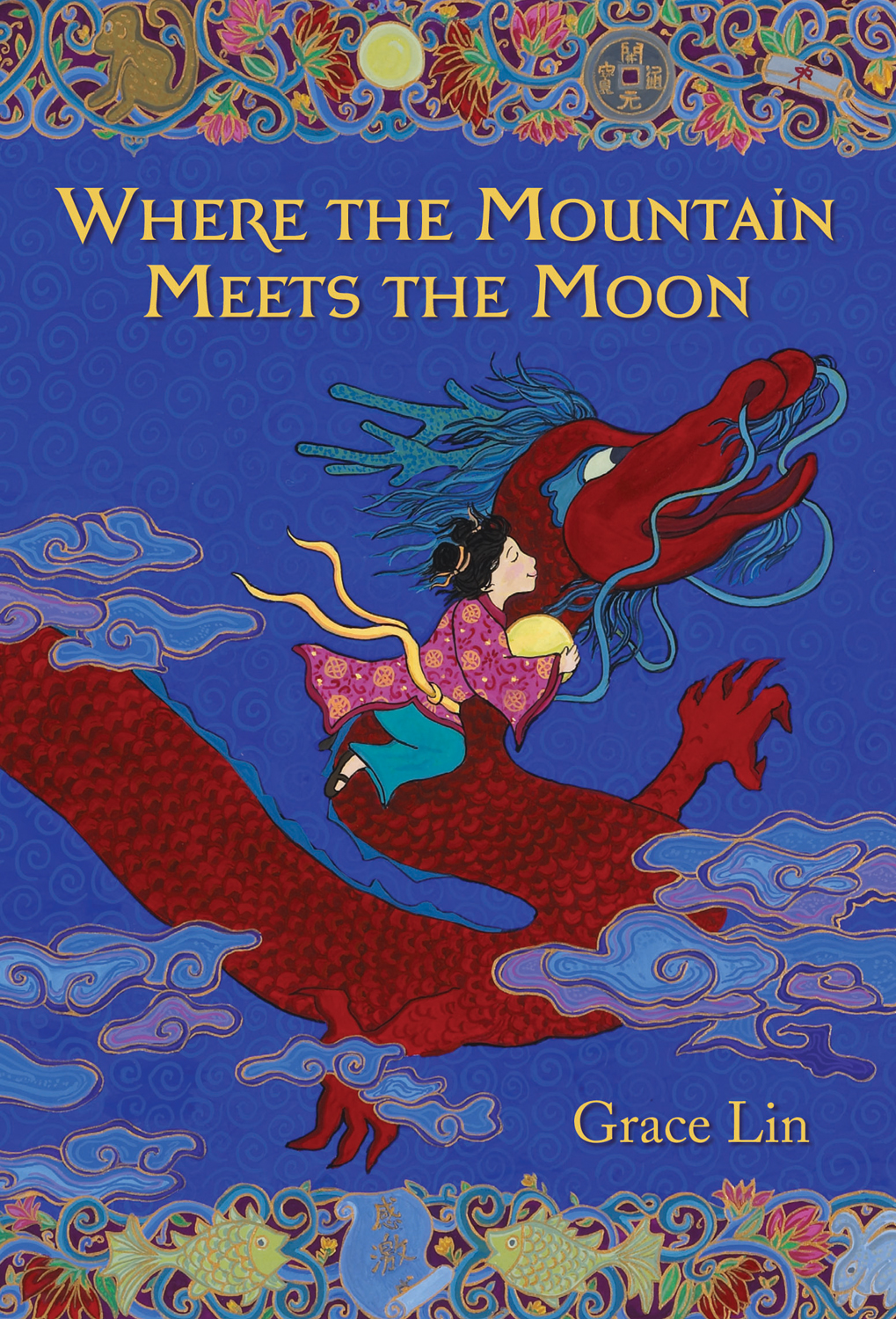
Grace Lin’s Where the Mountain Meets the Moon (2009) incorporates several well-known
Chinese folktales as part of its plot. Minli, a little girl from an
impoverished village located in a place called Fruitless Mountain Valley, goes on
a quest to see the Old Man of the Moon in an attempt to change the fortune of
her family. Along her journey she meets and befriends a friendly dragon who is
unable to fly. The dragon itself is a character from a famous folktale – about
a lifelike but unfinished painting of a dragon by a master painter which came
to life when the painting was completed by someone else – by drawing in the
dragon’s eyes. Minli and the Dragon decide to help one another – Minli in her
quest for fortune which she believed will bring her family happiness and the
Dragon in his quest for flight. Along their journey, they encounter several characters
from Chinese folktales, who each have their own stories to tell. All these
various characters and tales are skillfully woven into the fabric of the story.
Slide 9.1: Cover of
Where the Mountain Meets the Moon
Research
Research is a key factor in writing a good
book, we look at sources for Asian folktales e.g. unpublished stories on the
internet, newspaper articles and also books, old and new.
Books:
- Folktales from India
(1991) by A.K. Ramanujan
- Green Willow and Other Japanese Folktales (1987) by Grace James
- The Magic Boat and Other Chinese folktales (1980) by M.A. Jagendorf and Virginia Weng.
- Korean Folk-tales (1994)
by James Riordan
- Hikayat: From the Ancient Malay Kingdoms (2012) by Ninotaziz
- Malaysian Fables, Folk Tales and Legends (2012) by Walter Skeats and Edwin H Gomez
- Timeless Tales of Malaysia (2009) by Tutu Dutta
An excellent Internet source for World and Asian
folklore and myths (translated from the original):
For Malaysian folklore visit:
- www.sabrizain.org/malaya/library
Research for a book should not just focus
on one particular folktale but also on similar stories and variants of the
story. Reading a few versions of the same story will give you a feel for the
story.
 |
Illustration from Eight Treasures of
the Dragon by Tan Vay Fern |
Supporting research on the time and place
which form the backdrop to the story i.e. details such as old place names,
historical personages and cultural practices give the book texture and context.
The folktale from China, Dragon Wells of
Yanjing in Eight Treasures of the Dragon was
based on the story of a Dragon king and queen who decided to punish the people
of Yanjing (the old name of Beijing) for destroying their home by draining a
lake. In one version of the story,
Kublai Khan was mentioned. When I researched the history, I discovered that
Kublai Khan did indeed re-design Yanjing. A huge lake was drained and a canal
built to connect Yanjing with the South. That is the history; legend tells us that draining the lake had dire consequences for the people of Yanjing.
Slide 11.3: Photo of
water carrier
 |
| The majestic Baobab of Madagascar |
Another point to note is that plants i.e.
flowers and trees and also birds and animals play an important role in folklore
(as we saw in the story of Bloddoewedd, a woman made of flowers, who was turned
into an owl). Many trees have cultural significance even today – e.g. the
Banyan Tree and /Holy Basil/Sacred Fig of Asia, the Baobab in East Africa and
the Iroko tree of West Afrika, the Oak/Mistletoe/Clover in Europe etc An attempt must be made to identify a
flower, tree or animal mentioned in a
legend so that you can identify its scientific name and can even read up on it
to see how closely it matches the legend! I did this for most of my stories.
Next, I refer to my books – The Jugra Chronicles - to explain this
process. To date two books have been published in the series:
*Miyah
and the Forest Demon (2011)
*Rigih
and the Witch of Moon Lake (2013)
The title of the series – The Jugra Chronicles – Jugra is the name of the old Royal
town in Selangor. But it is also the name of a hill on Carey Island (close to
Port Klang) and is considered to be sacred to the Mah Meri. I talked to a few
members of the tribe on a trip to Carey Island some years ago. In the books,
Jugra was a powerful shaman whose actions had repercussions on his descendents.
First of all decide on a setting for your
story – the place and time. When writing a story set in this part of the world
it is always wise to consider the two main trade routes of the past – the
overland Silk Route and the sea bound Spice Route. As we are right in the midst
of the Spice Route (The so-called Spice Islands have identified as the
Moluccas), it is natural to think of the Spice Trade.
 |
| Map of Borneo |
I chose to set the story in Borneo, due to
the unique and diverse folklore traditions associated with the island –
including head-hunting and the use of magic! In the end, I narrowed it down to
a coastal region near Brunei - in the past, the Sultan of Brunei had suzerainty
over most of Borneo – and also because the two Malaysian states of Sabah and
Sarawak meets with Brunei and Indonesian Kalimantan here. The time period is
the 17
th Century – over a hundred years after the fall of the Melaka
Empire. I did some research on the history of the area and came across the name
‘Tanjungpura’ and decided to use it in my story. The story is set against the
backdrop of a power struggle in Tanjungpura, an ancient trading with ties to
the Han Kingdom (China), Hindustan (India), Majapahit (Indonesia) and Melaka (Malaysia)
– which is now under the Dutch.
 |
Illustration from Miyah and the Forest Demon
by Choong Kwee Kim |
The protagonist is a girl called Miyah,
whose father is the village Shaman. Her best friend is Suru, a girl whose
father (a spice trader from the Han Kingdom who was once stranded in the
village) has long since left the village. Miyah’s mother is the village
mid-wife, a role which is also associated with magical abilities.
The story is as follows:
One morning, Miyah’s mother asks her to
remain in the longhouse and look after her younger brother Bongsu as she had to
go another village to deliver a baby. But it is a beautiful day and Miyah has
promised to meet her friends at a waterfall upstream. Miyah disobeys her mother
and joins her friends at the waterfall. A sudden sun-shower at the waterfall
and the eerie cry of a bird, harbingers of misfortune, reminds Miyah of Bongsu.
She returns home to find Bongsu missing! This part of the story – of a child
who is lost in the forest and is believed to be abducted by an evil spirit is
quite a stock part of native folklore in Malaysia and many other countries. The
quest here is to recover a lost child rather than to look for treasure.
When Miyah returns, the village is also
strangely empty. Miyah has no one to turn to except Rigih, a boy who is an
outcast in the village because he came from another tribe. But he is related to
Miyah’s mother and agrees to help her. On the way to the forest, Miyah and
Rigih meets Sang Kanchil, the talking mousedeer, who leads them to Nenek
Kebayan (Nenek Kebayan is a central figure in Malay folklore, a little like
Babka from Russian folklore). Guided by the wise woman of the forest, they
embark on a quest to rescue Bongsu. They succeed in rescuing Bongsu but Miyah
is caught by the forest demon…
In the second book in the series, Rigih and
Bongsu’s attempt to rescue Miyah.
I also use another folktale – that of the seven
faeries who come down to earth to bath in a forest pool - to explain the origin
of Jugra and his magical powers. We also learn about the true nature of the
forest demon in this book.
Re-telling
a story
The stories in the book are ‘retold’ and
not ‘translated’. When you translate a story, you try to write it as close to
the original as possible, but in a different language. Retelling a story means
that this is your own interpretation of the story; with your own
characterization and your own dialogues and description. Even the chain of
events and sometimes the outcome of the stories can be changed sometimes,
although I prefer to remain true to the original story. I’ve read/heard most of
the stories in Malay but I try to understand (internalize them) them and then
re-tell them in my own words. It was a
little challenging especially when I come across words such as ‘huma’ etc and when
the original is in old Malay.
Yes, very often the same story appears in
several different versions. Usually I select one version but sometimes I
combine two or three different versions into one story!
The need to re-interpret and retell these
folktales, to make them relevant and appealing to a young contemporary
readership is the third key point. The author needs to balance authenticity
(being true to the story) with the need to hold the readers’ interest.
Pervasiveness
of Folklore
Folktales are quite universal.
A Malay folktale called Puteri Bunga Tanjung, which I have retold as The
Tanjung Blossom Faerie (it actually means Tanjung Blossom Princess), in Timeless Tales of Malaysia. This is the
story of seven faerie princesses who come to earth to take a bath in a
beautiful forest pool. The youngest sister loses her cloak or selendang and is
unable to return home. She sits under a tree and weeps and her tears turn into
fragrant blossoms when they touch the earth.
The lost fairy maiden is taken in by a poor
old woman – probably another Nenek Kebayan. The fairy helps the woman to make
fragrant flower posies and perfumed oil to sell in the village, but every
evening she returns to the forest to weep. As time passes, the old woman feels
sorry for the fairy and they search for the lost selendang so that the fairy
could return home. However, before she leaves, the fairy transforms the tree
she used to sit under into a Tanjung tree so that it bears night blooming
flowers which are shed at dawn, like the tears of a fairy.
 |
| The Tanjung Blossoms - Mimusops elengi |
- Regarded as a national folktale, this particular folktale
clearly originates from Penang as Tanjung is the old Malay name for
Penang. There are also similarities with another folktale, Bunga Tanjung which is known to originate from Penang. The bunga
tanjung (Mimusops elengi) is a
fragrant, night-blooming flower.
This motif of the seven fairy sisters
taking a bath in a pool appears in folktales in Japan, Korea and China. In
fact, in Ruth Manley’s Peony Lantern,
there is a character called O-Kuni and her travelling troupe of dancers. It
later turns out that she is actually a fairy trapped on earth because someone
had stolen her magical robe of feathers!
 |
| The Weavermaid and the Herdsboy |
We don’t know where the story first
originated from but it could be based on the Chinese folktale of ‘The Weavermaid and the Herdsboy’. In the Korean and Japanese version, the story
is usually referred to as The Robe of Feathers or the Celestial Robe of
Feathers. In this version, a fisherman/hunter/herdsman observe a
flock of seven
cranes land on the shores of a lake or forest pool. The cranes turn into
maidens who hang their robes on the branches of a tree before going for a swim.
The fisherman hides one of the robes so that one of the fairies is trapped on
earth. The fairy is forced to marry the fisherman and lives with him and his
mother for many years. Eventually, when everyone seems to have forgotten that
she is in fact a fairy, the mother accidently comes across the robe of feathers
which the fisherman had hidden and decides to air it. The fairy asks if she
could try it on and she turns into a crane and flies away!
 Even more surprising, this same motif of
seven fairy sisters appears in an Iban legend called ‘Jelenggai’, also found in
the Timeless Tales of Malaysia collection.
Even more surprising, this same motif of
seven fairy sisters appears in an Iban legend called ‘Jelenggai’, also found in
the Timeless Tales of Malaysia collection.
Another variant to this folktale is that of
Manohra, the bird Maiden. Retold in my book, Eight Jewels of the Phoenix, this is the story of seven princesses
who are bird maidens. As before, they take a bath in a secluded forest pool,
however the youngest is captured by a hunter who gives her as a gift to the
prince of the Kingdom. The prince falls in love with Manohra and so on… The
story of Manohra is widely known in the East Coast of Peninsular Malaysia and
is definitely of Thai origin as there is a classical Thai dance drama based on
this story. Manohra is also widely known in Cambodia and Laos and the origin of
this story is more likely to be from India.
So from studying folktales we can see that
stories travel all over the world!
References
1.
Divakaruni, Chitra Bannerjee
(2005), The Mirror of Fire and Dreaming,
published by Roaring Brook Press, Connecticut, United States of America.
2.
Dutta, Tutu (2009): Timeless Tales of Malaysia, published by
Marshall-Cavendish Malaysia.
3.
Dutta-Yean, Tutu (2009): Eight Fortunes of the Qilin, published
by MPH Group Publishing Sdn Bhd, Malaysia.
4.
Dutta-Yean, Tutu (2009): Eight Jewels of the Phoenix, published
by MPH Group Publishing Sdn Bhd, Malaysia.
5.
Dutta-Yean, Tutu (2011): Eight Treasures of the Dragon, published
by MPH Group Publishing Sdn Bhd, Malaysia.
6.
Dutta-Yean, Tutu (2011): The Jugra Chronicles: Miyah and the Forest
Demon, published by MPH Group Publishing Sdn Bhd, Malaysia.
7.
Dutta-Yean, Tutu (2013): The Jugra Chronicles: Rigih and the Witch of
Moon Lake, publishing in progress by MPH Group Publishing Sdn Bhd,
Malaysia.
8.
Garner, Alan (1967): The Owl Service, first published by
William Collins Sons & Co. Ltd, Great Britain.
9.
Jagendorf, M.A. and Virginia
Weng (1980): The Magic Boat and Other
Chinese Folktales, published by Vanguard, New York, United States of
America.
10.
James, Grace (1987): Green Willow and Other Japanese Fairy Tales,
published by Avenel Books, New York, United States of America.
11.
Lewis, C.S. (1950): The Lion, The Witch and the Wardrobe,
published by Goeffrey Bles, United Kingdom.
12.
Lin, Grace (2009): Where the Mountain Meets the Moon, published
by Little, Brown Books for Young Readers,
New York, United States of America.
13.
Manley, Ruth (1978): The Plum Rain Scroll, first published by
Hodder and Stoughton (Australia) Pty Ltd, Sydney, Australia.
14.
Manley, Ruth (1982): The Dragon Stone, first published by
Hodder and Stoughton (Australia) Pty Ltd, Sydney, Australia.
15.
Manley, Ruth (1987): The Peony Lantern, published by Hodder
and Stoughton (Australia) Pty Ltd, Sydney, Australia.
16.
Ninotaziz (2012): Hikayat: From the Ancient Malay Kingdoms, published
by Utusan Publications, Malaysia.
17.
Ramanujan, A.K. (1991): Folktales from India, published by
Pantheon Books, United States of America.
18.
Skeats, Walter and Edwin H.
Gomez (2012): Malaysian Fables, Folktales
and Legends, published by Silverfish Books Sdn Bhd, Malaysia.

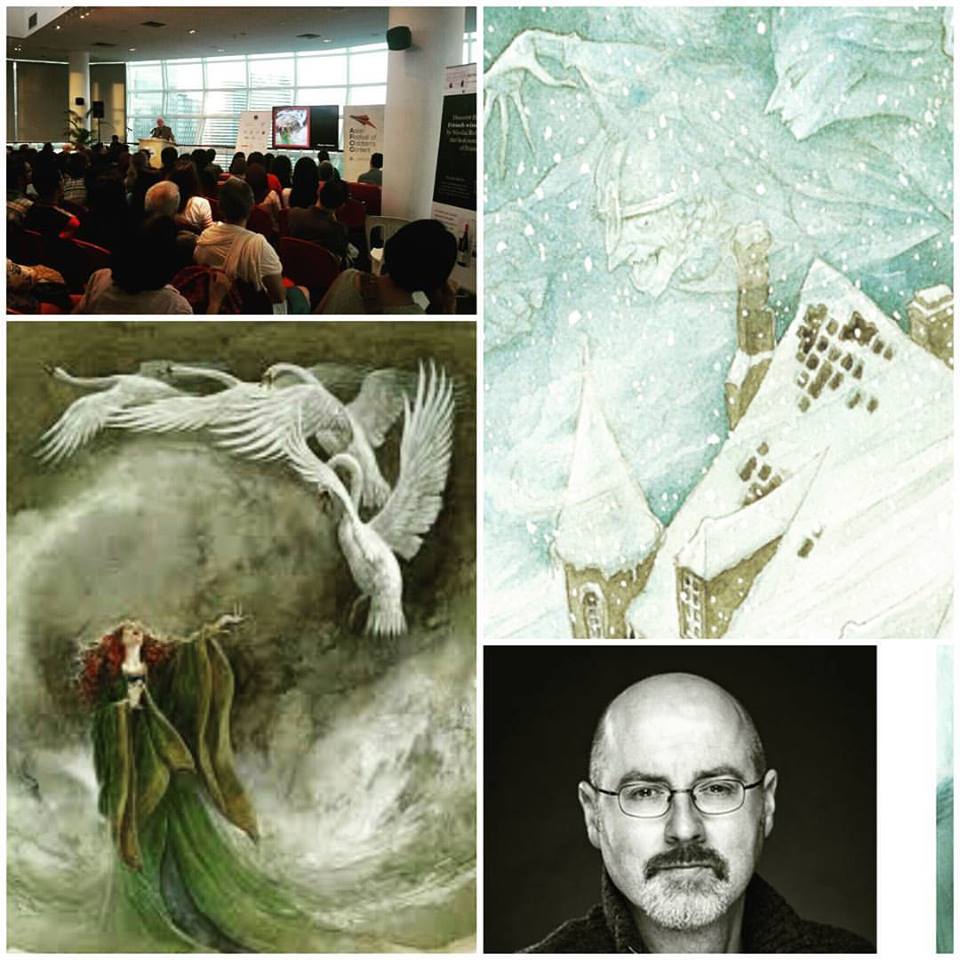


 First and foremost it was a great opportunity to network. Among the people who were there: Heidi Shamsuddin and Teoh Choon Ean, two prominent children's writers from Malaysia. Heidi was there as a speaker and also to launch her new books, published by her fledgling company, Paper Moon; while Choon Ean was there to launch her latest books.