Pages

Welcome! Selamat Datang! Bien Venue!

Dedicated to all those who are interested in world folklore, culture and nature. Comments and constructive criticisms are welcome!

Monday, May 11, 2015

The Golden Seal


THE GOLDEN SEAL
A short story by Golda Mowe.
Seal at Kepy Cape Town Scuba Diving School by Tim Sheerm (from Wikimedia)


Timon drifted between sleep and waking as he clung onto the floating crate. He couldn’t tell how long he had been adrift but he now felt so numb he could not even feel his legs. Maybe he should just let go and stop fighting the inevitable, he thought, but each time he attempted to do so, a primal fear would set in and make him cling harder to the crate.
He was glad he went out alone on the boat. Then again, if he had not quarrelled with his wife Marie, he would not be out at sea during stormy weather. He chuckled and coughed at the same time as he thought about how a silly argument over the placement of a single cushion on a newly bought sofa could lead up to a shipwreck at sea. Too late he realized that Marie was perfectly beautiful because she was a perfectionist. She admitted during their last argument that she married him because she thought he was the perfect project to work on. He was a handsome man who had bad hair and bad taste in clothes. He needed a woman’s touch, she thought.
A seal poked her head out of the water and stared at him. Timon smiled and reached out a hand to try to touch her. The seal re-submerged. Timon put his hand down and lay his cheek on the wet crate. He started to drift off to sleep once more. He woke up with a start when he felt something hit his head. It was a freshly killed sardine. Without giving it a second thought, he grabbed the fish with one hand and started biting into it. The ironic taste of blood filled his mouth. The more he bit, the hungrier he became for the sardine. He even crushed the head between his teeth and chewed on it like it was fruit.
The same seal poked her head out of water again to watch him. Timon’s gaze met hers and he said, “Thank you.” His voice sounded strange to him because it sounded like a cross between a squeal and a cough.
“You are welcome,” she said.
Timon almost released the crate with shock. “You can speak,” he said with wonder.
“Of course I can,” she said. “So can you.”
Timon chuckled. Again the sound that came out of him sounded alien, or rather sounded like a sound he had never thought he would be capable of making. It must be because he had not had any water to drink for a while, he reasoned.
The seal said, “Come swim with me.”
“I can’t. I will drown.”
“Don’t worry. I will take care of you.”
At that point Timon realised that he could be hallucinating. But if he was, he decided, it was a really good one. So he let go of the crate and moved towards the seal. He felt himself gliding through the water. The seal turned and swam away, and Timon chased after her. His clothes began to peel off him as they dove deeper and deeper. Then they went up and up until they broke through the water surface to gulp in air. After a while, Timon realised that he could hold his breath for long stretches of time without any problem. And more amazingly he could keep up with the seal. They crashed into a school of sardines.
Timon turned this way and that, reaching out with his flippers to try to catch one, but he could not grab hold of a single one. The female seal gave him a fish she caught and he reached out with his mouth. Then they dashed into the school again. This time Timon used his mouth to catch them, the way he saw she did.
After they both had their fill of fish, the seal swam ahead. Soon Timon found himself at the cliff edge. He was ecstatic. He was finally back on land. He tried to walk, but felt the sharp edges of the rock scrapping against his belly. He looked down, and saw fins where his hands should be. Then he looked behind him and saw a flipper in place of his legs. Timon’s breath caught in his throat as the horror of his new form finally registered in his mind.
“Look, Mommy,” a little girl called out and pointed from the cliff edge. “A golden seal.”
Timon tried to call for help, but the only thing that came out of his mouth was the seal call. He looked up with despair as people got out their cameras or phones to take pictures of him.
The female seal said, “Don’t do that. They will think that you like the attention.”
“What have you done to me?” Timon asked vehemently.
“You ate the fish I gave you. So you are now my husband.”
“But why?”
“You seemed interesting,” she said. “I wanted something different from all the other males.”
“Oww!” Timon yelled. Then he turned with a roar at the male seal that bit him. “What are you doing?” he demanded.
The other seal only glared at him then turned away. The female explained, “He just wants to show you what he can do to you if you ever try to approach any of his females.”
“I don’t want to.”
“It doesn’t matter. You are a male. Males don’t like males.”
Timon was livid. “Why did you change me? Why can’t you just be with the other males?”
The female settled her chin on the rock and closed her eyes. Then she said, “Because I don’t like any of the other males. They are arrogant and promiscuous. I would rather have a male that stays with me all the time instead of one that roves about the other females.”
“Well I can do that too,” Timon said then added a little more sheepishly, “Rove about, I mean.”
“Of course you can,” she said, “but you will not last a day. The males will tear you to pieces. If you are lucky, a marine biologist might save you. Then he will put you in a cage where you will be cold and fed dead fish with stale tasting blood.”
A new kind of fear entered Timon’s mind. A kind of fear that he had never considered before in his life. He lay down next to the female, and she snuggled up to him. He watched the surf crashed into the side of the rock and he felt the spray rain back down on him. He thought it strange that he did not feel cold. Then he realised that this was the life he had always wanted to live. Lazing about on the beach, and swimming whenever he felt like it. Maybe he should give it a try after all. But he must remember to stay out of the way of the other males.

Bio - Golda Mowe hails from Sibu, Sarawak, a Malaysian state located on the island of Borneo. She is an Iban, a tribe native to Sarawak, and a graduate of the prestigious Waseda University of Japan. Golda is a published author with two books to her credit - Iban Dreams (a folklore based fantasy fiction) and The Nanobots and Other Stories (a collection of sci-fi short stories for tweens.)

 You can read more of her stories at the following link: http://www.gmowe.ws/Golden_Seal.html#.VU1rMastnqk.facebook

Tuesday, April 14, 2015

TRUANCY - Issue 1

Truancyweb

http://www.delinquentspice.com/?p=246

Table of Contents
Editorial by Nin Harris
“I Growled” by Joyce Chng
“Cold Eyes” by Shada Bokir*
“The Devouring Night” by Mary Anne Mohanraj
“The Piscine Gifts” by Stace Dumoski**
“It is Important to be Polite”: The Subtle Artistry of Karen Nunis
“The Pala Tree and the Sundal Tree” by Tutu Dutta
“Cover Illustration: “Sedna” by Kirsty Greenwood
*Trigger Warning: This is a story about Mental Illness.
**Trigger Warning: Some body-shaming language is used in this fable.


Thursday, April 2, 2015

B is for Bamboo Flute / PHOENIX SONG


Pre-order from www.lantanapublishing.com


The theme behind the story:

Phoenix Song is set in an imaginary town in Malaysia called Sighing Bamboo Hill; named after a mysterious hill which is believed to be haunted because of the sound of rustling bamboo leaves wafting from the hill. Although the setting is fictitious, not very long ago there were many villages and towns in Malaysia, with similar stories of haunted hills, rivers and lakes; wild places which were the domain of spirits, faeries or demons…

Magical elements play an important role in Phoenix Song, but the main theme is the importance of family as seen through the eyes of the main character, an eight-year old boy called Arohan. His mixed ethnicity - part Indian and part Chinese - reflects the cultural diversity of Malaysia; a country with at least a dozen ethnic groups. He also has a grandmother who is a Nyonya – a small community of Straits-born Chinese whose ancestors came to Malaysia in the Treasure Ships of the great Ming Dynasty explorer, Admiral Zheng He. The Nyonyas practice a culture which is a fusion of Malay and Chinese traditions.

Pheonix Song draws upon two separate folktales:

The first one is the Malay folktale of Buluh Perindu (literally yearning or sighing bamboo). The bamboo grove represents nature in the story. In traditional Malay culture, nature was so revered that a child is taught to ask for permission before even plucking a single flower. In the original story, three brothers were given the task of bringing back a bamboo cutting from a hill which was haunted or cursed. The two elder brothers ignored the advice of an old man they met on the way, and were turned to stone. The story was a fragment and also referred to the old belief not to respond or look back when one hears one's name being called in wild and lonely places... The youngest brother, who showed respect for the old man and followed his counsel, managed to obtain a piece of the magical buluh perindu. He fashioned a flute out of the bamboo and succeeded in reversing the curse on his brothers, just by playing the flute.


The story also draws upon the Chinese legend of the scholarly woodsman who was such a supernaturally gifted musician, he could tame wild animals and even summon the phoenix whenever he played the xiao (a Chinese bamboo flute). The phoenix in our story is Cendrawasih or Fenghuang, a symbol of Spring, longevity and the renewal of life.

I came across the story of Buluh Perindu some years ago but felt that there was something missing. Although the bamboo flute produced beautiful music, there were no other stories about its power to break curses; apart from Mozart’s The Magic Flute :)

I later came across the Chinese folktale of the wild musician and the two stories seemed to fit. If any magical creature could break a curse, it would be the phoenix. In addition, there were other East Asian folktales linking the music of the bamboo flute to the phoenix. In one, a phoenix appears to advise a pining Persian king to make a bamboo flute in order to win the heart of a Chinese princess…

When Alice Curry from Lantana Publishing (UK) contacted me about the possibility of writing a story for a children’s picture book, I immediately thought of Buluh Perindu. The story lent itself easily to a contemporary setting, with younger characters and the focus shifting to family and sibling rivalry. To make the story even more immediate, the narrative is told in a series of dialogues, between Arohan and his extended family and sometimes with himself :) The book also serves to remind us of  the deep reverence (and fear) for nature, we once had...

Wednesday, April 1, 2015

A is for Arohan/ PHOENIX SONG


Pre-order from www.lantanapublishing.com
The story behind the book:

When Alice Curry, the Founder/Director of Lantana Publishing (UK), contacted me by email on 12 November 2014 about the possibility of writing a children's picture book, I didn't quite believe her. I mean it was too much of a good thing - whoever heard of a publisher actually asking you to write a book for them?  It's usually an endless round of submissions... 

I asked her how she found out about me and she said that it was through my blogpost on The Jugra Chronicles
http://tutudutta.blogspot.com/2013/05/the-jugra-chronicles-rigih-and-witch-of.html . 
Wow! So all those stories were true - you can get a book contract from a blog!!!

I googled Alice Curry and found out that she was with the Commonwealth Children's Book Trust, among other things. The brief was a contemporary story for a children's picture book in 500 - 1,500 words, drawing on traditional Asian folklore. 

A week or two of research, followed by a proposal and finally a draft manuscript, entitled The Singing Bamboo Flute, and the contract was eventually signed - all by email. 

But it wasn't all that easy. The original manuscript had 2,000 words - far too long. I went through every sentence, deleting as many words as I could until the mss was down to 1,500 words. If you think this is easy I dare you to take out 500 words from a 2,000 words story - without changing the story line. But even at 1,500 words, the mss was still too long. So I had to remove a chunk of the story. The sub-plot which had to be removed, was about the Penunggu - the Guardian of the Bamboo Grove. The story was now down to about 1,000 words and the title was changed to Phoenix Song.

I named the main protagonist, Arohan; an 8-year-old Malaysian boy of mixed parentage. I had no idea why, it just seemed like the right name for him. Apparently, Deepika Mukherjee's (a Facebook friend) son is also called Arohan. The real surprise behind this name later.


Original cover of Phoenix Song
Once the manuscript was finalised, illustrator Martina Peluso came on board. Her illustration style uses bold simple lines and figures tend to be smooth and rounded. Martina's paintings remind me of modern art and sculpture with their almost 3-D effect. 

I wasn't expecting any more changes to the text at this stage, but I was wrong. When the sketches came, some pages were crammed with text and others were empty! How could this be? As Alice Curry explained, sometimes the illustrator can take the story in an entirely different direction... so more text had to be deleted in certain parts and entirely new text written for other parts. I didn't really mind because I knew in a picture book, (ideally) 50% of the story is told through the text and 50% through the illustrations. The colour palette for Phoenix Song is vibrant and jewel like, and really suits the tropical Malaysian setting. 

Since someone asked me this question about the book, I think I should explain : in a picture book, royalty is split 50 - 50 between the author and the illustrator. The other point is that, the publisher chooses the illustrator, the author doesn't really have a say. In fact, I never communicated directly with Martina; I always went through the publisher (for fear of riling anyone up ;) )

But the real surprise about Arohan, came from Facebook friend, Nadine Gregory. According to Nadine, the name Arohan or Aarohan actually refers to the ascending scale of a raga (Indian classical music scale), while Avarohan refers to the descending scale! I was genuinely surprised. It's possible that I may have come across this term while researching on the Internet but forgot about it completely.

The synopsis:

Arohan is desperate for a guitar. What eight year old boy isn’t? So when Arohan’s grandmother gives him a plain old bamboo flute for his birthday, he is understandably a little upset. But the xiao is no ordinary flute. An instrument steeped in the myths and legends of China, the xiao has its own special magic, as Arohan is soon to discover. When his brothers go missing on the slopes of the hill behind their home in Malaysia, Arohan embarks on a fantastic journey to ensure that they return safe and sound. But does he have what it takes to placate the guardian of the bamboo grove and summon the mythical phoenix? A touching and courageous story of a young boy’s love for his family and the magical things that can happen when you listen to your heart.

Monday, January 19, 2015

The Pala Tree and the Sundal Tree

In a previous post, 'Cracking the Sundal Tree Code,' published on 8/5/2013, I stated that the Sundal Harum Malam from Malay folklore was without doubt the Chempaka tree - Michelia champaca or Magnolia champaca. The Sundal Tree achieved notoriety by being associated with the pontianak; a female vampire (the pontianak is always female) who seeks shelter among its branches.

Apparently, I spoke (or wrote) too soon. A Facebook friend, Nadine Gregory, originally from the state of Kerala in India (she also lived in Kuala Lumpur for a number of years), informed me about a tree which grew in Kerala called the Pala tree. This tree bore night blooming flowers and had the reputation for being the abode of evil spirits and children were warned to stay away from the tree at night.

Alstonia scholaris, The Pala Tree
I thought, "Interesting, but the Pala is probably endemic to southern India."

I looked it up on Wikipedia and found out that the Pala, is also known as Ezhilam pala, Sharada, Yakshi pala, Daiva pala, Saptha parna in Sanskrit, and of all things, Devil tree in English!

More importantly, the plant is found throughout India and the Indomalaya region - all the way to Southern China (Hoa Sua), the Philippines and Queensland, Australia. In Thailand it is known as Phya Sattabahn. The scientific name is Alstonia scholaris. A member of the dogbane family, the milky sap of the tree is saturated with poisonous alkaloids.

The tree grows to a respectable 20 to 30 metres in height and bears masses of night blooming flowers, twice a year. The small greenish-white flowers give off a very strong fragrance, similar to that of Cestrum nocturnum, the Night Jessamine or Raat Ki Rani, which was my initial suspect for the title of The Sundal Tree. I had to discard this idea because C. nocturnum originates from South America.

According to Nadine, the fragrance of the Pala blooms is strong enough to produce headaches in susceptible people. Nadine Gregory's story: "Ezhilam paala. A seemingly innocuous tree with such a heady fragrance when in bloom at night that it invariably gave me a headache. It never helped that I'd heard hundreds of stories about beautiful long haired women in white who'd lurk under these trees asking young men for a match to light a beedi. Yes, you read it right. Beedi smoking femme fatale who'd morph into a vampire and suck young men's blood = yakshi. Women were always safe. Thank you, Malayalam movies for scarring me so deeply..." 
smile emoticon

I thought, 'This is it!' The local name of the tree itself, Yakshi pala, conjures up images of a blood thirsty seductress! In southern India, the yakshi is envisaged as an alluringly beautiful young woman who lure men to their death.

Blooms of  Pala/Sundal tree?
The traditional version of the story:
A man (usually from the upper castes) walking home at dusk, sees an extraordinarily beautiful woman who asks him for help. To add to her allure, the heady scent of a strange exotic flower fills the air around her. She is alone and afraid to walk home by herself. The man gallantly offers to escort her home. When they reach her house, which looks quite well appointed, the woman offers him a betel quid and asks for lime. They chew a betel quid each and enter her home. Once inside, the man is shocked to see her transform into a red-eyed fiend with claws and long nails. Even more terrifying, the house has disappeared and he is actually on the branches of a Pala tree (in some cases, palm tree, but I dismiss that idea offhand). In the morning, passersby are shocked to find teeth, nails and hair, all that is left of the man, on the ground below the tree, plus shoes and blood soaked clothes, of course.
smile emoticon


Does the story sound familiar? Exactly like the pontianak tales known throughout Malaysia a, Singapore and probably Indonesia too - just replace the yakshi with the pontianak and the Pala with the Sundal Tree. The yakshi from Kerala is a vengeful spirit of a woman who has been wronged, probably by an upper caste man, and who probably died before marriage or before childbirth. The pontianak is the vengeful spirit of a woman who died during childbirth. In more modern times, she is the vengeful spirit of a woman who has been through a tragic love affair. However, the pontianak, being a vampire, only drains the blood of men (in olden times, they feast on the afterbirth) while the yakshi actually devours them whole... Only one creature in folklore has an appetite like that, the wendingo of Native American folklore.

A Yakshi on the gateway to the Sanchi Stupa


However, we should note that in northern India, yakshi and yaksha (the male counterpart) are envisaged as nature sprites or tree spirits, closer to forest elves and dryads than to malevolent bloodthirsty vampires. They are fertility symbols and described as the 'fragrance under the bark or in the blossoms of flowers,' and completely vegetarian of course. Yakshas and Yakshis can even confer boons and blessings on the humans they favour...

Another Yakshi from Sanchi, this one is housed in the British Museum

So why is there such a discrepancy in the yakshi of the south and the north? Another Facebook friend, Jeeks Raj, mentioned the pisacha (literally 'eater of raw flesh'); a demon sometimes associated with night-blooming trees. This creature of the night is described as the vilest and most malignant order of malevolent beings. The pisacha haunts charnal grounds and cross-roads and feeds on human flesh and blood.  Is it possible that the yakshi of south India is in fact a pisacha, disguised as a yakshi?

Finally, is there any way to defeat or should we say, vanquish the yakshi/pisacha? Apparently they are undone by iron. An iron dagger or even a nail, will render them powerless, if not kill them outright. Oddly enough, there are folklore in Malaysia, that an iron nail, embedded into the nape of the neck of a pontianak will turn the vampire into an ordinary woman.

So is Alstonia scholaris the Sundal tree of folklore? Very likely...

Monday, October 27, 2014

Day Trip to Malacca


We made a day trip to Historic Malacca early in October ('we' meaning Charmaine Augustin, Lee Yulie, Catherine and yours truly). Malacca's fame rest on the fact that it used to be the hub for the spice trade in centuries past. The spice trade was so lucrative and Malacca's position so strategic that the Portuguese, under the helm of Alfonso De Albuquerque, seized control of the port city in 1511. Portuguese conquest brought the Malacca Sultanate to an end. The last Sultan of Malacca, Sultan Mahmud, fled to Johor. He made several attempts to retake Malacca but to no avail.

A tricycle bedecked in pink may be the best way to see the town!
The Portuguese built a near-impregnable fort called A Famosa to protect their conquest. However, the city was taken over by the Dutch a century later and by the British in the next century. By the time the British took control of Malacca, it was no longer a major port city - that role had been taken by Penang and later still, Singapore. Malacca was designated a UNESCO World Heritage Site, together with Georgetown in Penang, on 7 July 2008 due to it being 'the most complete surviving historic city centered on the Straits of Malacca.'

A Famosa is the most famous remnant of Portuguese rule in Malacca.
(Picture taken from the Internet.)
As for the journey to Malacca - it was a bright and sunny day and everyone was in a cheerful mood, despite losing our way at least three times... Catherine (a retired nurse) kept us entertained with ghost stories from her nursing days. The one which stayed in my mind was that of a woman who was desperate for a child but tragically passed away when she was giving birth... apparently her ghost would appear and ask to hold her child in her arms...

Yulie, Charmaine and Catherine
When we finally reached Malacca, we immediately made a beeline for a restaurant called Nancy's Kitchen. Charmaine had already decided that this was the place that we would have lunch in based on the fact that Denise Keller (a host of MTV Asia) had stated in that famous documentary  entitled Passage to Malaysia that Nancy's Kitchen served the most authentic Nyonya food in Malacca. Nyonya food is a fusion of Malay and Chinese cuisine; developed in Malacca as the city had a Chinese community dating back all the way to the 15th Century.

Bukit Cina (Chinese Hill), an ancient graveyard in Malacca
bears testimony to the fact that the Baba- Nyonya community
has been living here for many centuries.
Image taken from the Internet

Admiral Zeng He (Admiral Cheng Ho in these parts), the famous emissary of  Emperor Yong Le of the Ming Dynasty brought a boatload of people on his Treasure Ships from China to Malacca on his many voyages... Legend has it that the intrepid Admiral also brought a Chinese princess called Hang Li Po to be the wife of Sultan Mansor Shah of Malacca. Legend has it, Princess Hang Li Po was accompanied by a retinue of 500 ladies-in-waiting, maids and attendants.


Yulie's friends joined us for lunch...

Oh back to the food - Charmaine ordered soup, Nyonya Chicken Curry, Egg Foo Yong, Otak-Otak, kang kong belacan and lobak - a kind of sausage made from minced chicken/pork and vegetables such as carrot and radish. Was it everything we were hoping for? Honestly, I was underwhelmed... it was delicious enough, especially the chicken curry and the lobak, but hardly worthy of the title of 'most authentic Nyonya cuisine' as claimed by Keller. Charmaine decided that was the last time we were going to listen to MTV hosts for food and restaurant advice... even if their mother was a native of Malacca.

The Geographer Cafe is a popular spot for tourists.
It is better known for drinks rather than food.

For dessert, we adjourned to another restaurant called Jonker 88 - based on the advice of a blogger. Jonker Street is the most famous street in Malacca, where all the historic shophouses are located. We all had cendol - a classic Malaysian dessert made of finely shaved ice, coconut milk, Gula Malacca (brown palm sugar) and cendol - green noodles flavoured with pandan leaves. The ones served here also had red beans added and you could also get a topping of durian ice cream...

Bowls of cendol from 88 Jonker Street
Disappointed again mainly due to the fact that the cendol was frozen solid. Cendol is supposed to be soft, with the consistency of pasta or mochi... Charmaine decided that we should always follow our own instincts and not rely on the recommendations of a blogger. Charmaine and Yulie are fastidious foodies and they own a company called Passion Doux (Sweet Passion) which specialises in high end gourmet food. One of the reasons for visiting Malacca was to source for gourmet quality local food.

This young woman made better cendol than 88 Jonker!
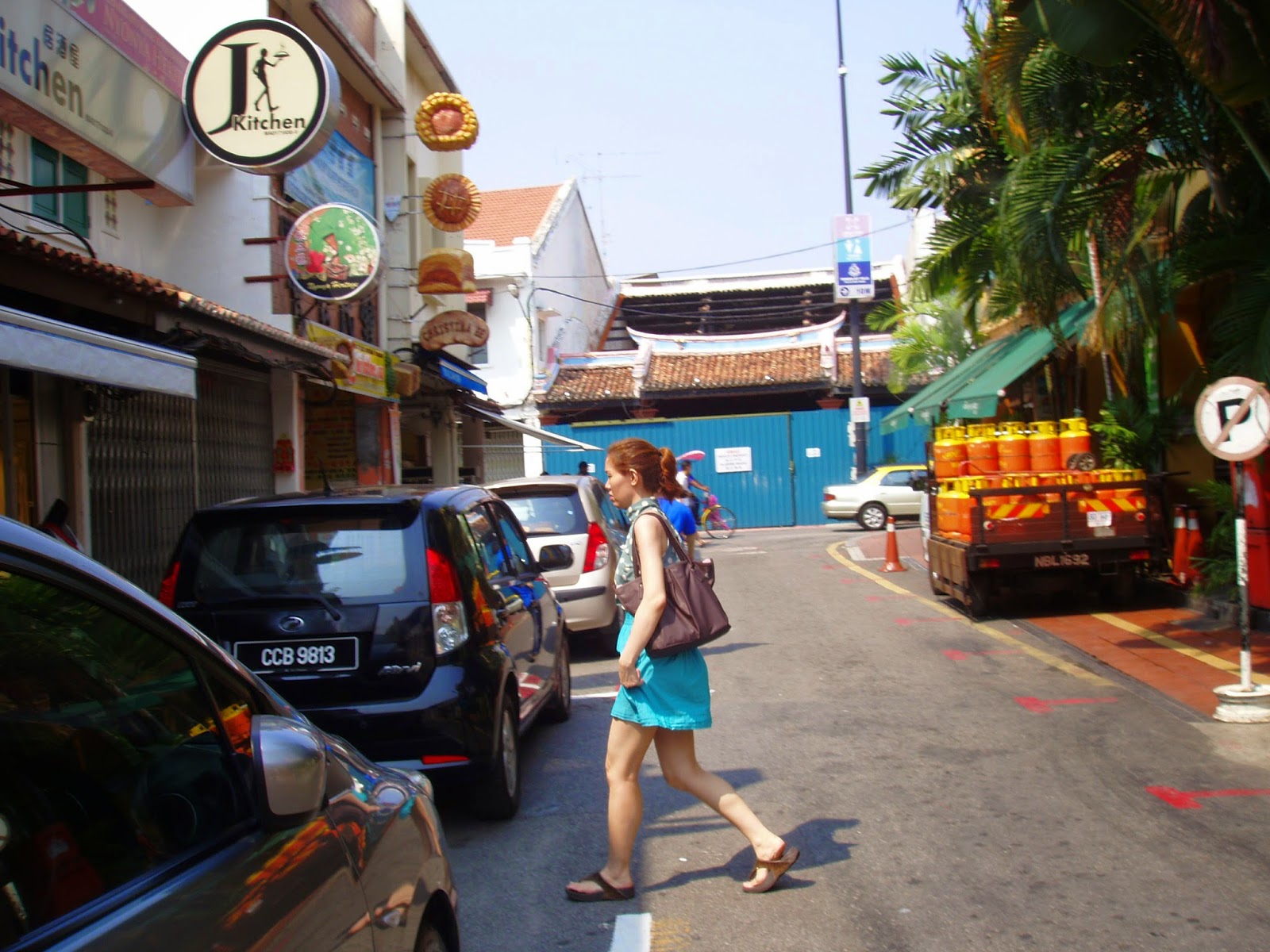
I was quite taken by the sights and sounds of the city, inspite of the fact that many of the shops, including the Baba-Nyonya Heritage House - was closed.

Street musician playing a traditional lute

Entrance to the Hokkien Clan House?


Detail of  a mother tiger and  her cub on a plaster cast on the side wall.
The opposite wall had a dragon which had been defaced.

One of the most impressive shops we visited was Jonker Gallery, the interior was extraordinary with carved and gilded wood decorations everywhere. Unfortunately they did not allow photography inside. I managed to snap one anyway...

Impressive interior of Jonker Gallery, which sold mainly T-shirts...

Our last stop was at Puri Padi, one of Yulie's favourite shop in Malacca. The entrance was enchanting - very Balinese in style with decorative stone gateway and water feature wall with goldfish swimming in a crystal clear pool beneath...
Yulie's favourite shop is Balinese style Puri Padi.

Beautiful water feature adds to the allure of  Puri Padi.
We left Malacca before sunset, perhaps with mixed feelings. The fact that many of the shops and even the Baba-Nyonya heritage museum was closed on a Thursday was disappointing. The other drawback were the dearth of local handicrafts in the shops. The realisation dawned that perhaps tourist destinations from Malacca to Miami were probably full of Made-in-China trinkets. This was a sobering thought. Still there is plenty in Malacca to keep you occupied - just make sure you visit during the weekends when the town actually comes to life!

Catherine and Charmaine take a brief respite from the heat...


Thursday, September 18, 2014

The greatest love songs ever...

I pay homage to the greatest love songs ever (pardon me if you disagree): quirky, romantic, joyful, moving and even heart rending... Of course, this gives me the chance to create my own playlist and hopefully music companies won't pull the plug on me... (no copyright infringement intended as this is a strictly non- profit making blog and I'm sixpence none the richer...)

Starting with:
The newbies (after 1990)

No 11: If I lose myself by One Republic

After Queen, I didn't have a favourite rock band, until I discovered One Republic...


                                               No 10: Dreams by The Cranberries


Starting the countdown with The Cranberries, an Irish rock band, formed in Limerick, in 1990. Their lead singer, Dolores O' Riordan, has one of the most extraordinary voices. Dreams was released in 1992. Unfortunately, their music videos tend to be somewhat strange (sometimes bordering on bizarre ) and do little justice to their songs. This particular video is quite appealing apart from the band members falling in space...

                                                       No 9: Take On Me by a-ha


 Norwegian group, a-ha came up with this stunning video as a showcase for their even more stunning song. Take On Me was released in 1999 and became a worldwide hit for the group. It is also one of the most popular videos on Youtube, scoring a staggering 93 million hits (and counting)...

                                             No 8: Kiss Me by Sixpence None the Richer


Sixpence is an American Pop/Rock band which first formed in New Braunsfel, Texas. Kiss Me was released in 1997 and propelled the band to stardom. The lead vocalist is Leigh Nash.

                                                  No 7: Kiss from a Rose by Seal


Kiss From A Rose was first released in 1994, as a track on Seal's second album, Seal II. It was re-released in 1995 and incorporated into the soundtrack of the Batman Forever movie. The movie exposure propelled the song (and Seal) into international stardom. The song won the Song of the Year award at the Grammy's in 1996. Seal is originally from Nigeria.

I love the Old English feel of the music and the reference to fairy tales in the lyrics.


                                                      No 6: What Is Love by EXO


Can't ignore the huge inroads made by K-Pop in the last decade. What Is Love by EXO is next. Released in 2012, it showcases EXO's lead vocalists. The twelve-member group (yes twelve) comprises of  two groups - EXO-K sings in Korean while EXO-M sings in Mandarin. This video demonstrates the vocal pyrotechnics of D.O. and Baekhyun, lead vocalists of EXO-K. The traditional sound of the music, combined with the bluesy singing makes this a stunning debut song for EXO.


Unlike groups like The Cranberries and Sixpence, EXO did not form spontaneously out of a mutual love for music - members were selected through a massive talent hunt and careful screening process by Korea's music giant, S.M. Entertainment (S.M. stands for Star Museum). S.M.'s stable includes the super groups, Super Junior (gained international fame after releasing Sorry, Sorry) and Girls Generation. The young men (and women) who were lucky enough to be selected will undergo months of rigorous training until they are ready to debut as a group. Success, fame and fortune is almost guaranteed as companies such as S.M. Entertainment leave nothing to chance.

K-Pop fans tend to be extremely possessive of their idols; when news broke out that Baekhyun of EXO was dating Taeyeon, lead singer of Girls Generation, it caused an uproar. Female fans were outraged by Taeyeon's boldness and for a while she was almost an outcast.

More recently, Jessica, one of the most popular members of Girls Generation, has been dropped from the group. It was alleged that  she placed her personal interest ahead that of the group and tried to use the group's popularity as a platform to launch her fashion career. She has her own fashion line, called Blanc.

EXO itself is down to eleven members as one of its members, Kris of EXO-M, has filed a lawsuit against S.M. Entertainment to nullify his contract. Life as a K-Pop star can be harsh.


                                                       No 5: Starlight by Muse


                                            No 4: The Reason by Hoobastank

I love this song, but the video is ridiculous!


                                                  No 3: Linger by The Cranberries

Another song by The Cranberries - released after Dreams. Apparently, this was the one of the first songs written by Dolores O' Riordan when she auditioned for the band in 1990.

                                                    No 2: My Immortal by Evanescence


No 1: Foolish Games by Jewel

This sensitive, beautiful and heart wrenching song by Jewel could be the ultimate love song for this age...


The Oldies (before 1990)

                                         No 8: Early One Morning by Nana Mouskouri


                          No 5: Aku Sudah Jatuh Cinta (I have fallen in love) by Norshila Amin


The joy of falling in love is reflected in this wonderful song. The youthful and exuberant mood is beautifully captured by Norshila Amin. The tall and willowy singer reached her heyday in the late 80s and early 90s but disappeared from the public eye soon after.There may be better known Malaysian singers and more popular songs, but for me, this song is like a splash of cool water on a hot sweltering day. The upbeat but traditional sounding music is composed by A Ali and the lyrics are by Juwie.


                                      No 4: Unchained Melody by The Righteous Brothers


When you think of a love song without doubt, Unchained Melody, will come to mind. Not surprising really, as this great song by the Righteous Brothers, must be the quintessential love song. Released in 1965, the song enjoyed a revival when it was used in the soundtrack of the movie, Ghost, in 1990. Who can forget the love scene between Patrick Swayze and Demi Moore?

                                     No 3: Tsugaru Kaiko Fuyugeshiki by Sayuri Ishikawa


I've just discovered the diva of Japanese folksongs or enka, Sayuri Ishikawa, who originates from Kumamoto, Japan. The title of this moving song means, Tsugaru covered in snow/Snow falling over Tsugaru. It was released in 1977 and is Sayuri Ishikawa's signature song. The lyrics were written by Yu Aku while the music was composed by Takashi Miki. This video has French sub-titles...

                                                      Amagi Goe (the path over Amagi)


Sayuri Ishikawa shows her remarkable vocal prowess in the song, Amagi Goe. Written by Osamu Yoshioka and composed by Gen Tetsuya, the song is about forbidden love and secret trysts on Amagi.

                                       No 2: Both Sides Now by Judy Collins


                                                     Both Sides Now by Joni Mitchell


All great love songs are poetry and so is this great song by folk singer, Joni Mitchell. The song was written by Mitchell in 1967, but the first recording of the song was by Judy Collins in the same year. It became an international hit and I remember listening to the Judy Collins version of the song as a young teenager in the 70s.. Both Sides Now won the Grammy Award in 1969 for Best Traditional Folk recording. Joni Mitchell released her own version of the song in 1969.

According to fan comments on Youtube, the Judy Collins version best exemplifies the spirit of the 60s - a time of radical change but also of idealism and free expression. The Joni Mitchell version is slower in tempo and less free spirited but perhaps more heartfelt.

                       No 1: The First Time Ever I Saw Your Face by Roberta Flack


A 1957 song written by Ewan MacColl, a British folk singer, for Peggy Seeger, who later became his wife. Roberta Flack recorded it in 1972 and it became a worldwide hit for her. The song is most closely associated with her although almost every singer of note has covered it. The greatest love song ever written, surely...

I also love the version by Daniel Schuhmacher: