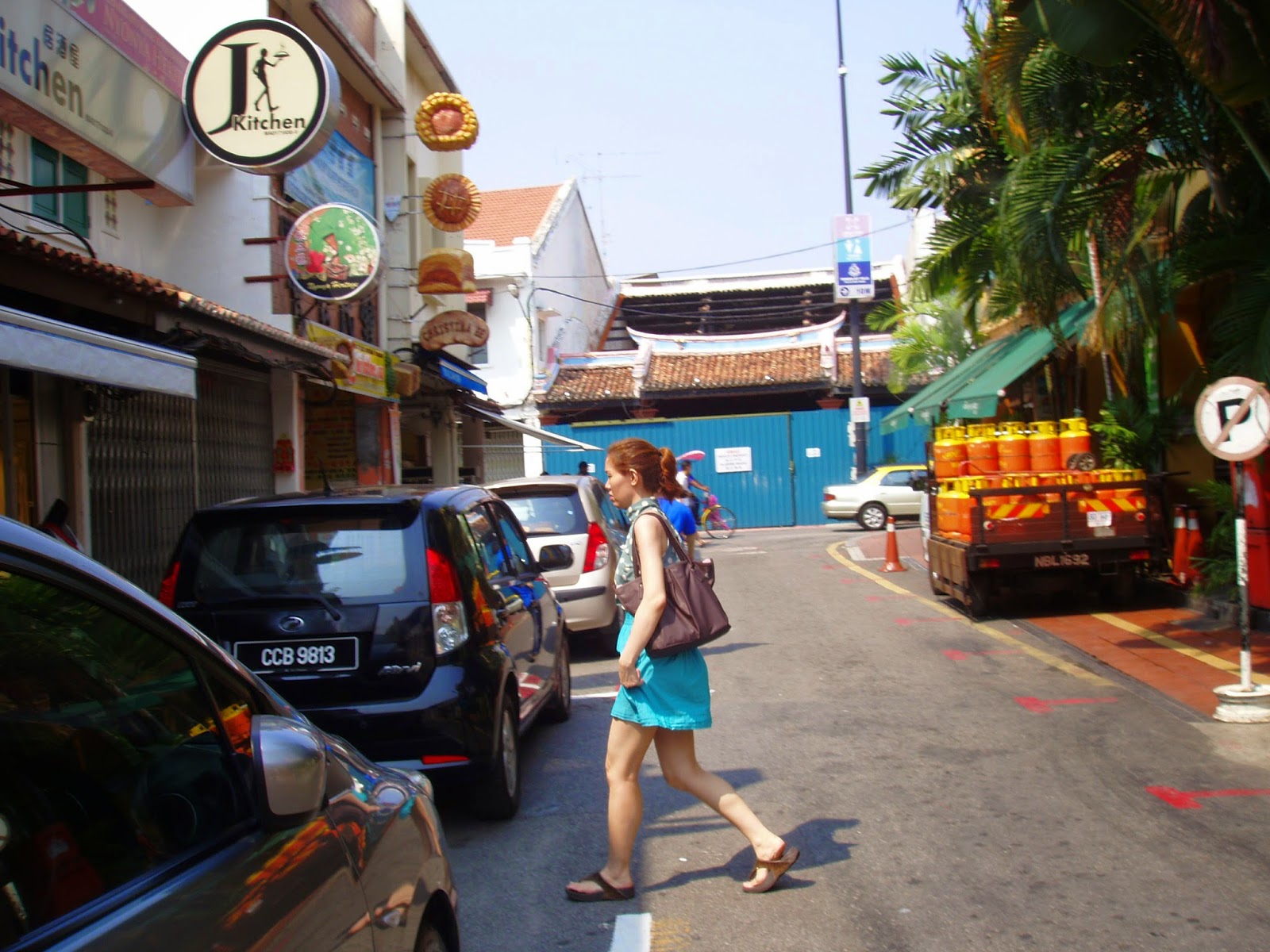
We made a day trip to Historic Malacca early in October ('we' meaning Charmaine Augustin, Lee Yulie, Catherine and yours truly). Malacca's fame rest on the fact that it used to be the hub for the spice trade in centuries past. The spice trade was so lucrative and Malacca's position so strategic that the Portuguese, under the helm of Alfonso De Albuquerque, seized control of the port city in 1511. Portuguese conquest brought the Malacca Sultanate to an end. The last Sultan of Malacca, Sultan Mahmud, fled to Johor. He made several attempts to retake Malacca but to no avail.
 |
| A tricycle bedecked in pink may be the best way to see the town! |
The Portuguese built a near-impregnable fort called A Famosa to protect their conquest. However, the city was taken over by the Dutch a century later and by the British in the next century. By the time the British took control of Malacca, it was no longer a major port city - that role had been taken by Penang and later still, Singapore. Malacca was designated a UNESCO World Heritage Site, together with Georgetown in Penang, on 7 July 2008 due to it being 'the most complete surviving historic city centered on the Straits of Malacca.'
 |
A Famosa is the most famous remnant of Portuguese rule in Malacca.
(Picture taken from the Internet.) |
As for the journey to Malacca - it was a bright and sunny day and everyone was in a cheerful mood, despite losing our way at least three times... Catherine (a retired nurse) kept us entertained with ghost stories from her nursing days. The one which stayed in my mind was that of a woman who was desperate for a child but tragically passed away when she was giving birth... apparently her ghost would appear and ask to hold her child in her arms...
 |
| Yulie, Charmaine and Catherine |
When we finally reached Malacca, we immediately made a beeline for a restaurant called Nancy's Kitchen. Charmaine had already decided that this was the place that we would have lunch in based on the fact that Denise Keller (a host of MTV Asia) had stated in that famous documentary entitled
Passage to Malaysia that Nancy's Kitchen served the most authentic Nyonya food in Malacca. Nyonya food is a fusion of Malay and Chinese cuisine; developed in Malacca as the city had a Chinese community dating back all the way to the 15th Century.
 |
Bukit Cina (Chinese Hill), an ancient graveyard in Malacca
bears testimony to the fact that the Baba- Nyonya community
has been living here for many centuries.
Image taken from the Internet |
Admiral Zeng He (Admiral Cheng Ho in these parts), the famous emissary of Emperor Yong Le of the Ming Dynasty brought a boatload of people on his Treasure Ships from China to Malacca on his many voyages... Legend has it that the intrepid Admiral also brought a Chinese princess called Hang Li Po to be the wife of Sultan Mansor Shah of Malacca. Legend has it, Princess Hang Li Po was accompanied by a retinue of 500 ladies-in-waiting, maids and attendants.
 |
| Yulie's friends joined us for lunch... |
Oh back to the food - Charmaine ordered soup, Nyonya Chicken Curry, Egg Foo Yong, Otak-Otak, kang kong belacan and lobak - a kind of sausage made from minced chicken/pork and vegetables such as carrot and radish. Was it everything we were hoping for? Honestly, I was underwhelmed... it was delicious enough, especially the chicken curry and the lobak, but hardly worthy of the title of 'most authentic Nyonya cuisine' as claimed by Keller. Charmaine decided that was the last time we were going to listen to MTV hosts for food and restaurant advice... even if their mother was a native of Malacca.
 |
The Geographer Cafe is a popular spot for tourists.
It is better known for drinks rather than food. |
For dessert, we adjourned to another restaurant called Jonker 88 - based on the advice of a blogger. Jonker Street is the most famous street in Malacca, where all the historic shophouses are located. We all had
cendol - a classic Malaysian dessert made of finely shaved ice, coconut milk,
Gula Malacca (brown palm sugar) and
cendol - green noodles flavoured with
pandan leaves. The ones served here also had red beans added and you could also get a topping of
durian ice cream...
 |
| Bowls of cendol from 88 Jonker Street |
Disappointed again mainly due to the fact that the
cendol was frozen solid.
Cendol is supposed to be soft, with the consistency of pasta or mochi... Charmaine decided that we should always follow our own instincts and not rely on the recommendations of a blogger. Charmaine and Yulie are fastidious foodies and they own a company called Passion Doux (Sweet Passion) which specialises in high end gourmet food. One of the reasons for visiting Malacca was to source for gourmet quality local food.
 |
| This young woman made better cendol than 88 Jonker! |
I was quite taken by the sights and sounds of the city, inspite of the fact that many of the shops, including the Baba-Nyonya Heritage House - was closed.
 |
| Street musician playing a traditional lute |
 |
Entrance to the Hokkien Clan House?
|
 |
Detail of a mother tiger and her cub on a plaster cast on the side wall.
The opposite wall had a dragon which had been defaced. |
One of the most impressive shops we visited was Jonker Gallery, the interior was extraordinary with carved and gilded wood decorations everywhere. Unfortunately they did not allow photography inside. I managed to snap one anyway...
 |
| Impressive interior of Jonker Gallery, which sold mainly T-shirts... |
Our last stop was at Puri Padi, one of Yulie's favourite shop in Malacca. The entrance was enchanting - very Balinese in style with decorative stone gateway and water feature wall with goldfish swimming in a crystal clear pool beneath...
 |
| Yulie's favourite shop is Balinese style Puri Padi. |
 |
| Beautiful water feature adds to the allure of Puri Padi. |
We left Malacca before sunset, perhaps with mixed feelings. The fact that many of the shops and even the Baba-Nyonya heritage museum was closed on a Thursday was disappointing. The other drawback were the dearth of local handicrafts in the shops. The realisation dawned that perhaps tourist destinations from Malacca to Miami were probably full of Made-in-China trinkets. This was a sobering thought. Still there is plenty in Malacca to keep you occupied - just make sure you visit during the weekends when the town actually comes to life!
 |
| Catherine and Charmaine take a brief respite from the heat... |