Pages

Welcome! Selamat Datang! Bien Venue!

Dedicated to all those who are interested in world folklore, culture and nature. Comments and constructive criticisms are welcome!

Friday, May 31, 2013

Adapting Asian Folktales for Children's and YA Literature - paper presented at AFCC 2013


ADAPTING ASIAN FOLKLORE AS A BASIS FOR
CHILDREN’S AND YA LITERATURE

                       
Introduction
If you take a close look at children’s books, many are based on fairy tales (either in terms of the plot/sub-plot or it contains an idea, or a motif from an ancient source). Fairy tales themselves spring from folklore. Not surprising as these stories are rooted in the society and culture they come from. I also believe that almost all folk tales are based on real life; events which have etched themselves into the collective memory of a group of people. Of course they have been embellished over the years and centuries through numerous retelling but it is the nature of oral traditions that a story gets altered by the story teller to become relevant for the time and place they are being retold. Stories became fixed only when publishing and printing became available.

Slide 2.1:  Illustration of Sembilan of the Rice Fields, from Timeless Tales of Malaysia


  1. Dressing Old Tales in New Clothes
*The Owl Service, (1967) by Alan Garner

An excellent example of a book based on an old myth is Alan Garner’s The Owl Service. This award-winning book in a sense relives an old legend dressed in modern clothes. Garner’s book is about three teenagers who are thrown together by circumstance and became caught up in a love triangle from an ancient Welsh legend – of Lleu Llaw Gyffes, and his wife Blodeuwedd, a woman made from the flowers of broom, meadowsweet and oak. She was conjured from the essence of these flowers by Lleu’s uncle, the wizard Gwydion. Later, she fell in love with Gronw Pebr,  and together, they conspired to murder Lleu. Gronw mortally wounded Lleu with a spear but he escaped death by turning into an eagle. Lleu’s uncle, Gwydion tracked the eagle down and healed him.  Lleu demanded revenge and by magic, he and Gronw exchanged places. Lleu killed Gronw by throwing a spear with such force that it went through a rock behind which Gronw was hiding. For her part in her husband’s murder, Blodeuwedd was turned into an owl by Gwydion, a fate ‘worse than death’ we are told.  In The Owl Service, Alison is Bloduewedd, Gwyn is Lleu and Roger is Gronw. We learn that Gwyn’s ancient ancestors probably owned the valley even though his mother works as housekeeper for Alison’s mother and her stepfather, Clive Bradley (Roger’s father).

  1. Using Folktales as an Integral Part of the Plot
 This brings us to three books called the Chronicles of Old Japan by Australian author, Ruth Manley. I believe she would have written more books but unfortunately, she passed away in 1986, so we are left with only three wonderful books.
  • The Plum Rain Scroll, 1978
  • The Dragon Stone, 1982
  • The Peony Lantern, 1987
Ruth Manley’s books are steeped in Japanese folklore and extremely entertaining to read. They peopled by eccentric lords and ladies, samurai and ninja and also creatures from Japanese folklore such as nishu, baku, onni etc. Manley incorporates characters, ideas and storylines taken from Japanese folklore directly into her stories. According to a commentary I read on her books, Manley’s books most closely resembles Llyod Alexander’s Chronicles of Prydain, which are based on Welsh folklore.

Slide 5.1: Cover of old Plum Rain Scroll

The Plum Rain Scroll is a magical scroll which is written in the ‘old language’. It contains three great magic – the secret of immortality; the secret of turning baser metal into gold (similar to the philosopher’s stone) but most important of all, the ‘unanswerable word’ - word with the power to render all who hear it powerless to resist. The main protagonist is an odd-job boy called Taro, a foundling who helped his Aunt Piety to run an Inn called the Tachibana-ya. Aunt Piety is actually a fox-woman who has magical powers, she is also married to Uncle Thunder, an eccentric and absent-minded inventor who could be one of the Emperor’s son. Taro is thrown into the fray when the evil warlord, Lord Marishoten, and his Black Warriors attempted to capture Aunt Piety, she being the only person in the land who can still read the ‘old language’. Along the way to rescue his aunt, Taro meets up and form allegiances with a motley crew of friends including Prince Hachi, the legendary prince eight-thousand spears; a travelling troupe whose members include Oboro, the Cherry Blossom Princess; the ghost of a young samurai called Hiroshi (who was murdered by Marishoten); and Mouse also known as Lord Sweet Potato, a high-born nobleman who has a dream-eater called Baku, for a pet and so on. In the first book, Ruth Manley throws in almost every imaginable creature you could encounter in Japanese folklore into her book including the Tengu of Vast Supernatural Wisdom! Taro and his friends race against Marishoten and his henchmen to locate the Plum Rain Scroll, with only an old riddle to guide them. Towards the end, Taro discovers that Oboro was a real princess.

Slide 6.1: Cover of new Plum Rain Scroll


The Dragon Stone – Another antagonist emerges in the second book. She is the Jewel Maid and it turns out that Lord Marishoten is actually her servant. The Jewel Maid is based on an old Japanese legend – that of Tamano, a beautiful and ancient nine-tailed fox demon.  In folklore, Tamano bewitched the Emperor and sought to destroy the Imperial line until her true identity was discovered and she was driven out. She sought refuge in a black stone which came to be known as the Death Stone. In the book, the Dragon Stone has the power to bend the will of people; it was created by the Jewel Maid. Manley incorporates an iconic Japanese folktale, the Taketori Monogatari  into this book. To summarise: A poor bamboo cutter finds a shining child (and nuggets of gold) in the stump of a large bamboo. He takes her home to his wife and they raise her as their own child. She is known as Kaguyahime and grows up into an accomplished and amazing beauty. Her five most illustrious suitors are each given an impossible task to win her hand.  In The Dragon Stone, Kaguyahime is sent to earth for the express purpose of locating the Dragon Stome to prevent it from falling into the hands of the Jewel Maid again. As in the folktale, Otomo no Miyuki was given the task of obtaining the Dragon Stone. In this he succeeds but he falls under the stone’s influence and triggers off the Genpei Wars (a real historical event). It falls to Taro, Oboro and friends including Prince Hachi to locate and unmake the Dragon Stone, again guided by a riddle.

The Peony Lantern incorporates several legends and myths into its storyline. Even the title of the book refers to an eerie Japanese ghost story. A central subplot is the story of Ho-Wori and the Princess of the Sea (this is a myth I retold in my book ‘Eight Treasures of the Dragon’ as ‘Ho-Wori and the Princess of the Sea’). It is the story of two brothers Ho-Wori (Prince Fire Fade) and Ho-Deri (Prince Fire Flash) who are bitter rivals. One day, Ho-Wori gets lost at sea and is taken to the place of the Sea king. He falls in love with the sea king’s daughter and marries her. After what seems only a few weeks, he is overcome with homesickness and decides to return home. He is given a treasure chest and two magical pearls as gifts by the sea king. In the book, The Jewel Maid and Lord Marishoten reemerge, but this time they are seeking the objects of power known as the windflowers. No one actually knew what the windflowers were until the emperor suddenly remembered his youth and his visit to the kingdom of the sea (he was actually Ho-Wori or Prince Fire Fade).  In any case, he realised that the windflowers were actually the two pearls – the tide-ebbing and the tide-flowing pearls - which had been given to him by the sea king. Unfortunately, the Jewel Maid had cast a spell on him and he had fallen into a deep sleep and is unable to convey his knowledge to anyone. Meanwhile, The Jewel Maid kidnaps Oboro, believing that she has the windflowers. Ruth Manley successfully incorporated this old myth into an integral part of the story.


  1. Using a Quest or a Journey to retell Folktales and Construct a Story
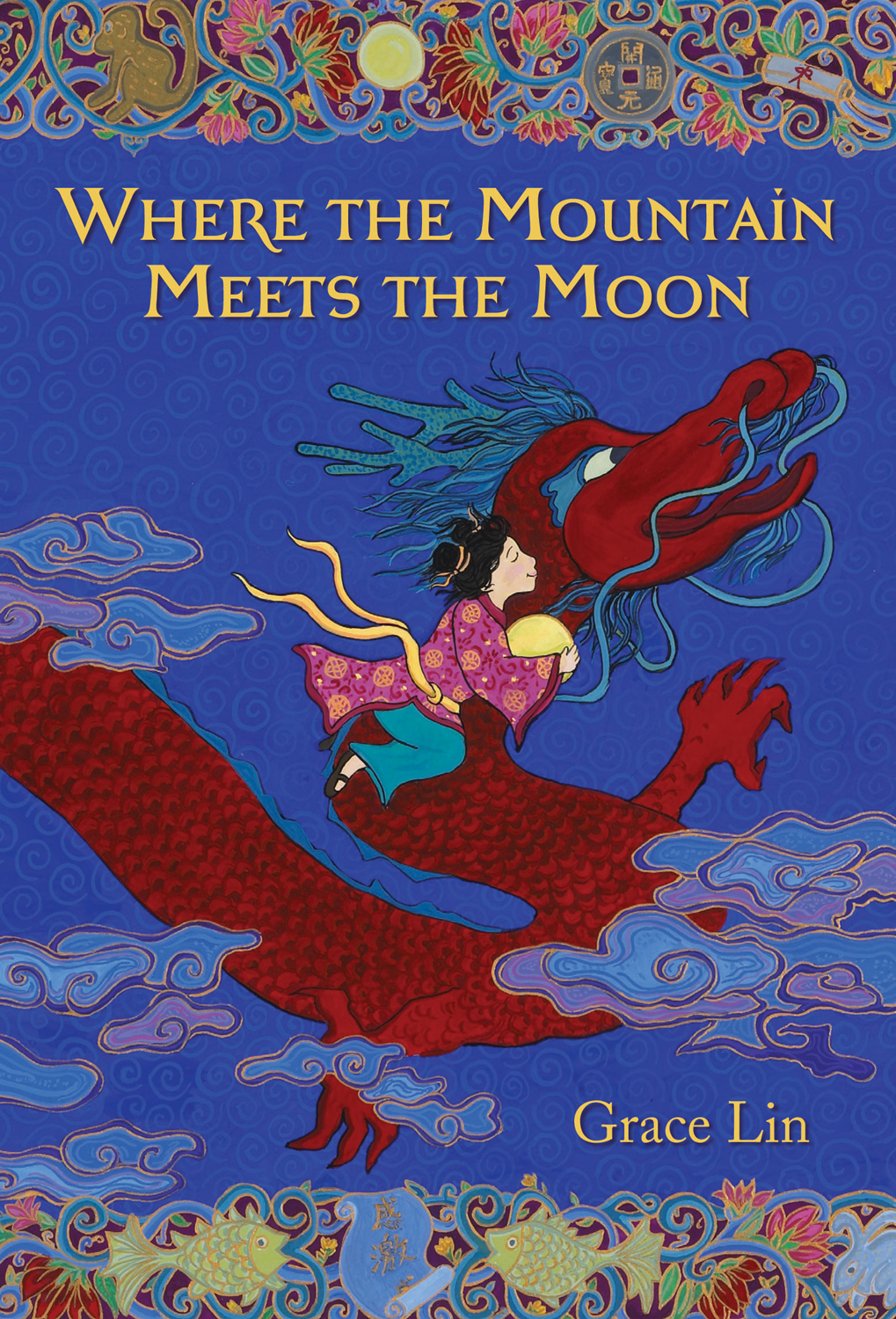
Grace Lin’s Where the Mountain Meets the Moon (2009) incorporates several well-known Chinese folktales as part of its plot. Minli, a little girl from an impoverished village located in a place called Fruitless Mountain Valley, goes on a quest to see the Old Man of the Moon in an attempt to change the fortune of her family. Along her journey she meets and befriends a friendly dragon who is unable to fly. The dragon itself is a character from a famous folktale – about a lifelike but unfinished painting of a dragon by a master painter which came to life when the painting was completed by someone else – by drawing in the dragon’s eyes. Minli and the Dragon decide to help one another – Minli in her quest for fortune which she believed will bring her family happiness and the Dragon in his quest for flight. Along their journey, they encounter several characters from Chinese folktales, who each have their own stories to tell. All these various characters and tales are skillfully woven into the fabric of the story.

Slide 9.1: Cover of Where the Mountain Meets the Moon

Research
Research is a key factor in writing a good book, we look at sources for Asian folktales e.g. unpublished stories on the internet, newspaper articles and also books, old and new.

Books:
  • Folktales from India (1991) by A.K. Ramanujan
  • Green Willow and Other Japanese Folktales (1987) by Grace James
  • The Magic Boat and Other Chinese folktales (1980) by M.A. Jagendorf and Virginia Weng.
  • Korean Folk-tales (1994) by James Riordan
  • Hikayat: From the Ancient Malay Kingdoms (2012) by Ninotaziz
  • Malaysian Fables, Folk Tales and Legends (2012) by Walter Skeats and Edwin H Gomez
  • Timeless Tales of Malaysia (2009) by Tutu Dutta
An excellent Internet source for World and Asian folklore and myths (translated from the original):
For Malaysian folklore visit:
  • www.sabrizain.org/malaya/library
Research for a book should not just focus on one particular folktale but also on similar stories and variants of the story. Reading a few versions of the same story will give you a feel for the story.

Illustration from Eight Treasures of
the Dragon by Tan Vay Fern
Supporting research on the time and place which form the backdrop to the story i.e. details such as old place names, historical personages and cultural practices give the book texture and context.  The folktale from China, Dragon Wells of Yanjing in Eight Treasures of the Dragon was based on the story of a Dragon king and queen who decided to punish the people of Yanjing (the old name of Beijing) for destroying their home by draining a lake. In one version of the story, Kublai Khan was mentioned. When I researched the history, I discovered that Kublai Khan did indeed re-design Yanjing. A huge lake was drained and a canal built to connect Yanjing with the South. That is the history; legend tells us that draining the lake had dire consequences for the people of Yanjing.


Slide 11.3: Photo of water carrier


The majestic Baobab of Madagascar 
Another point to note is that plants i.e. flowers and trees and also birds and animals play an important role in folklore (as we saw in the story of Bloddoewedd, a woman made of flowers, who was turned into an owl). Many trees have cultural significance even today – e.g. the Banyan Tree and /Holy Basil/Sacred Fig of Asia, the Baobab in East Africa and the Iroko tree of West Afrika, the Oak/Mistletoe/Clover in Europe etc  An attempt must be made to identify a flower,  tree or animal mentioned in a legend so that you can identify its scientific name and can even read up on it to see how closely it matches the legend! I did this for most of my stories.


Next, I refer to my books – The Jugra Chronicles - to explain this process. To date two books have been published in the series:

*Miyah and the Forest Demon (2011)                     
*Rigih and the Witch of Moon Lake (2013)

The title of the series – The Jugra Chronicles –  Jugra is the name of the old Royal town in Selangor. But it is also the name of a hill on Carey Island (close to Port Klang) and is considered to be sacred to the Mah Meri. I talked to a few members of the tribe on a trip to Carey Island some years ago. In the books, Jugra was a powerful shaman whose actions had repercussions on his descendents.

First of all decide on a setting for your story – the place and time. When writing a story set in this part of the world it is always wise to consider the two main trade routes of the past – the overland Silk Route and the sea bound Spice Route. As we are right in the midst of the Spice Route (The so-called Spice Islands have identified as the Moluccas), it is natural to think of the Spice Trade.

Map of Borneo
I chose to set the story in Borneo, due to the unique and diverse folklore traditions associated with the island – including head-hunting and the use of magic! In the end, I narrowed it down to a coastal region near Brunei - in the past, the Sultan of Brunei had suzerainty over most of Borneo – and also because the two Malaysian states of Sabah and Sarawak meets with Brunei and Indonesian Kalimantan here. The time period is the 17th Century – over a hundred years after the fall of the Melaka Empire. I did some research on the history of the area and came across the name ‘Tanjungpura’ and decided to use it in my story. The story is set against the backdrop of a power struggle in Tanjungpura, an ancient trading with ties to the Han Kingdom (China), Hindustan (India), Majapahit (Indonesia) and Melaka (Malaysia) – which is now under the Dutch.
Illustration from Miyah and the Forest Demon
by Choong Kwee Kim

The protagonist is a girl called Miyah, whose father is the village Shaman. Her best friend is Suru, a girl whose father (a spice trader from the Han Kingdom who was once stranded in the village) has long since left the village. Miyah’s mother is the village mid-wife, a role which is also associated with magical abilities.

The story is as follows:
One morning, Miyah’s mother asks her to remain in the longhouse and look after her younger brother Bongsu as she had to go another village to deliver a baby. But it is a beautiful day and Miyah has promised to meet her friends at a waterfall upstream. Miyah disobeys her mother and joins her friends at the waterfall. A sudden sun-shower at the waterfall and the eerie cry of a bird, harbingers of misfortune, reminds Miyah of Bongsu. She returns home to find Bongsu missing! This part of the story – of a child who is lost in the forest and is believed to be abducted by an evil spirit is quite a stock part of native folklore in Malaysia and many other countries. The quest here is to recover a lost child rather than to look for treasure.

When Miyah returns, the village is also strangely empty. Miyah has no one to turn to except Rigih, a boy who is an outcast in the village because he came from another tribe. But he is related to Miyah’s mother and agrees to help her. On the way to the forest, Miyah and Rigih meets Sang Kanchil, the talking mousedeer, who leads them to Nenek Kebayan (Nenek Kebayan is a central figure in Malay folklore, a little like Babka from Russian folklore). Guided by the wise woman of the forest, they embark on a quest to rescue Bongsu. They succeed in rescuing Bongsu but Miyah is caught by the forest demon…

In the second book in the series, Rigih and Bongsu’s attempt to rescue Miyah.
I also use another folktale – that of the seven faeries who come down to earth to bath in a forest pool - to explain the origin of Jugra and his magical powers. We also learn about the true nature of the forest demon in this book.

Re-telling a story
The stories in the book are ‘retold’ and not ‘translated’. When you translate a story, you try to write it as close to the original as possible, but in a different language. Retelling a story means that this is your own interpretation of the story; with your own characterization and your own dialogues and description. Even the chain of events and sometimes the outcome of the stories can be changed sometimes, although I prefer to remain true to the original story. I’ve read/heard most of the stories in Malay but I try to understand (internalize them) them and then re-tell them in my own words.  It was a little challenging especially when I come across words such as ‘huma’ etc and when the original is in old Malay.
 
Yes, very often the same story appears in several different versions. Usually I select one version but sometimes I combine two or three different versions into one story!

The need to re-interpret and retell these folktales, to make them relevant and appealing to a young contemporary readership is the third key point. The author needs to balance authenticity (being true to the story) with the need to hold the readers’ interest.

Pervasiveness of Folklore
Folktales are quite universal.  A Malay folktale called Puteri Bunga Tanjung, which I have retold as The Tanjung Blossom Faerie (it actually means Tanjung Blossom Princess), in Timeless Tales of Malaysia. This is the story of seven faerie princesses who come to earth to take a bath in a beautiful forest pool. The youngest sister loses her cloak or selendang and is unable to return home. She sits under a tree and weeps and her tears turn into fragrant blossoms when they touch the earth.

The lost fairy maiden is taken in by a poor old woman – probably another Nenek Kebayan. The fairy helps the woman to make fragrant flower posies and perfumed oil to sell in the village, but every evening she returns to the forest to weep. As time passes, the old woman feels sorry for the fairy and they search for the lost selendang so that the fairy could return home. However, before she leaves, the fairy transforms the tree she used to sit under into a Tanjung tree so that it bears night blooming flowers which are shed at dawn, like the tears of a fairy.

The Tanjung Blossoms - Mimusops elengi
  1. Regarded as a national folktale, this particular folktale clearly originates from Penang as Tanjung is the old Malay name for Penang. There are also similarities with another folktale, Bunga Tanjung which is known to originate from Penang. The bunga tanjung (Mimusops elengi) is a fragrant, night-blooming flower.
This motif of the seven fairy sisters taking a bath in a pool appears in folktales in Japan, Korea and China. In fact, in Ruth Manley’s Peony Lantern, there is a character called O-Kuni and her travelling troupe of dancers. It later turns out that she is actually a fairy trapped on earth because someone had stolen her magical robe of feathers!

The Weavermaid and the Herdsboy
We don’t know where the story first originated from but it could be based on the Chinese folktale of  ‘The Weavermaid and the Herdsboy’.  In the Korean and Japanese version, the story is usually referred to as The Robe of Feathers or the Celestial Robe of Feathers. In this version, a fisherman/hunter/herdsman observe a

flock of seven cranes land on the shores of a lake or forest pool. The cranes turn into maidens who hang their robes on the branches of a tree before going for a swim. The fisherman hides one of the robes so that one of the fairies is trapped on earth. The fairy is forced to marry the fisherman and lives with him and his mother for many years. Eventually, when everyone seems to have forgotten that she is in fact a fairy, the mother accidently comes across the robe of feathers which the fisherman had hidden and decides to air it. The fairy asks if she could try it on and she turns into a crane and flies away!

Even more surprising, this same motif of seven fairy sisters appears in an Iban legend called ‘Jelenggai’, also found in the Timeless Tales of Malaysia collection.

Another variant to this folktale is that of Manohra, the bird Maiden. Retold in my book, Eight Jewels of the Phoenix, this is the story of seven princesses who are bird maidens. As before, they take a bath in a secluded forest pool, however the youngest is captured by a hunter who gives her as a gift to the prince of the Kingdom. The prince falls in love with Manohra and so on… The story of Manohra is widely known in the East Coast of Peninsular Malaysia and is definitely of Thai origin as there is a classical Thai dance drama based on this story. Manohra is also widely known in Cambodia and Laos and the origin of this story is more likely to be from India.

So from studying folktales we can see that stories travel all over the world!


References

1.      Divakaruni, Chitra Bannerjee (2005), The Mirror of Fire and Dreaming, published by Roaring Brook Press, Connecticut, United States of America.

2.      Dutta, Tutu (2009): Timeless Tales of Malaysia, published by Marshall-Cavendish Malaysia.

3.      Dutta-Yean, Tutu (2009): Eight Fortunes of the Qilin, published by MPH Group Publishing Sdn Bhd, Malaysia.

4.      Dutta-Yean, Tutu (2009): Eight Jewels of the Phoenix, published by MPH Group Publishing Sdn Bhd, Malaysia.

5.      Dutta-Yean, Tutu (2011): Eight Treasures of the Dragon, published by MPH Group Publishing Sdn Bhd, Malaysia.

6.      Dutta-Yean, Tutu (2011): The Jugra Chronicles: Miyah and the Forest Demon, published by MPH Group Publishing Sdn Bhd, Malaysia.

7.      Dutta-Yean, Tutu (2013): The Jugra Chronicles: Rigih and the Witch of Moon Lake, publishing in progress by MPH Group Publishing Sdn Bhd, Malaysia.

8.      Garner, Alan (1967): The Owl Service, first published by William Collins Sons & Co. Ltd, Great Britain.

9.      Jagendorf, M.A. and Virginia Weng (1980): The Magic Boat and Other Chinese Folktales, published by Vanguard, New York, United States of America.

10.  James, Grace (1987): Green Willow and Other Japanese Fairy Tales, published by Avenel Books, New York, United States of America.

11.  Lewis, C.S. (1950): The Lion, The Witch and the Wardrobe, published by Goeffrey Bles, United Kingdom.

12.  Lin, Grace (2009): Where the Mountain Meets the Moon, published by Little, Brown Books for Young Readers,  New York, United States of America.

13.  Manley, Ruth (1978): The Plum Rain Scroll, first published by Hodder and Stoughton (Australia) Pty Ltd, Sydney, Australia.

14.  Manley, Ruth (1982): The Dragon Stone, first published by Hodder and Stoughton (Australia) Pty Ltd, Sydney, Australia.

15.  Manley, Ruth (1987): The Peony Lantern, published by Hodder and Stoughton (Australia) Pty Ltd, Sydney, Australia.

16.  Ninotaziz (2012): Hikayat: From the Ancient Malay Kingdoms, published by Utusan Publications, Malaysia.

17.  Ramanujan, A.K. (1991): Folktales from India, published by Pantheon Books, United States of America.

18.  Skeats, Walter and Edwin H. Gomez (2012): Malaysian Fables, Folktales and Legends, published by Silverfish Books Sdn Bhd, Malaysia.


Wednesday, May 1, 2013

The Jugra Chronicles : Miyah and Rigih

Buy from  MPHOnline.com
According to Eric Forbes (Senior Editor, MPH Group Publishing. Eric is a bibliophile and has his own blog: goodbooksguide.blogspot.com ) there is a possibility that the second book in The Jugra Chronicles series might be published by mid-May i.e. before I leave for Singapore for the Asian Festival of Children's Content. The first book in the series, Miyah and the Forest Demon, was published in 2011. Illustrated by journalist/children's author Choong Kwee Kim, the folklore influenced YA book is set in 17th Century Borneo. The main protagonist is 12-year-old Miyah, from the Tapoh longhouse. For a write-up about the book, refer to Alan Wong's post:  bpbites.blogspot.com/2011/05/hantu-witch-and-sampan.html  Alan Wong wrote that it was 'styled according to CS Lewis' Narnia Chronicles' (gasp!) but the actual inspiration behind The Jugra Chronicles is Ruth Manley's Chronicles of Old Japan - The Plum Rain Scroll, The Dragon Stone and The Peony Lantern. Unfortunately, Manley passed away before her last book was published. It has always been a secret wish of mine to write the fourth book in the series (anyone from Hodder and Stoughton paying attention?)

Miyah and Suru go for a boat ride.
Illustration by Choong Kwee Kim.
So what is the Forest Demon? This creature from Bidayuh and Malay folklore - the infamous Hantu Rimba - grabs and 'swallows' the unwary who are unfortunate enough to cross its path. But what is the Hantu Rimba really like? What was its true nature? What did it sound like? The folklore tends to be quite sketchy about such matters - we only know about its ogre-like eating habits. But I had a more manipulative and subtle entity in mind.

Bubbles, Blossom and Buttercup are the adorable
Powerpuff  Girls!
Copyright owned by Cartoon Network etc

Well, believe it or not, I found my inspiration in Him, a demonic villain from the Powerpuff Girls!  Created by Craig McCraken, this animated TV series was shown over Cartoon Network. My daughter used to watch it as a child and of  course I had to watch it as well. The Powerpuff girls were created by their father, Professor Utonium, using a mixture of 'sugar, spice and everything nice'. But he accidentally spilled some mysterious Chemical X into the mixture and created three perfect girls with superpowers. The girls had a job too - they routinely saved Townsville, USA (incidentally, there is a real city called Townsville in Queensland, Australia) from a series of supervillains. The most formidable (and scary) of them all was, Him. He has no name because he is "so sinister, so evil, so scary, so horribly vile that his real name can never be said..." His gender is somewhat ambiguous as he wore a mini-dress with frills,
Even Mojo Jojo is scared of the vile and scary Him!
high-heeled boots (which could be concealing cloven hoofs) and spoke in a high-pitched falsetto. But it was his voice which was truly scary - a high chilling voice with echoes which turns to a sinister basso profondo when infuriated. To me, it sounded like many layers of voices speaking at the same time. This voice effect is used quite often now, in films of demonic possession. To cut to the chase, Him's voice helped me to 'visualise' the evil entity for my book.

So the Hantu Rimba of Bidayuh folklore acquired some of the attributes of Him. Of course, the true nature of the Hantu Rimba has to be uncovered in the second book, Rigih and the Witch of Moon Lake, otherwise it would be impossible to vanquish it (the devil is in the details).  The second book picks up the story three years after the first book. Miyah's cousin and friend, Rigih, is the main protagonist. He is aided in his quest to rescue Miyah by the mysterious Witch of Moon Lake. The Witch herself is based on the traditional Kadazan/Dusun shamanic healers known as Bobohizan (female) and Bobolian (male). These shamans have deep knowledge of herbal lore and are also the keepers of old tribal customs and traditions. They spend long hours in meditation to go into a trance where they are able to travel to the spirit world. In the past, they also played an important role during the planting and harvest season to invoke the rice spirit for a bountiful harvest. I believe, there are still some practicing Bobohizans and Bobolians in the state of Sabah. Oddly enough, in the southern islands of the Philippines, female shamans are known as Babaylians.

The cover illustration is by Tan Vay Fern.
The cover and the black and white illustrations on the inside are by Tan Vay Fern. She made the Witch/ Bobohizan more beautiful than I had imagined, but I'm not complaining! Her forceful personality comes through from the unwavering, direct gaze. Vay Fern used stylised traditional motifs from Sarawak and Sabah in her designs for chapter headings and also for the costumes of the characters.

A special lake plays a small but important role in the book (you can tell from the title). The Moon Lake is styled after Lake Lonar, located in the Buldhana district of Maharashtra, India. Both the science and the myth behind the lake is fascinating. Most of the blogs will tell you that Lake Lonar was created 60,000 years ago but a study in 2010 put the age of the lake at 650,000 years - plus or minus 80,000 years! Even the
Lake Lonar seen from space. Copyright NASA.
origin of the lake was misunderstood - less than a decade ago, it was thought to be a volcanic crater despite the total lack of evidence. We now know that the lake was created by a meteorite which struck the Deccan plateau and created an almost circular impact crater, with a circumference of 6 km. Lake Lonar is of intense scientific interest because it is the only impact crater on basaltic rock found on Earth. The extremely hard black basaltic rock is thought to mirror the geology of the moon or Mars! Lake Lonar is also much saltier than the sea and only extremophiles can live in its water. For more hard science, check out ferrebeekeeper.wordpress.com/2010/09/22/lake-lonar/


So what is the myth behind Lake Lonar? According to local folklore, a great underworld demon called Lonarasur (Lonar-Asura) would venture out at night and torment the people living in its surroundings. The people prayed to Vishnu (a Deva) for help. In answer to their prayers, Vishnu assumed the form of a beautiful young man called Daitya Sudana, who persuaded Lonarasur's twin sisters to reveal the location of the demon's lair. It turned out to be a subterranean cavern underneath a hill. Vishnu lifted up the hill and found the demon hiding in his circular lair. He tossed the hill away and it is said to have landed near the village of Datephal, 35 miles away from Lonar where there is a conical hill. Vishnu slew Lonarasur in his lair -  and his blood formed the salty water of the lake. The number of ruined temples along the shores of the lake indicate that people must have sensed the powerful magic emanating from the place.

Did I get my idea for Moon Lake from Lake Lonar? Not really. I've known about meteorite impact craters for a long time and had already made up my mind to incorporate one in my story. But the research into crater lakes uncovered Lake Lonar and gave me a sense of the place.

The Rigih book was supposed to have been published last year. In fact, all the illustrations and layout had been completed but Eric Forbes thought that it needed more editing. As I had already read the text for the umpteenth time (umpteenth meaning at least 12 times),  I allowed a couple of months to elapse to 'forget' the book and gain some distance and objectivity. Sometimes you need to forget what you have written to look at your own work with fresh eyes. When I reread it, I felt compelled to make quite a lot of changes. There were no major changes to the storyline or plot but the dialogues and characterisation  had to be revised. I felt some of the story sequence lacked continuity as well. In the end, some sentences were deleted and I may have added 5-6 more pages to the book; hopefully it made a difference. I didn't try to be literary or quirky, in fact this is probably the most severely edited book I have ever written. Of course it was not just more work for me; Eric and Alan Wong had to put in extra time; not to forget Ng Seng Chee, the DTP person who had to painstakingly make all the changes, word by word, and redo the layout as well!


Sunday, April 14, 2013

Asian Festival of Children's Content (AFCC 2013), Singapore

An email from Kota Buku ('Book City' in English) confirmed that I will be presenting a paper at the AFCC 2013 Writers and Illustrators Conference in Singapore on Tuesday, 28 May! Of course, I've known about this all along; after all I spent a couple of weeks researching and writing a paper for the Conference. But it was nice receiving the confirmation all the same. Many thanks to Linda Tan Lingard, who alerted me that Kota Buku was looking for speakers for AFCC 2013.

I feel all the more honoured by the fact that the country of focus this year is Malaysia. The AFCC is organised by the National Book Development Council of Singapore. It started out as the Asian Children's Writers and Illustrators Conference about a decade ago but expanded its scope into the Asian Festival of Children's Content in 2010. This new platform created a buzz in the regional children's book circle  and that's when I first heard about it. For more information, please go to afcc.com.sg or www.papertigers.org/wordpress/tag/2013-afcc/

I attended the AFCC last year (refer to my post, Asian Festival of Children's Content 2012) on an impulse but it was worth all the last minute arrangements. Apart from the talks, lectures and workshops, it is an amazing platform for networking. You actually meet editors from Scholastic, Little Brown, Hachette, Harper Collins as well as local publishers face-to-face. Not surprisingly, I met Norhayati Razali, Manager of Kota Buku at AFCC 2012. Kota Buku is a government-linked organisation set up to invigorate the book publishing industry in Malaysia); the organisation visits most of the major international book fairs (Bologna & Frankfurt) to promote Malaysian books. Must not forget to mention that Malaysia Night is on 27 May and will feature traditional dances and even a theatre.

This year's participants will include Yusof Gajah, a Malaysian artist/illustrator known for his iconic elephant drawings and paintings ('Gajah' means elephant in Malay); bestselling author Ain Maisarah (must find out the secret of her success!), talented illustrator Emila Yusof and prize-winning author Teoh Choon Ean. I'm also keen to meet, John McKenzie, Principal Lecturer at the University of Canterbury College of Education from New Zealand, who will be the moderator for my talk and Naomi Kojima, a well known illustrator who is also a Facebook friend. Will also catch up with Daphne Lee, Malaysian author/teacher/editor/columnist; Tan Vay Fern, an illustrator I collaborated with on two of my books and of course old friends Gwen Smith and Mohana Gill. Best of all, my publisher MPH Publishing will be bringing over books to the AFCC 2013. Last year, Marshall Cavendish arranged for copies of Timeless Tales of Malaysia to be sent to the venue, more or less at the last minute.

I've added more people on my 'must meet' list: Marjorie Coughlan and Corinne Robson from papertigers.org  Paper Tigers is a website devoted to books for young readers. It embraces multiculturalism, with a particular focus on the Pacific Rim and South Asia. Also Sue Flotow from SCBWI Singapore; Jayapriya Vasudevan, co-owner of the Jacaranda Literary Agency; Dayan De Silva,
Kamini Ramachandran 
publisher/owner of Saga Seed Books from Malaysia and Kamini Ramachandran, a professional storyteller from Singapore. She is the co-founder of Moon Shadow Stories - an organisation which seeks to restore the lost art of the oral narrative tradition for adults.

And must not forget to say hello to Kenneth Quek, the Festival Director and Dr Myra Garces Bacsal, Programme Director of AFCC Writers and Illustrators Conference.

And my subject of choice?  Adapting Asian Folklore as a Basis for Children's and YA Literature. Hmm... should I have picked a more current, edgy and market-oriented topic?

The abstract of my paper:


ADAPTING ASIAN FOLKLORE AS A BASIS 
FOR CHILDREN’S AND YOUNG ADULT LITERATURE

ABSTRACT

The paper starts by examining how folktales have been incorporated as an integral part of the plot in certain children’s and YA books and also on the influence of Asian folklore in a number of YA books. References will be made to C.S. Lewis (The Lion, the Witch and the Wardrobe), Alan Garner (The Owl Service), Ruth Manley (The Plum Rain Scroll, The Dragon Stone and Peony Lantern) and Grace Lin (Where the Mountain Meets the Moon).

As research is a key factor in writing a good book, we look at sources for Asian folktales e.g. unpublished stories on the internet, newspaper articles and also books, old and new. Research for a book should not just focus on one particular folktale but also on similar stories and variants of the story.

Supporting research on the time and place which form the backdrop to the story i.e. details such as old place names, historical personages and cultural practices give the book texture and context. Reference will be made to The Jugra Chronicles: Miyah and the Forest Demon in this section. 

The need to re-interpret and retell these folktales, to make them relevant and appealing to a young contemporary readership is the third key point. The author needs to balance authenticity (being true to the story) with the need to hold the readers’ interest.

Finally, the paper examines the pervasiveness of certain folktales throughout Asia to show the underlying unity in diversity.  For example, The Tanjung Blossom Faerie is a story of seven faerie sisters (retold in Timeless Tales of Malaysia) who descend to earth to take a bath in a beautiful forest pool. The youngest sister loses her cloak and is unable to return home. A traditional Malay folktale, this story appears in folktales from Japan, Korea and China as The Weavermaid and the Herdsboy. Even more surprising, this same motif of seven faerie sisters appears in an Iban legend called Jelenggai (retold in Timeless Tales of Malaysia).

Thursday, March 14, 2013

Six Degrees of Separation...

 ‘Six Degrees of Separation’ Applies to Countries as Well ...

(A travel piece I wrote for Quill magazine, a publication of MPH Group Publishing, way back in 2010)
WHEN I FIRST HEARD that we were going to be posted to Cuba, the thought occurred to me “Surely there is nothing to connect Malaysia to this faraway Caribbean island ...” But I found out that the hypothesis of ‘six degrees of separation’ applies to countries as well as people. The first connection—we were informed at a diplomatic dinner party that one of the best-known Spanish songs among Malaysians originated in Cuba: Guantanamera (‘lady from Guantanamo’). Significantly, the lyric to the song is based on a poem by José Martí, the Cuban poet and national hero who fought against the Spanish for the country’s independence.

Pix 1: Peacocks strut in the inner courtyard of the Havana City Museum, located at the Plaza de Armas. The statue in the background is that of Christopher Columbus, who is credited with discovering Cuba.
Even more surprising came the revelation that many Cubans of the older generation have heard of Malaysia before, thanks to a book called Sandokan, the Tiger of Malaysia. Not surprisingly, the mention of this book produced enthusiastic nods from the Cubans and mystified expressions from the Malaysians ... could it be about a tiger from Sandakan? (Sandakan is a town in Sabah, a state in Malaysian Borneo)
After a bit of Internet research, I discovered that Sandokan was written by an Italian writer named Emilio Salgari in the late 19th century. The book was translated into Spanish as Sandokan, La Tigre della Malesia and is about the adventures of a heroic pirate chief called Sandokan! The book was a childhood

favourite of Cuban revolutionary, Ernesto ‘Che’ Guevara (who was actually born in Argentina) and became popular in Cuba as well. Apparently Guevara suffered from asthma as a child and was quite a bookworm! Never having read it, I can’t vouch for the accuracy of Sandokan with regard to Malaysia but it seems that Salgari was well-read and well-informed about the East as he committed ritual suicide in the manner of the Japanese ... but I digress.

Pix2: Panoramic view of Havana
To return to Havana ... if you are expecting lush tropical vegetation, white sandy beaches and Caribbean-style shantytown right out of Pirates of the Caribbean, you will not be disappointed. But Havana offers so much more—La Habana Vieja, an architectural treasure which truly deserves to be called a World Heritage site; the world famous cigars of La Casa Del Habano; the vintage American cars still cruising its streets, the talented artists and performers of the city; not to mention Ernest Hemingway! The suburbs are reminiscent of Kuala Lumpur 40 years ago, except that the houses in Havana are grander and more elegant. For a Malaysian, used to seeing ‘cloned’ terrace houses everywhere, it was refreshing to note that each house no matter how big or small was individually designed!

Pix 3: The Malaysia Residence in Siboney, Havana is typical of the stately old houses here. The major residential areas of Havana are: Miramar, Siboney and Cubanacan.
In fact, the phrase ‘faded glory’ comes to mind as one walks down the tree-lined avenue of the Paseo del Prado in Central Havana. As for Old Havana (La Habana Vieja) it is like stepping into the past. Old Havana is the core of the original city and it is for the most part intact, albeit in need of restoration and is one of the best examples of Spanish colonial architecture in the Americas. Central Havana and its outlying residential areas display more heterogeneous architectural styles: Colonial, Baroque, Neoclassical, Art Nouveau, Art Deco and Modern.

Pix4: Pedestrian walkway along the Paseo del Prado, Central Habana
To find out more about Old Havana and its past, we decided to invite along a Cuban friend, Sra Miriam Rosabal, as a guide on a tour of the old city. Two other Malaysian ladies residing in Havana—Mrs Siti Sadiah Ahmad Zaidi and Mrs Patricia Chan—made up the small group. Sra Rosabal is a profesora in her early sixties and a bit of a history buff; like many bright Cubans of her generation, she studied in Moscow, speaks Russian and has many fond memories of that city. Nowadays, young Cubans are more likely to go to Beijing to further their studies.
Dr Leal Spangler - foreigners call him Dr Spangler, which is actually his mother's
maiden name. Cubans call him Dr Leal (his father's surname)

It was a lovely day- brilliant blue sky with a bracing wind blowing- and the four of us had a pleasant time exploring the many criss-crossing narrow streets (calles) of old Havana with quaint names such as Calle Mercaderes (Merchants Street). We walked between rows of tall old colonial townhouses, and noticed that in spite of being linked, each townhouse is unique. Some are falling apart and have been boarded-up but one could tell from the ornate wrought iron grills on balconies and bay windows and the massive 12-foot tall carved wooden doors that some were once great houses.

Pix6: Patricia Chan walking along Calle Brasil, Old Havana
Cuba was discovered by the great exlorer Christopher Columbus in 1492, who claimed it for Spain. However, the Conquistador of Cuba was Diego Velazquez de Cuellar, who founded the first Spanish settlement at Baracoa, a town close to Havana, in 1511. Although the island’s lack of mineral resources (i.e. gold and silver) made it uninteresting to Spain initially, its strategic geographical location gave it much importance later. Havana itself was founded by Panfilo de Narvaes in 1519; the original name of the city was San Cristobal de le Habana. The city celebrated her 490th anniversary on 16 November 2009, a milestone in a long and colourful history. According to Sra Rosabal, on every Anniversary of the city followers of the Santaria faith light candles around an ancient Cieba tree, planted just beside a monument called El Templete, at the stroke of midnight.

Pix 7. The Cieba tree and El Templete, located at the Plaza de Armas, commemorate the founding of Havana in 1519.

The name Habana is said to be derived from Habaguanex, the local chief of a Native American tribe. Legend also has it that he had a beautiful daughter called Habana. In any case, one of the icons of the city is a sculpture of a beautiful Native American maiden. But that is legend; the reality was, when the Spanish conquistadors landed on the island, two worlds collided and one was annihilated. The native Siboney and Taino tribes who used to inhabit the island were enslaved and forced to look for gold! Most were wiped out by a war of attrition with the Spanish settlers and the diseases they brought with them.

Pix 8: The ‘Noble Native’ at Parque de la India. India here actually refers to Native Americans, not India.
Due to its strategic location, sheltered natural harbour and the fact that the island is close to the Gulf Stream, Havana Bay became the meeting point for Spanish galleons crossing the Atlantic. (Galleons are large ships with sails used mainly between the 15th and 17th centuries for fighting and for transporting goods.) Merchant Ships carrying gold, silver, tropical woods, alpaca wool, gemstones and other riches from the New World would assemble at Havana harbour, before making the journey to Spain accompanied by the Spanish Armada. Havana became the principal port of Spain’s New World colonies and a royal decree in 1634 gave Havana the impressive titles of Key to the New World and Rampart of the West Indies! The earlier reference to ‘Pirates of the Caribbean’ is not spurious—English, French and Dutch sea marauders (i.e. pirates, corsairs and buccaneers) attacked the city in the 16th century.

Pix 9: Vintage car on the Malecon; in the background is Havana harbour
This led to massive fortifications to protect the harbour and the city. As the only entrance to the harbour is through a narrow inlet from Havana Bay, two fortresses were erected in the 16th century to protect the entrance—El Morro Castle guards the western flank while La Punta Castle guarded the eastern flank. According to Sra Rosabal, “A long chain stretching across the inlet, from one castle to the other, was raised at sunset every day to prevent pirate ships from entering the harbour after dark and lowered at sunrise the next day!”

Pix 10: El Morro Castle seen from across the Malecon sea wall. El Morro is the oldest colonial fortress in the Americas.
A third fortress,  La Real Fuerza Castle, located at the historic Plaza de Armas, guarded the city. La Real Fuerza Castle is now the Maritime Museum and is well worth a visit—from above the castle walls, the four-leaf clover design typical of Spanish fortresses in the New World can be clearly seen. A model of the Santisima Trinidad, the most powerful battleship of the 18th century is also housed in this museum. It should be mentioned that the original Santisima Trinidad was constructed in Havana harbour itself and that the ship went down in the famous Battle of Trafalgar in 1805!
A fourth fortress, the San Carlos de la Cabana, was constructed in the 18th century. This massive fortress, the largest in the Americas, was constructed not to keep out mere pirates but the British Navy itself. Cuba fell to the British in 1762; eleven months later, Britain returned Cuba to Spain in exchange for Florida. (British occupation is the third connection we have with Cuba.)
Upon regaining Cuba, the construction of La Cabana was initiated to make sure Havana never fell into enemy hands again. Despite its enormous cost, the fortress never engaged in any major battle. San Carlos de la Cabana is now a museum and a popular destination for tourists who visit to watch a re-enactment of the past: the firing of the cannons at nine o’clock every night by young Habaneros (natives of Havana are called Habaneros/Habaneras) in period costumes, signalling that the city is closing its walls!

Pix 12: The massive ramparts of San Carlos de la Cabana
All this information should convey the message that Havana was a very important and very well-fortified city, but it was also an elegant and cultured city. By the mid-18th century it was the third largest city in the Americas—behind Lima, Peru (seat of the old Inca Empire) and Mexico City (seat of the old Aztec Empire), but ahead of Boston, New York and Philadelphia. By the 19th century, Havana would be known as the ‘Paris of the Antilles’.

Pix 13: The lobby of the National Hotel
Havana’s strategic location also made it part of a dark chapter in the history of the New World—the transatlantic slave trade. It was the British who introduced slave labour to Cuba in 1762. In less than a year, the British transformed the island’s economy and society by opening trade with Britain’s Caribbean and American colonies and introducing slave labour; slaves from West Africa were transported to the island to work in the sugar plantations.  Havana became an important part of the Slave Route—ships carrying slaves from West Africa would stop at the harbour for supplies. Some would be sold in Havana itself. According to Sra Rosabal, “Slaves were downloaded from ships in the harbour and brought to the plaza of the Basilica de San Francisco de Asis, paraded on a platform and sold to the highest bidder!”

Pix 14: Woman in traditional dress walking across the Plaza de San Francisco de Asis
In the past, the economy of the island depended on slave labour not just for the sugarcane, coffee and tobacco plantations but also for the construction of the city itself. Most of the slaves were from the Yoruba nation and brought their cultural practices with them, which combined with Catholicism eventually evolved into Santaria. African heritage is pervasive throughout the Caribbean and it is believed that up to 50 per cent of Cubans are followers of this faith.
Today, the Basilica de San Francisco de Asis has been converted to a museum and concert hall for classical musicians and singers. Music enthusiasts say that the acoustics in the Basilica are so good that singers and musicians performing there do not need microphones. Further down the road from the Basilica is the Antigua Iglesia de San Francisco de Paula—another popular venue for musicians. Talented musical groups such as Ars Longa, an acappella group specializing in Medieval music; and Santa Cecilia, an all-female wind ensemble perform at both venues regularly. The San Francisco de Paula church also boasts magnificent stained glass windows.

Pix 15: Santa Cecilia performing at the Basilica de San Francisco de Asis
When slavery was abolished in 1886, the role of the African slaves was taken over by the Chinese coolies. The upheavals in the Middle Kingdom towards the end of the Qing Dynasty forced many Chinese to look for a better way of life overseas—they were looking for ‘tai ping’ but ended up almost enslaved with very harsh living and working conditions. These indentured labourers were mainly Cantonese speaking and the first shipment of 209 coolies arrived in 1847. Most of the coolies were put to work in sugarcane plantations, however in Havana itself they were forced to work in the construction of the railways, together with Irish and Mexican workers. Conditions were so harsh that it was estimated that each kilometer of railway line came at a toll of 16 lives! Although the consequences were dire for some, by the dawn of the 20th century, Havana had one of the oldest and largest Barrio Chino (Chinatown) in the Americas with 60,000 inhabitants. (I definitely see a fourth connection here!)

Pix 16: The pai fang at Calle Dragones marks the entrance to Barrio Chino
Eventually, most of the Chinese became integrated into the fabric of the country and a few achieved prominence—among them, the late Wilfredo Lam who is counted among the foremost of Cuban painters. The Centro Wilfredo Lam is located at a corner of Plaza de la Catedral and there is a Casa de Artes y Tradiciones China (House of Chinese Arts and Traditions) in Havana. However, many Chinese Cubans left the country for the United States during the revolution of 1959. At present, the Chinese Community Centre is located at the former Casino Chung Wah at Calle Amistad, Centro Habana. A member of the clan association said that the number of Chinese still living in Havana now totalled only 200.
In an exception to the rule, the Chinese restaurants in the Barrio Chino are allowed to operate as private enterprises; however, visitors tend to comment that the food offered is Cuban and not Chinese! However, intrepid Malaysians living here have managed to find one restaurant in Barrio Chino offering real Chinese food—Tien Tan. (Chinese food is the fifth connection.)
Cuba’s long association with Spain ended with the sinking (more accurately blowing up) of US battleship Maine in Havana Harbour in 1898. This led to the Spanish-American War, which signalled the end of Spanish colonisation in the New World, and Cuba became independent in 1902. The period 1902 to 1959 became known as the Republican state and saw a boom in construction – a prominent architect stated that 80% of the buildings in Central Havana and the outlying metropolitan areas were constructed during this period. However, the boom attracted the attention of the Mafia and Havana became a ‘casino in the 1950’s’ according to the same source.
“Cubans call the administration in the years 1902 to 1959 as the ‘pseudo-republic’ as the country was still under US influence,” according to Sra Rosabal. Apart from the Capitolio, American influence is seen in the names of certain streets, which reminded me of New York. There is a Parque Central (Central Park) in Central Havana; Miramar which is the ‘embassy enclave’ is on 5th Avenue while Siboney is on 7th Avenue. However, skyscrapers are absent – no building is supposed to be taller than the Jose Marti Memorial.
Pix 18: The Capitolio in Central Havana is a replica of the Capitol Building in Washington, D.C.
After the revolution of 1959, the city halted its growth and (with a few exceptions) seems to have frozen in time. However, the last few years has seen extensive restoration to the most historic landmarks and buildings of Old Havana and Central Havana. A Malaysian visitor who was here eight years ago said that she saw a great deal of improvements, especially in Old Havana. I’ve noticed a remarkable amount of restoration work being done in the short time of two years too.

Pix 18: Horse drawn carriage on the street of Old Havana.
Much of the credit for this accomplishment goes to Dr Eusebio Leal Spengler, Havana city’s official historian. He is credited with the idea of turning Old Havana into a living museum, where people can live and carry out a trade while at the same time preserving the old buildings by turning some of them into specialty shops, restaurants and hotels. The money derived from tourism is re-invested into restoring the rest of the old city, which is very extensive.

Pix 18: Jardin Diana de Gales (Diana of Wales) is a part of the Havana City Historian’s Office
A great example of this project is the Hostel Los Frailes on Calle Brasil, a former hostel/tavern for poor pilgrims run by monks, which has been turned into a boutique hotel with a medieval monastery look. Other interesting places with quaint names include the Chinese-styled Torre de Marfil (Tower of Ivory), Casa de Asia and Casa de Arabe. And the Museo de Chocolate serves the best milk chocolate ‘smoothie’ I’ve ever tried!

Pix 19: The entrance to Hostel Los Frailes
Another amazing example is the Museo de le Farmacia. This establishment started as an apothecary called La Reunion Farmacia in 1853. By the turn of the century, it was the most prestigious and elegant pharmacy in Havana with formulas obtained from England, France and the United States. By 1912, it was the second most important pharmacy in the world, covering 13,000 square metres! The pharmacy was nationalised in 1959 and was adversely affected by the economic blockade on Cuba; it was turned into a museum and restoration work was completed in 2004. Part of the Museo de le Farmacia also serves as a regular pharmacy today.

Pix 20: A salon in the La Reunion Farmacia, Calle Brasil, Old Havana.
I’ll end with the most famous writer associated with Cuba—Ernest Hemingway. He lived in Havana for the last 22 years of his life and wrote the Nobel Prize-winning The Old Man and the Sea here. According to Sra Rosabal, “This novel is based on the lives of the fishermen he observed in Cojimar, a fishing village a few miles north of Havana. His favourite place at Cojimar was a restaurant called La Terraza.” Hemingway actually lived in the Ambos Mundos Hotel in Old Havana for seven years (1932-1939). The famous Room 511 in the hotel, which appeared rather small and spartan to me, has been converted to a museum and preserved for posterity. After his marriage to Martha Gellhorn, Hemingway moved to a house called Finca La Vigia, located in a village a few miles outside of Havana. (Although Gellhorn is best known for being Hemingway’s third wife, she was also one of the foremost war correspondents of the 20th Century). The farmhouse is now the Museo Hemingway. This is the sixth connection as Sra Rosabal spent a month helping to catalogue the items in this house and I read The Old Man and the Sea as a teen!
Hemingway also stayed at the Ambos Mundos Hotel for many years.