Pages

Welcome! Selamat Datang! Bien Venue!

Dedicated to all those who are interested in world folklore, culture and nature. Comments and constructive criticisms are welcome!

Monday, September 23, 2013

The Dragon of Lake Chini


Saffron Tree, a blog/website dedicated to children's and YA books, based in India and the United States, reviewed my book Eight Treasures of the Dragon recently. The reviewer, Sathish Ramakrishnan, and his two young sons actually seemed to enjoy the book! All, except for the one story from Malaysia, entitled the Dragon of Tasik Chini. I can't say I blame Sathish as I wasn't all that keen on the story either. Unfortunately, even after going through several old books and an extensive Internet search I could only uncover that one dragon story. Fortunately, Sathish seemed really taken by the story from India, Prince Mombathi (The Candlewax Prince), even more so because it was completely new to him. The story is based on The Wax Prince, by Shovona Devi from her book The Orient Pearls: Indian Folklore (1915). The fact that she was Rabindranath Tagore's niece added to the allure.

The link to the review is here:  Saffron Tree: Eight Treasures of the Dragon

The cover depicts Nyai Rara Kidul, the She-Dragon of the South Seas,
a legend from Java, Indonesia

Eight Treasures of the Dragon
MPH Group Publishing (2011)
160 pages
ISBN: 978-967-5997-29-7

RM24.90 | Buy from MPHOnline.com

I also did a Q&A for Saffron Tree, where Sathish posed this all important Question: Are Nagas in fact Dragons? The truth is, I asked myself the same question while researching the book and I'm quite sure they are... nagas are the precursors of the dragons. Dragonlore is prevalent all over East Asia - China, Japan and Korea; but in South Asia and Southeast Asia, it is the naga which takes the place of the dragon.

The link to the interview is below:
Interview with Tutu Dutta-Yean

In any case, how many countries can boast of a real lake associated with an authentic dragon (or naga) legend? The story of Naga Sri Gumum, for that is the name of the dragon, has been told in oral folklore for centuries in the Lake Chini area.

Tasik Cini or Lake Chini consists of 12 interlinked bodies
of water.


The lake is the second largest freshwater lake in Malaysia; the largest being Lake Bera. In fact, Chini is actually made up of 12 interlinked lakes and may also be connected to Bera through a subterranean waterway (the last info is based on folklore). The size of the lake depends on the season; during the monsoon rains from October to January, the water of the lake rises and the 12 lakes  may turn into a single body of water. Lake Chini is also a UNESCO Biosphere reserve with 100 species of fish and 200 species of birds and is a bird-watchers paradise. If you are interested, there are plenty of cheap but comfortable home-stay accommodations and small chalets around the lake.

Certain parts of the lake are covered with lotus plant.

But more important is the folklore associated with the lake - there is supposed to be an ancient Khmer city or more likely a citadel at the bottom of the lake. In fact, it has been suggested that the city dates back to the 5th Century and was intentionally flooded to keep it from enemy hands. Fascinating of course, except that the Khmer Empire (9th Century - 14th Century) did not yet exist in the 5th Century, what existed then was the kingdom of Chenla. If there is a Khmer citadel under Chini, perhaps it originated from the 11th Century. It was during this time that Harshavarman III is said to have abandoned Angkor to take refuge in the south when the throne of Angkor was usurped by the conqueror, Jayavarman VI. Harshvarman's followers and successors continued a long struggle against Jayavarman VI and may have sought refuge in the Lake Chini region.


The sacred lotus, Nelumbo nucifera, covers the lake from
June to September every year.

Or it could have happened in 1400 AD when the Thais sacked Angkor, twice, effectively causing the demise of the Khmer Empire. It's quite possible that when Angkor was attacked, a group of people may have sought refuge in a safe haven such as Lake Chini, which may have reminded them of Tonle Sap, albeit on a much smaller scale.

Photo by TK Chuan
Why does such a legend persist? There are some clues - for one thing the profusion of sacred lotus, Nelumbo nucifera, growing on the lake. This is a plant not normally found growing in the wild in Malaysia. Some scientists have speculated that the lotus seeds were brought by Hindu priests (if it happened in the 11th Century) or Buddhist monks (if it happened in 1400 AD) centuries ago and planted in the lake.

Can the lotus plant survive for so long? A group of scientists, led by J Shen-Miller in fact succeeded in germinating a 1,300 year old sacred lotus seed recovered from a dry lake bed in northeastern China in 1995. Located in Xipaozi Village, Liaoning Province, the dry lake bed used to be a large shallow lake used for lotus cultivation at least 1,300 years ago. Scientists speculated that a massive earthquake in 1484, may have drained Xipaozi Lake into the Bohai Gulf (the Bohai Gulf is connected to the Yellow Sea.)

 Shen-Miller's article cited the work of Japanese botanist Ichiro Ohga in the 1920s. Ohga was the first person to report the presence of old viable fruits in the lake bed. He also realised how old the fruits were and postulated that the lake was drained during the 1484 earthquake. Ohga was the Government Botanist of South Manchuria during the Japanese Occupation of northeastern Manchuria in the 1920s. He was helped in his field work by a local farmer, Liu Guay San. Farmer Liu collected most of the lotus fruits specimens Ohga used in his studies from the soil of his ancestral village. Unfortunately, farmer Liu was executed after the war for being a Japanese collaborator. Perhaps this goes to show that no good deed goes unpunished - however, I find the story fascinating. Who would have thought that one would find the plot for a novel in the American Journal of Botany?

According to Shen-Miller et al, the sacred lotus has been cultivated in China for 5,000 years. All parts of the plant - seeds, rhizome (roots), leaf, stalk, flowers and fruit receptacle can be used as food.

Note the fruit receptacle containing seeds to the left
Photo courtesy of www.facebook.com/tk.chuan.5
And not just any food - one of my favourite dessert is the lotus seed mooncake.

The golden paste inside the thin layer of pastry is made from
ground lotus seeds and sugar. This special dessert is only available
during the Mid-Autumn Festival also known as the Mooncake Festival.
Another culinary delight is the lotus root soup:


To return to Lake Chini - the other clue is the fact that the indigenous people living in the lake area, the Jakun and the Semelai, use languages which contain Khmer words.

So what has this to do with the dragon? There is a huge amount of dragon lore or naga lore in Cambodia. Not surprising, as the Khmer Empire was based on the mastery of water. Water is all around and Tonle Sap and the Mekong River dominate the landscape.


Although all the blogs about Naga Sri Gumum state that the Chini dragon legend has no connection with the Khmer lost city, I think there is a connection. I also feel that the legend of the dragon of Lake Chini is connected with the Lake Bera dragon. In fact, I connected the two in my retelling of the legend.

In the Lake Bera story, a grandmother and her grandson were foraging in the forest when they came across a large, leathery egg - an egg unlike anything they have seen before. The grandmother warns the boy not to touch the egg but he secretly hides it in his shoulder basket and brings it home. The boys father finds the egg and eats it all by himself which leads to his transformation to a naga. The father is abandoned by his family and he swims away down the river. This leads to the Chini story - some boys find a carcass of a leviathan by the side of a lake and start to eat pieces it. An old woman finds out about it and warns her grandson not to touch the carcass but she is too late, he has already eaten some of the fat. This unleashed a curse - it rained continuously until the entire valley is flooded. Everyone who ate the carcass is drowned. Read my book for the full story...


There is in fact a Khmer legend about a naga prince who is captured and sacrificed. Apparently, his body was also eaten by the people of that city. This of course unleashed a terrible curse - a deluge drowned the entire valley and killed all the people. This legend is however set in Cambodia, probably around the great lake of Tonle Sap, the largest and most extraordinary lake in Southeast Asia.


Friday, August 16, 2013

The Mystery of Ulek Mayang

A Ritual Offering to the Seven Princesses of the Sea

There is a dance ritual from the state of Terengganu, on the east coast of Malaysia, called Ulek Mayang. This dance is accompanied by one of the most haunting songs I've ever heard, also called Ulek Mayang. I first heard it as a teenager and I made up my mind to unravel the mystery behind the song - unfortunately, I'm still not quite there yet.  

There is no doubt that both the dance and song are offerings to the spirits of the sea.  In Trengganu, these guardians of the sea take the form of seven beautiful princesses.


(The video is by Hajar Aznam, University of Technology, Sydney. The music/song is from the Ministry of Tourism, Malaysia)

The tale behind the  folk song is as follows:

A group of fishermen who were out at sea were caught in a storm. One of them, a young man, was swept overboard by a huge wave. The man finds himself being dragged deeper into the sea. While he fights for his life, he hears a haunting song and two lovely maidens appear before him. They charm him with their beauty and their song and pull him deeper into the water.


                    (A more complete version of the song and dance ritual is depicted in this video)

However, the other fishermen managed to pull the young man out of the sea and drag him to shore. They try their best to revive him, to no avail. They look for a pawang (shaman) for help. The pawang told them that although the young man is alive, his spirit is still lost. The pawang burns some incense and asks the other men to bring offerings such as mayang (long sheaves of areca flowers) and rice coloured with turmeric.

The pawang should be waving mayang (sheaves of Areca palm flowers)
instead of coconut leaves in this re-enactment. 
The pawang began his incantations, when he became aware of another presence. He was shocked when two beautiful young women appear near the young man. The pawang realised that they were two of the seven legendary princesses of the sea. A battle of will ensued between the pawang and the two princesses. When the two princesses realised that they were about to lose, they summoned two more of their sisters. The epic battle of will continued, and finally the four sisters summoned two more sisters. The pawang felt his hold on the young man's spirit slipping away, when the seventh princess emerged. She is the eldest and the most powerful of the seven princesses.

The seventh princess proclaimed that she knew the origins of everyone present (when vanquishing demons/spirits it is always necessary to know their true name and origin) and that those who belong to the sea must return to the sea and those who belong to land must return to the land. The six princesses have no choice but to yield to their eldest sister, they relinquish their hold on the young man. Then all seven princesses walk into the sea and vanish.

The young man regained consciousness with no knowledge of what had just transpired. However, he  remembered a dream where six beautiful princesses enchanted him. The pawang and the young man gave offerings to the seven princesses of the sea. These consisted of bowls of coloured rice and flowers.

The words of the song (somewhat simplified)
Harvesting the extraordinary inflorescence
of the Fishtail palm. 

Ulek, mayang ku ulek
Ulek dengan jala jemala
Ulek, mayang di ulek
Ulek dengan tuannya puteri

Tuan Puteri berbaju serong
Tuan Puteri bersanggul sendeng
Tuan Puteri bersubang gading
Tuan Puteri berselendang kuning

Umbok, mayang diumbok
Umbok dengan jala jemala
Nok ulek, mayang diulek
Ulek dengan tuannya puteri

Ku tahu asal usul mu
Yang laut balik ke laut
Yang darat balik ke darat
Nasi berwarna hamba sembahkan

Umbak, mayang ku umbak
Umbak dengan jala jemala
Pulih, mayang ku pulih

Pulih balik sedia kala

Areca catechu inflorescence
The name of the song Ulek Mayang refers to the inflorescence of the Areca catechu. Mayang is the long sheaves of flowers, while ulek means entreat. The song entreats/summons the spirit of the flowers or perhaps uses the flowers to appease the spirits of the seven princesses i.e. pleading with them not to take the lives of fishermen and those who are at sea. If you are wondering how the inflorescence of a plant could have so much power, consider the Welsh legend of Bloduewedd (refer to my post, Adapting Asian Folktales for Children's and YA Literature /2013/05/adapting-asian-folktales-for-childrens.html  ), a woman created from the essence of the flowers of oak, broom and meadowsweet by a powerful sorcerer called Gwydion.

Incidently, the term mayang mengurai also refers to a woman's unusually long luxuriant hair which resembles Areca catechu inflorescence.  Mayang could also refer to the inflorescence of the coconut flower, although coconuts have less ritual significance than the areca nut.

The song also describes the seven princesses - all seven are dressed in exactly the same way. They are dressed in a garment which is askew; their hair is knotted on the side; they are adorned with ivory ear-rings and each carry a yellow selendang  (a long scarf).


Bunches of ripe areca nuts hang froma palm tree.
The areca flowers produce a huge amount of fruits
 which turn bright red when ripened.
However it is the nut inside which is of value.
The areca palm or areca nut palm is also known as
betel palm because thin slices of the nut is chewed
wrapped up in a betel leaf. When chewed, the nut and
betel leaves act as stimulants; the betel quid play a
very important role in the culture of India and Southeast Asia
(refer to my post Betel, Banyan, Basil &  Bamboo.)
The areca nut is known as pinang in Malay,
bunga in Filipino and supari in Bengali and Marathi.


A traditional  hantaran for a bride incorporating
betel leaves and a string of jasmine buds.
Areca nuts and betel leaves from the plant Piper betle, (known as sirih in Malay and paan in Bengali and Hindi) are widely used in rituals and as offerings in temples in India and parts of Southeast Asia. In ancient Burma, being offered a chewed piece of betel quid by royalty signifies one is held in high esteem! In old Vietnam, being given a betel quid signifies a proposal of marriage...

Not surprisingly, betel leaves and areca nuts play an integral role in traditional Malay marriages. The hantaran (bridal gifts) of five, seven or nine items, must include a floral arrangement incorporating betel leaves. The other compulsory items are a wedding ring and a set of traditional clothes. In the past, an expensive betel box (tapak sirih) was also one of the hantaran, especially for members of the bangsawan (nobility) and for royalty. However, as betel chewing is no longer popular (in fact, it is frowned upon), the betel box is no longer produced.

Traditional tapak sirih.

Monday, August 5, 2013

Cracking the Sundal Tree Code

The Kenanga/Ylang-Ylang and the Chempaka

I've uncovered two other candidates for the title of Sundal Harum Malam recently: Cananga odorata, and Michelia champaca (or Magnolia champaca). Both trees yield flowers which are highly valued for their scents.

Kenanga/Ylang-Ylang


Pale yellow ylang-ylang flowers


Cananga odorata is commonly known as ylang-ylang (ilang-ilang) or kenanga in Indonesia and Malaysia. It is a tropical tree, native to South Asia and Southeast Asia. The now famous name ylang-ylang is derived from Tagalog, the national language of the Philippines. According to Wikipedia ylang-ylang does not mean 'flower of flowers'; the name probably came from ilang, which means 'wilderness' or it could be ilang-ilan, meaning 'rare.' In the past, it used to be known as the Macassar oil tree (Makassar is the largest city in Sulawesi, an island of Indonesia). Macassar oil is a combination of fairly cheap coconut oil mixed with essential oils distilled from the ylang-ylang flowers. It was popular during the Victorian and Edwardian era as a hair-dressing aid for both women and men.

The flowers are also used as an aphrodisiac and strewn on the bed of newly weds in Indonesia. The ylang-ylang together with the jasmine (sampaguita in the Philippines) are used to decorate bridal beds in many parts of Asia. On course the sweet, pure white jasmine (Jasminum sambac) is the flower of flowers for both bridal and bridal bed decorations and also for garlands and as offering in temples. Its essential oil is also widely used as a top note in perfumes.

The essentials oils from the ylang-ylang are used in aromatherapy and are supposed to promote relaxation. However, in high concentration, ylang-ylang can cause headache and nausea. Essential oils extracted through steam distillation of the flowers are widely used as a middle note or 'heart' of perfumes. The fragrance of the ylang-ylang is rich and deep with notes of rubber and custard and bright with hints of jasmine and neroli. A famous example of a perfume with ylang-ylang is Chanel No 5.

The fruits of the kenanga/ylang-ylang is also attractive to birds.

Orange chempaka flower


Michelia champaca or Magnolia champaca is a very tall tree native to the Indomalayan region. A member of the Magnolia family, it is known for its strongly scented flowers which varies in colour from creamy white to yellow and orange. However, the tree is valued more for its timber rather than its flowers; it is also used in landscaping as its fruits are attractive to birds.

The flower is commonly known as chempaka in Indonesia and Malaysia and as champa in India and Laos. Oddly enough in India, champa refers to both the frangipani as well as the chempaka.

The flowers are also used as offerings in temples and floated in bowls of water to perfume rooms. However, the chempaka is not as popular as the jasmine and the ylang-ylang for bridal decoration as its fragrance is considered to be too overpowering.

The chempaka is being referred to as the Joy perfume flower on the Internet. This is nonsense, of course. Joy actually refers to the perfume by Jean Patou, first formulated in the 1930's just before the Great Depression. It is nevertheless, considered as one of the greatest fragrances ever created and was voted 'Scent of the Century' in 2000, beating closest rival, Chanel No 5. But my research shows that Joy is actually made from the essences of rose and jasmine, with ylang-ylang and tuberose as the heart, and maybe (just maybe) some chempaka. However, you can get champaca absolute as a single note perfume  - Ormonde Jayne launched Champaca in 2002 and Tom Forde created Champaca Absolute in 2009; both are outrageously expansive.

White chempaka flower - the Sundal Harum Malam?

So apart from the night jessamine, described in the previous post, there are two more contenders for the title of Sundal Harum Malam - the ylang-ylang/kenanga and the chempaka. Although the night jessamine fits the fragrance profile best, the fact that it originated in the Caribbean casts some doubt. A plant has to be growing in this region for hundreds of years to become part of the folklore.

However a blog I recently came across (www.alamendah.wordpress.com ), mentioned that the white chempaka or kantil is said to be the favoured haunt of the kuntilanak (the Indonesian version of the pontianak) in Javanese folklore. So perhaps the chempaka (Michelia champaca) is the Sundal Harum Malam after all - an immensely tall tree with strongly scented white flowers.

Tuesday, July 2, 2013

In Search of the Sundal Tree (Sundal Harum Malam)

For reasons unknown, I feel compelled to pursue this subject further. Perhaps it is the slew of misinformation on the Internet regarding the identity of the sundal. Some Malaysian bloggers even assert that the sundal harum malam (night-scented sundal) is actually Polianthus tuberosa. Seriously?

Like the sundal of folklore, the tuberose is a night-blooming, heavily scented flower. The odour profile is described as 'carnal, creamy and fleshy floral notes, which can present mentholated facets when blooming or even rotten meat off-notes when ripe.' The scent is a complex mix of flower shop freshness and velvety opulence, and is used as a middle note in perfumery; however only the most costly perfume has real tuberose extracts. It is also said to be extremely polarising i.e. some people love it and some hate it.

But the sundal of folklore is associated with the pontianak - in fact, this vampiric creature is supposed to haunt the sundal tree. It is possible that pontianaks or langsuir absorb the scent or essence of the sundal flowers to increase their powers of attraction over men. But how can a plant, barely three feet (one metre) tall, give shelter to a pontianak?  The other problem is that all species of Polianthus are native to Mexico. I suspect that since the plant has no common name in Malaysia, local gardeners decided to give an exotic plant a local name, as a form of identification. Anyway, the tuberose is in a class of its own, with an intensity and creaminess beyond any other. The natural blooms are so powerful that they can fill a room and continue exuding fragrance for days. The tuberose is seductive alright, but it is definitely NOT the sundal of folklore. However, if you are desperate to get hold of a tuberose-based perfume, Fracas by Robert Piguet is supposed to set the benchmark - according to www.fragrantica.com/notes/tuberose-25.html

Can the Polianthus tuberosa be the
sundal of folklore?

Beautiful Polianthus tuberosa flowers 


So what are the serious contenders for the title of sundal harum malam? After an extensive internet search (and several false leads), it seems that the sundal could be one of the following trees:

the Frangipani/Champa/Bunga Kemboja
The first contender is the frangipani (Plumeria sp), also known as champa in Laos and India, and bunga kemboja in Malaysia. This seems to be the ideal candidate as the frangipani is thought to be haunted by ghosts and demons in local folklore and often planted in cemeteries, in fact another name for the tree is graveyard tree. But it is also known as the Temple Tree in Sri Lanka and often planted around Buddhist and Hindu temples. But the spanner in the works is that the Plumeria supposed to have originated in the New World! This means that botanists think it was only introduced in Asia by Portuguese and Spanish sailors, probably in the 16-17th Century. But the frangipani is widespread in Asia (from India to China) and so steeped in ancient folklore, that I find this hard to believe. I think it has been around for at least a millennium - after all, people from this part of the world sailed all the way to Hawaii and New Zealand before any Western sailors did, there is no reason why people from the New World could not have sailed here too.

However, the frangipani has large sparse leaves - hardly a place for a creature of the night to hide. We had a large frangapani tree growing in the front yard of the house when we were living in Federal Hill, Kuala Lumpur but I never felt any supernatural energy from the plant!


Parijat/Harsingar/Sundal?

The next candidate is the parijata, harsingar or shefali; other names for this flower are coral jasmine and night flowering jasmine. Nyctanthes arbor-tristis is also known as the sad tree or the tree of sorrow as its flowers are shed like tears, at the first light of dawn. The parijata was one of the treasures thrown up, by the churning of the primordial ocean, samudra mantha, by the devas and asuras (refer to my post, The Devas and the Asuras). It is also the only flower which can be picked from the ground to be given as offerings at temples; all other flowers have to be hand-picked from the plant. The parijat or shefali is also the state flower of Bengal. There is another charming story associated with this flower: Parijata was a beautiful and sensitive princess who fell in love with Surya, the sun god. Unfortunately, her love was unrequited. The sun god spurned her and she pined away. When she was cremated on her funeral pyre, a beautiful tree sprang up from the ashes of the sad princess. But she could not stand the light of the sun and bloomed only at night, shedding her flowers in sorrow at dawn.

Heliotrope flowers follow the sun as it moves across the sky
The story of Princess Parijata bears striking similarity with the myth of Clytia (or Clytie) and Helios, the sun god. In the Greek myth, Clytia, a water nymph, was madly in love with Helios (or Apollo, in some versions of the story). Unfortunately, Helios only had eyes for her sister, Leucothea. Helios even disguised himself as a woman to visit Leucothea in her chamber. Clytia was consumed with jealousy and betrayed her sister, by informing her father about Helios' deception. Instead of confining Leucothea in the dungeon, as most normal fathers of that time would do, her father had her buried alive... Helios was devastated and tried to revive his beloved Leucothea, but to no avail. Finally, he drenched her body in perfume so that her essence would evaporate in the sun and follow him on his journey across the sky. Helios could not forgive Clytia for her betrayal of her sister and spurned her. Clytia went insane when she realised that she had lost Helios forever; it's also possible that she felt remorse for causing her sister's death. She sat on the cold hard ground and stared at the sun, from sunrise to sunset, for nine days without eating or drinking. Eventually, she wilted and died. Helios finally felt sorry for her, and turned her into the heliothrope - a plant bearing deep violet-blue flowers which follow the sun as it moves across the sky. In some versions of the story, Apollo turns Clytia into the sunflower, but this is highly improbable because (yes, you've guessed it!), sunflowers originate in the Americas and was unknown in Europe, until about a century or two ago.


The fragrant tanjung blossoms are thought to be the tears of a faerie
Another candidate found throughout tropical Asia and Southeast Asia is Mimusops elengi. Known as the tanjung tree in Malaysia/Singapore and bakul/vakul tree in India. The tanjung flower or bunga tanjung appears frequently in Malay folklore, sometimes to represent a lost lover. There is an enchanting folktale about the tanjung flower, which like the parijat, is sweet-scented, blooms at night and is shed at the first light of dawn. According to the folktale, the flowers are actually the tears of a faerie, who was stranded in the forest because she was unable to find her magic selendang (a long scarf) which allowed her to return home. Similar folklore of stranded faeries (usually because someone has hidden her magic cloak) appears in many Asian cultures, from India to Japan. There is a re-telling of the Tanjung Blossom Faerie in my book, Timeless Tales of Malaysia. But the tanjung or vakul is the exact opposite of the sundal in folklore. It is considered as sacred by the Hindus and its frangrant 'flowers of paradise' are offered to both Vishnu and Siva as offerings. The flowers are also said to chase away evil spirits, unlike the sundal which is supposed to attract ghostly spirits!

Night Jessamine/Sundal tree?

The fourth candidate is the night jessamine (Cestrum nocturnum) also known as Raat Ki Rani or Queen of the Night, in India. A member of the nightshade family, the night jessamine seems to have all the right attributes - a tree bearing quantities of small white flowers which produce an overwhelming sickly sweet frangrance at night. The plant is native to the West Indies and South Asia. The heavy scent from this plant can cause breathing difficulties, headache and nausea in susceptible individuals. The plant is poisonous in all its parts and can cause feverish symptoms, rapid pulse rate and delirium if ingested. The small ovoid purplish fruits are especially toxic. The flowers are also used in shamanic rituals in Nepal.

Buy from MPHOnline.com
Although I mentioned that the sundal tree might be the parijata in my latest book, Rigih and the Witch of Moon Lake  (refer to post The Jugra Chronicles), it seems now that the most likely identity of the sundal tree is the night jessamine, Cestrum nocturnum. The only obstacle is that it does not seem to be native to Southeast Asia. But then again, there are ancient carvings of flowers which look like the frangipani in Sri Lanka, which scientists claim originated in the New World so its quite possible that the night jessamine has been around much longer than we suspect. At the moment, I've picked the night jessamine for the title of Sundal Harum Malam but I'm still researching the true identity of the Sundal Tree!


Tuesday, June 18, 2013

Looking Back at AFCC 2013

My second excursion to Singapore for the Asian Festival of Children's Content 2013 was a great deal more organised than the first in 2012. A big thank you to Kota Buku and the Singapore Book Council for arranging everything - transport and lodging especially. And I wasn't alone this time - my daughter and several other delegates, including Razin Abdul Rahman senior manager at Kota Buku, illustrator/artist Yusof Gajah and his wife, Zakiah; and authors Teoh Choon Ean and Ain Maisarah, were on the same bus. Ean handed be a leaflet announcing The Calistro Prize - 'Celebrating the creation of Malaysian stories for Malaysian children and teenagers.' Interested? Go to www.calistroprize.wordpress.com

So how was AFCC 2013? This year, I actually had an agenda in mind and a whole list of people to meet. I also needed to recce the venue because the Conference was being held at the National Library - an enormous building compared to the cosy colonial style Old Parliament House which served as the venue last year.


The big news first: The Hedwig Annuar Book Award (HABA) went to Edmund Lim, author of Where's Grandma and Tan Zixi, illustrator. The SingTel Asian Picture Book Award (SAPBA) was awarded to two different books: Debra Chong, author of If I Were; and Baasansuren Bolormaa, illustrator of  Old City. The talented Baasansuren Bolormaa is from Mongolia. I believe the AFCC is going to be the platform to discover new talent from all over Asia.
Illustration from 'Old City' by Baasansuren Bolormaa 

However, the shock was the fact that the Scholastic Asia Book Award (SABA) was not awarded this year. Alas - rumour has it that there were no submissions. Perhaps the requirement for six hard copies was too daunting... Ean and I both decided that we will not fail to make a submission this time around. SABA 'recognises children's writers of Asian origin and their efforts to celebrate Asian life and experiences, and share them with the rest of the world.' For more info: www.scholasticbookaward.asia or afcc.com.sg

The first talk I attended 'YA - A Malaysian Perspective' featured Teoh Choon Ean and Golda Mowe. Ean talked about the steps she followed to write a YA fiction in two weeks flat! Known as the 'uncrowned queen of short stories,' she admitted that she is also known as the 'lazy writer' because she only writes when there is a prize to be won! According to Ean, the important points to consider when writing Fiction are: Character, Plot, Setting, Theme and Style. In YA literature, style is subordinate to the story-telling i.e. when it comes to word smithing vs telling a good story, the latter always wins (a good case in point being the Twilight saga. However, the Hunger Game books have both style and great plot) So what goes into the YA novel? Fast-paced plotting; the plot is the story structure. The theme often focuses on the challenges of youth - the writer needs to be aware that a young adult is facing certain situations or events for the first time in his/her life. We also need to consider the inspiration for a story. Apparently, her observation that "teenagers live their lives as if they have the nine lives of a cat" led to her first YA novel. She wove nine separate short stories into a novel called Nine Lives using an umbrella concept which linked them. Being more comfortable with short stories myself, I find this idea could be put to good use. According to Ean, a survey in 2005 revealed that Malaysians above the age 10 read only two books a year, which was the same figure in 1995. 

http://www.gmowe.ws/IbanDream.html
Golda Mowe, the author of Iban Dream, talked about her struggles to write and publish her book - a process, we are told which took five years! One of the major obstacles she faced was her own mastery of the English language; she realised that ESL (English as a Second Language) was not enough and she needed to acquire First Language proficiency - which she did, undoubtedly.  Iban Dream was finally published by Singapore-based Monsoon Books and she was the only Malaysian author to have a book launch at AFCC 2013. I admit to feeling slightly alarmed that her book was also based on legendary Sarawak and there seemed to be parallel plot lines to The Jugra Chronicles. But since I started reading it, I think they are completely different. Golda, being of Iban descent, herself has an insider's understanding of Iban culture. One of the fascinating thinga she mentioned in her talk is the papan turai. Apparently it is a storyboard (in the literal sense, made of wood), used to pass down knowledge, history, customs, myths and legend to the next generation. And reading her book is like being immersed in the legendary Sarawak of old, where gods and demons walk among men. Her writing style is quite intricate and literary; and she writes about tribal practices like animal sacrifices and head-hunting without flinching  - as I said, she is fearless! Although Iban Dream is being positioned as a YA novel, I feel it verges on full-fledged Adult Fiction.

Talking about adult fiction, it appears that Malaysia is finally on the world literary map. Malaysian author, Tan Twan Eng not only garnered the Man Asian Literary award early this year for his book, The Garden of Evening Mists, he was also awarded the Walter Scott Prize for Historical Fiction, for the same book last week. While celebrating his success, Facebook friends felt that the book could have been better conceived - the setting in Japanese-occupied Malaya in WWII, was a bone of contention in particular.

Grandma Lim's Persimmon is a Malaysian-published book which debuted at AFCC 2013. Authored by Singapore-based Sunita Bhamray and illustrated by South African Marjorie van Heerden, this charming picture book, published by Linda Tan Lingard's Oyez!Book represents a multi-national effort. Linda, who is also a literary agent as well as a publisher, talked about marketing and selling the rights to your book internationally during her session 'Marketing Your Books and Selling Rights - How a literary agent can help you.


Back to Malaysian Speakers at AFCC 2013 - Next came Ain Maisarah and her Pink brand of books. All her books used to have pink covers and the titles usually start with 'Aku mahu...' (I want ...) being targeted towards the chick lit market. Ain Maisarah has been described as a publishing phenomenon, having book sales in six digit figures (book sales in these numbers are rare in Malaysia). She embodies her image in person too - I noticed on the bus that she was carrying two pairs of expansive looking pink stiletto high-heeled shoes in a plastic bag by hand. I normally cram all my shoes into my suitcase...

Ain Maisarah and her husband own their own publishing company and recently rebranded her books as Blink (Blue + Pink) when they decided to expand their market to include boys. I also observed that Ain Maisarah had something in common with best-selling Singapore author Adeline Foo (The Dairy of Amos Lee) - they are both charming and spoke in soft, almost girlish voices - could this be the secret of their success? (Wink!)

Can you see me now?
The highlight of AFCC 2013 was of course Malaysia Night, the inaugural Cultural night which celebrates the AFCC Country of focus. A group of students from Sekolah Seni Johor (Johor Art School), in bright colourful costumes, put up a dance drama based on Jainal Amambing's book, The Proud Butterfly and the Strange Tree. The guest of honour was HRH Raja Zarith Sofia, a noted children's book author and gifted illustrator herself. Emilia Yusof, the guest illustrator for AFCC 2012, presented her with an original painting of her story book character. Emila Yusof was the guest illustrator for AFCC 2013.

I managed to meet up with both Marjorie Coughlan and Corrine Robson from www.papertigers.org Surprising fact: even though Papertigers.org is based in San Francisco, Marjorie is British and lives in York, UK while Corrine is based in Vancouver, Canada. Apparently, there is an office in San Francisco which maintains the website (which is fantastic). Marjorie presented a paper on the fine art of reviewing children's books while Corrine is on the Project Splash! Asia committee. I had tried to get Eight Treasures of the Dragon included in the Project Splash! Asia anthology by Kenneth Quek, AFCC Festival informed me that it was too late as the booklet was already in print.


Also spoke to two extraordinary story-tellers: Kamini Ramachandran and Rosemarie Somaiah. Both are riveting speakers and have compelling presence. If you need a spokesperson to front your campaign - hire a storyteller! Another surprise, Kamini was born and raised in Malaysia. My daughter bought a copy of Rosemarie's book The Never Mind Girl and other stories. Kamini is contemplating writing a book based on the Ramayana, but I will not divulge anymore of her ideas here...

What else? Renee Ting,  President and Publisher of Shen's Books revealed  that out of 2,000-odd children's titles published in the US, less than 100 are Asian themed. She divided the books into 10 categories: Non-fiction, Folklore, Historical Fiction/Memior, Big Issues, Focus on Culture, Immigration/Emigration, First Generation hyphenated American, Multi-Ethnic, Ethinicity/Culture as Setting and Ethnicity as Non-Issue. Using this system, The Jugra Chronicles will probably fall into the Historical Fiction + Culture as Setting.

According to Renee, Asian themed children's books did not gain prominence until Grace Lin was awarded a Newbery Honour. She also mentioned that a successful book serves as a Mirror - where readers can relate to the characters or see themselves in it and/or serves as a Window - where readers look out into another world and see something new.

I heard from Ean that Vatsala Kaul Banerjee's talk 'Child's Play - Editing Children's Book' was really good. Unfortunately, I was late (attending a story-telling session by Rosemarie Somaiah) and was turned away at the door - apparently the room was packed, with people sitting on the floor! Vatsala Banerjee is the Publishing Director at Hachette India. Maybe I'll get Ean to guest blog about it.

Stunning cover illustration by Yusof Gajah
I could not miss Yusof Gajah's talk about his life and his art. He was quite an engaging and amusing speaker. He is one of those lucky people who achieved success early in life - he recalled seeing a poster with his art on it in the subway station in Tokyo. Apparently he couldn't help himself and had to take one of the posters home! He also won the Nami Concours (held on Nami Island, South Korea) with his first ever submission and is now a judge on the Nami panel. Yusof Gajah encouraged other illustrators to participate in similar contests to make a name for themselves. Yusof Gajah also participated in the Illustrations Review session at AFCC 2013 with author/illustrator Naomi Kojima and Shirin Yim Bridges.


Then the people I only get to meet once a year when we congregate for the AFCC - Linda Tan Lingard, Norhayati Razali, Daphne Lee, Salwah Shukor, Mohana Gill and Peter Duke. And old friends Gwen Smith and Tan Vay Fern were there too. I had a chat with fellow introvert, Salwah, about the difficulties of  standing out in a crowd. I also asked her how she coped in a profession where one is expected to be quite forceful (she is a lawyer). She said she preferred negotiations to going to court... Salwah and her friend, Roshni Menon, have their own publishing company, SmallPrint, which was apparently set-up because they could not bear the pain of rejection, at this point in their lives! SmallPrint's first publication is a little gem called Three Green Dreams, by Roshni Menon.

I also managed to chat with Daphne Lee, who mentioned that she is acquiring the rights for her books from MPH Publishing and plans to republish them. I asked her how she managed to accomplish this - she said she just had to ask them for it! Daphne, Marjorie Coughlan and Anushka Ravishankar participated in a session entitled Asian Themes in Children's Books.

The lovely people at my talk - I noticed an audible
sigh of relief when I mentioned that I was going to
post my paper online! 
So how did my talk go? Better than expected, considering my fear of public speaking. The attendance was better than expected too. Very grateful to Tan Sri Dr Asiah Abu Samah,  the Chairman of Kota Buku; Norhayati Razali, Dr Gwen Smith, Teoh Choon Ean, Tan Vay Fern and Golda Mowe for the support! Many thanks to Kenneth Quek for printing out my paper - I tend to forget my facts, occasionally. The moderator for my session, Ken McKenzie asked a pertinent question. He said he always had to struggle on "whether it was right to change/re-tell folklore, which may be considered sacred to the people they originated from, to make them relevant to young people today?"  I admitted that I went through a similar struggle when I first started re-telling folktales. Where the stories really what the original storyteller (panglipur lara in Malay) intended or something which I made up? But in the end, I had to do it of course. But I think Kamini Ramachandran had the right answer - she said that 'you honour the stories you right about." Absolutely, we honour the stories by keeping them interesting and alive for a new generation; otherwise they will just fade away.

After my talk, I made a dash for the Women's Restroom. Came to a complete standstill when I entered the doorway and saw men ... I wondered, perplexed, "Why are all these MEN in the Women's Restroom?" A voice in my head said, "Duh, you're in the Men's Restroom!" I turned around and dashed out and made a beeline for the Women's Restroom next door!


Friday, May 31, 2013

Adapting Asian Folktales for Children's and YA Literature - paper presented at AFCC 2013


ADAPTING ASIAN FOLKLORE AS A BASIS FOR
CHILDREN’S AND YA LITERATURE

                       
Introduction
If you take a close look at children’s books, many are based on fairy tales (either in terms of the plot/sub-plot or it contains an idea, or a motif from an ancient source). Fairy tales themselves spring from folklore. Not surprising as these stories are rooted in the society and culture they come from. I also believe that almost all folk tales are based on real life; events which have etched themselves into the collective memory of a group of people. Of course they have been embellished over the years and centuries through numerous retelling but it is the nature of oral traditions that a story gets altered by the story teller to become relevant for the time and place they are being retold. Stories became fixed only when publishing and printing became available.

Slide 2.1:  Illustration of Sembilan of the Rice Fields, from Timeless Tales of Malaysia


  1. Dressing Old Tales in New Clothes
*The Owl Service, (1967) by Alan Garner

An excellent example of a book based on an old myth is Alan Garner’s The Owl Service. This award-winning book in a sense relives an old legend dressed in modern clothes. Garner’s book is about three teenagers who are thrown together by circumstance and became caught up in a love triangle from an ancient Welsh legend – of Lleu Llaw Gyffes, and his wife Blodeuwedd, a woman made from the flowers of broom, meadowsweet and oak. She was conjured from the essence of these flowers by Lleu’s uncle, the wizard Gwydion. Later, she fell in love with Gronw Pebr,  and together, they conspired to murder Lleu. Gronw mortally wounded Lleu with a spear but he escaped death by turning into an eagle. Lleu’s uncle, Gwydion tracked the eagle down and healed him.  Lleu demanded revenge and by magic, he and Gronw exchanged places. Lleu killed Gronw by throwing a spear with such force that it went through a rock behind which Gronw was hiding. For her part in her husband’s murder, Blodeuwedd was turned into an owl by Gwydion, a fate ‘worse than death’ we are told.  In The Owl Service, Alison is Bloduewedd, Gwyn is Lleu and Roger is Gronw. We learn that Gwyn’s ancient ancestors probably owned the valley even though his mother works as housekeeper for Alison’s mother and her stepfather, Clive Bradley (Roger’s father).

  1. Using Folktales as an Integral Part of the Plot
 This brings us to three books called the Chronicles of Old Japan by Australian author, Ruth Manley. I believe she would have written more books but unfortunately, she passed away in 1986, so we are left with only three wonderful books.
  • The Plum Rain Scroll, 1978
  • The Dragon Stone, 1982
  • The Peony Lantern, 1987
Ruth Manley’s books are steeped in Japanese folklore and extremely entertaining to read. They peopled by eccentric lords and ladies, samurai and ninja and also creatures from Japanese folklore such as nishu, baku, onni etc. Manley incorporates characters, ideas and storylines taken from Japanese folklore directly into her stories. According to a commentary I read on her books, Manley’s books most closely resembles Llyod Alexander’s Chronicles of Prydain, which are based on Welsh folklore.

Slide 5.1: Cover of old Plum Rain Scroll

The Plum Rain Scroll is a magical scroll which is written in the ‘old language’. It contains three great magic – the secret of immortality; the secret of turning baser metal into gold (similar to the philosopher’s stone) but most important of all, the ‘unanswerable word’ - word with the power to render all who hear it powerless to resist. The main protagonist is an odd-job boy called Taro, a foundling who helped his Aunt Piety to run an Inn called the Tachibana-ya. Aunt Piety is actually a fox-woman who has magical powers, she is also married to Uncle Thunder, an eccentric and absent-minded inventor who could be one of the Emperor’s son. Taro is thrown into the fray when the evil warlord, Lord Marishoten, and his Black Warriors attempted to capture Aunt Piety, she being the only person in the land who can still read the ‘old language’. Along the way to rescue his aunt, Taro meets up and form allegiances with a motley crew of friends including Prince Hachi, the legendary prince eight-thousand spears; a travelling troupe whose members include Oboro, the Cherry Blossom Princess; the ghost of a young samurai called Hiroshi (who was murdered by Marishoten); and Mouse also known as Lord Sweet Potato, a high-born nobleman who has a dream-eater called Baku, for a pet and so on. In the first book, Ruth Manley throws in almost every imaginable creature you could encounter in Japanese folklore into her book including the Tengu of Vast Supernatural Wisdom! Taro and his friends race against Marishoten and his henchmen to locate the Plum Rain Scroll, with only an old riddle to guide them. Towards the end, Taro discovers that Oboro was a real princess.

Slide 6.1: Cover of new Plum Rain Scroll


The Dragon Stone – Another antagonist emerges in the second book. She is the Jewel Maid and it turns out that Lord Marishoten is actually her servant. The Jewel Maid is based on an old Japanese legend – that of Tamano, a beautiful and ancient nine-tailed fox demon.  In folklore, Tamano bewitched the Emperor and sought to destroy the Imperial line until her true identity was discovered and she was driven out. She sought refuge in a black stone which came to be known as the Death Stone. In the book, the Dragon Stone has the power to bend the will of people; it was created by the Jewel Maid. Manley incorporates an iconic Japanese folktale, the Taketori Monogatari  into this book. To summarise: A poor bamboo cutter finds a shining child (and nuggets of gold) in the stump of a large bamboo. He takes her home to his wife and they raise her as their own child. She is known as Kaguyahime and grows up into an accomplished and amazing beauty. Her five most illustrious suitors are each given an impossible task to win her hand.  In The Dragon Stone, Kaguyahime is sent to earth for the express purpose of locating the Dragon Stome to prevent it from falling into the hands of the Jewel Maid again. As in the folktale, Otomo no Miyuki was given the task of obtaining the Dragon Stone. In this he succeeds but he falls under the stone’s influence and triggers off the Genpei Wars (a real historical event). It falls to Taro, Oboro and friends including Prince Hachi to locate and unmake the Dragon Stone, again guided by a riddle.

The Peony Lantern incorporates several legends and myths into its storyline. Even the title of the book refers to an eerie Japanese ghost story. A central subplot is the story of Ho-Wori and the Princess of the Sea (this is a myth I retold in my book ‘Eight Treasures of the Dragon’ as ‘Ho-Wori and the Princess of the Sea’). It is the story of two brothers Ho-Wori (Prince Fire Fade) and Ho-Deri (Prince Fire Flash) who are bitter rivals. One day, Ho-Wori gets lost at sea and is taken to the place of the Sea king. He falls in love with the sea king’s daughter and marries her. After what seems only a few weeks, he is overcome with homesickness and decides to return home. He is given a treasure chest and two magical pearls as gifts by the sea king. In the book, The Jewel Maid and Lord Marishoten reemerge, but this time they are seeking the objects of power known as the windflowers. No one actually knew what the windflowers were until the emperor suddenly remembered his youth and his visit to the kingdom of the sea (he was actually Ho-Wori or Prince Fire Fade).  In any case, he realised that the windflowers were actually the two pearls – the tide-ebbing and the tide-flowing pearls - which had been given to him by the sea king. Unfortunately, the Jewel Maid had cast a spell on him and he had fallen into a deep sleep and is unable to convey his knowledge to anyone. Meanwhile, The Jewel Maid kidnaps Oboro, believing that she has the windflowers. Ruth Manley successfully incorporated this old myth into an integral part of the story.


  1. Using a Quest or a Journey to retell Folktales and Construct a Story
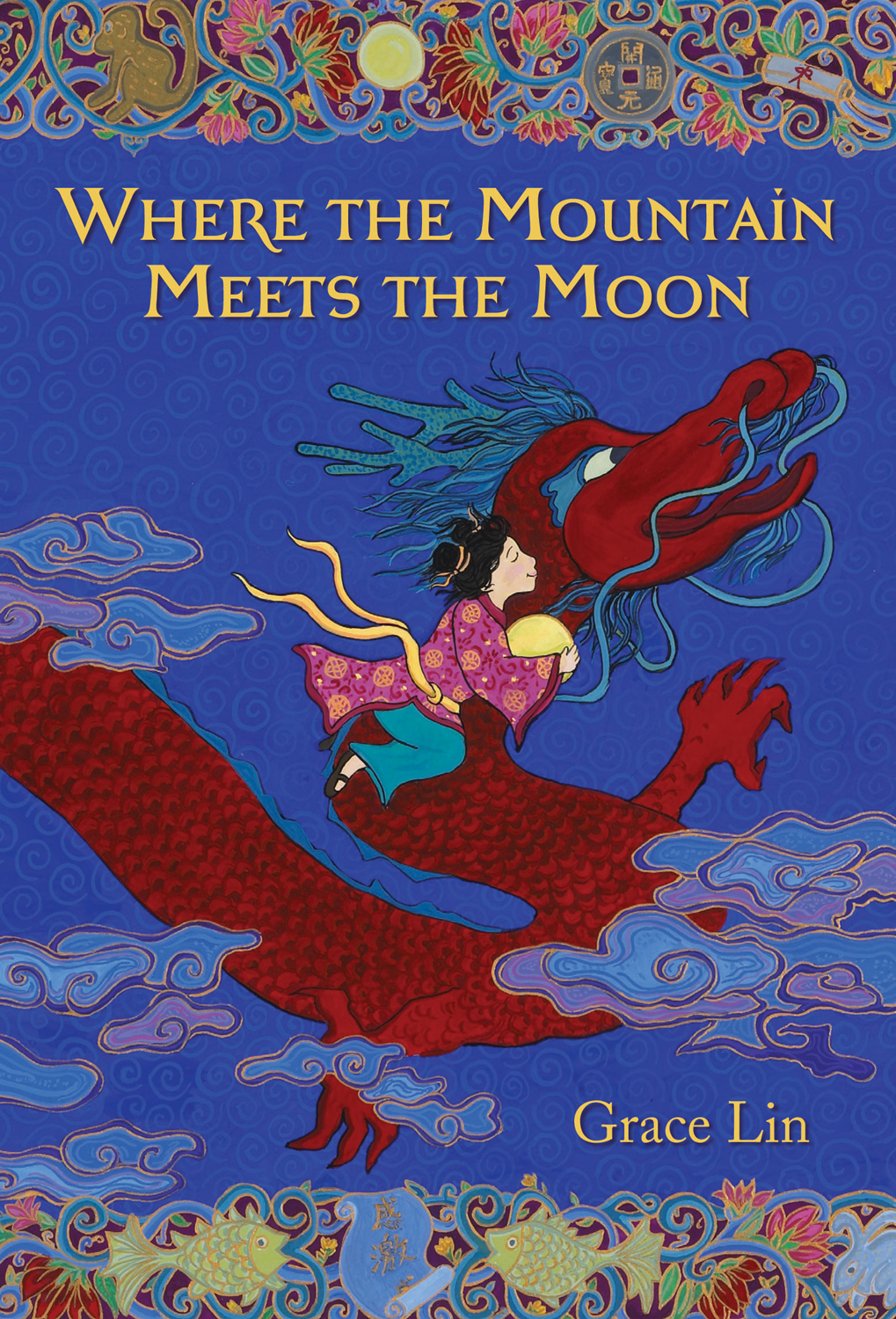
Grace Lin’s Where the Mountain Meets the Moon (2009) incorporates several well-known Chinese folktales as part of its plot. Minli, a little girl from an impoverished village located in a place called Fruitless Mountain Valley, goes on a quest to see the Old Man of the Moon in an attempt to change the fortune of her family. Along her journey she meets and befriends a friendly dragon who is unable to fly. The dragon itself is a character from a famous folktale – about a lifelike but unfinished painting of a dragon by a master painter which came to life when the painting was completed by someone else – by drawing in the dragon’s eyes. Minli and the Dragon decide to help one another – Minli in her quest for fortune which she believed will bring her family happiness and the Dragon in his quest for flight. Along their journey, they encounter several characters from Chinese folktales, who each have their own stories to tell. All these various characters and tales are skillfully woven into the fabric of the story.

Slide 9.1: Cover of Where the Mountain Meets the Moon

Research
Research is a key factor in writing a good book, we look at sources for Asian folktales e.g. unpublished stories on the internet, newspaper articles and also books, old and new.

Books:
  • Folktales from India (1991) by A.K. Ramanujan
  • Green Willow and Other Japanese Folktales (1987) by Grace James
  • The Magic Boat and Other Chinese folktales (1980) by M.A. Jagendorf and Virginia Weng.
  • Korean Folk-tales (1994) by James Riordan
  • Hikayat: From the Ancient Malay Kingdoms (2012) by Ninotaziz
  • Malaysian Fables, Folk Tales and Legends (2012) by Walter Skeats and Edwin H Gomez
  • Timeless Tales of Malaysia (2009) by Tutu Dutta
An excellent Internet source for World and Asian folklore and myths (translated from the original):
For Malaysian folklore visit:
  • www.sabrizain.org/malaya/library
Research for a book should not just focus on one particular folktale but also on similar stories and variants of the story. Reading a few versions of the same story will give you a feel for the story.

Illustration from Eight Treasures of
the Dragon by Tan Vay Fern
Supporting research on the time and place which form the backdrop to the story i.e. details such as old place names, historical personages and cultural practices give the book texture and context.  The folktale from China, Dragon Wells of Yanjing in Eight Treasures of the Dragon was based on the story of a Dragon king and queen who decided to punish the people of Yanjing (the old name of Beijing) for destroying their home by draining a lake. In one version of the story, Kublai Khan was mentioned. When I researched the history, I discovered that Kublai Khan did indeed re-design Yanjing. A huge lake was drained and a canal built to connect Yanjing with the South. That is the history; legend tells us that draining the lake had dire consequences for the people of Yanjing.


Slide 11.3: Photo of water carrier


The majestic Baobab of Madagascar 
Another point to note is that plants i.e. flowers and trees and also birds and animals play an important role in folklore (as we saw in the story of Bloddoewedd, a woman made of flowers, who was turned into an owl). Many trees have cultural significance even today – e.g. the Banyan Tree and /Holy Basil/Sacred Fig of Asia, the Baobab in East Africa and the Iroko tree of West Afrika, the Oak/Mistletoe/Clover in Europe etc  An attempt must be made to identify a flower,  tree or animal mentioned in a legend so that you can identify its scientific name and can even read up on it to see how closely it matches the legend! I did this for most of my stories.


Next, I refer to my books – The Jugra Chronicles - to explain this process. To date two books have been published in the series:

*Miyah and the Forest Demon (2011)                     
*Rigih and the Witch of Moon Lake (2013)

The title of the series – The Jugra Chronicles –  Jugra is the name of the old Royal town in Selangor. But it is also the name of a hill on Carey Island (close to Port Klang) and is considered to be sacred to the Mah Meri. I talked to a few members of the tribe on a trip to Carey Island some years ago. In the books, Jugra was a powerful shaman whose actions had repercussions on his descendents.

First of all decide on a setting for your story – the place and time. When writing a story set in this part of the world it is always wise to consider the two main trade routes of the past – the overland Silk Route and the sea bound Spice Route. As we are right in the midst of the Spice Route (The so-called Spice Islands have identified as the Moluccas), it is natural to think of the Spice Trade.

Map of Borneo
I chose to set the story in Borneo, due to the unique and diverse folklore traditions associated with the island – including head-hunting and the use of magic! In the end, I narrowed it down to a coastal region near Brunei - in the past, the Sultan of Brunei had suzerainty over most of Borneo – and also because the two Malaysian states of Sabah and Sarawak meets with Brunei and Indonesian Kalimantan here. The time period is the 17th Century – over a hundred years after the fall of the Melaka Empire. I did some research on the history of the area and came across the name ‘Tanjungpura’ and decided to use it in my story. The story is set against the backdrop of a power struggle in Tanjungpura, an ancient trading with ties to the Han Kingdom (China), Hindustan (India), Majapahit (Indonesia) and Melaka (Malaysia) – which is now under the Dutch.
Illustration from Miyah and the Forest Demon
by Choong Kwee Kim

The protagonist is a girl called Miyah, whose father is the village Shaman. Her best friend is Suru, a girl whose father (a spice trader from the Han Kingdom who was once stranded in the village) has long since left the village. Miyah’s mother is the village mid-wife, a role which is also associated with magical abilities.

The story is as follows:
One morning, Miyah’s mother asks her to remain in the longhouse and look after her younger brother Bongsu as she had to go another village to deliver a baby. But it is a beautiful day and Miyah has promised to meet her friends at a waterfall upstream. Miyah disobeys her mother and joins her friends at the waterfall. A sudden sun-shower at the waterfall and the eerie cry of a bird, harbingers of misfortune, reminds Miyah of Bongsu. She returns home to find Bongsu missing! This part of the story – of a child who is lost in the forest and is believed to be abducted by an evil spirit is quite a stock part of native folklore in Malaysia and many other countries. The quest here is to recover a lost child rather than to look for treasure.

When Miyah returns, the village is also strangely empty. Miyah has no one to turn to except Rigih, a boy who is an outcast in the village because he came from another tribe. But he is related to Miyah’s mother and agrees to help her. On the way to the forest, Miyah and Rigih meets Sang Kanchil, the talking mousedeer, who leads them to Nenek Kebayan (Nenek Kebayan is a central figure in Malay folklore, a little like Babka from Russian folklore). Guided by the wise woman of the forest, they embark on a quest to rescue Bongsu. They succeed in rescuing Bongsu but Miyah is caught by the forest demon…

In the second book in the series, Rigih and Bongsu’s attempt to rescue Miyah.
I also use another folktale – that of the seven faeries who come down to earth to bath in a forest pool - to explain the origin of Jugra and his magical powers. We also learn about the true nature of the forest demon in this book.

Re-telling a story
The stories in the book are ‘retold’ and not ‘translated’. When you translate a story, you try to write it as close to the original as possible, but in a different language. Retelling a story means that this is your own interpretation of the story; with your own characterization and your own dialogues and description. Even the chain of events and sometimes the outcome of the stories can be changed sometimes, although I prefer to remain true to the original story. I’ve read/heard most of the stories in Malay but I try to understand (internalize them) them and then re-tell them in my own words.  It was a little challenging especially when I come across words such as ‘huma’ etc and when the original is in old Malay.
 
Yes, very often the same story appears in several different versions. Usually I select one version but sometimes I combine two or three different versions into one story!

The need to re-interpret and retell these folktales, to make them relevant and appealing to a young contemporary readership is the third key point. The author needs to balance authenticity (being true to the story) with the need to hold the readers’ interest.

Pervasiveness of Folklore
Folktales are quite universal.  A Malay folktale called Puteri Bunga Tanjung, which I have retold as The Tanjung Blossom Faerie (it actually means Tanjung Blossom Princess), in Timeless Tales of Malaysia. This is the story of seven faerie princesses who come to earth to take a bath in a beautiful forest pool. The youngest sister loses her cloak or selendang and is unable to return home. She sits under a tree and weeps and her tears turn into fragrant blossoms when they touch the earth.

The lost fairy maiden is taken in by a poor old woman – probably another Nenek Kebayan. The fairy helps the woman to make fragrant flower posies and perfumed oil to sell in the village, but every evening she returns to the forest to weep. As time passes, the old woman feels sorry for the fairy and they search for the lost selendang so that the fairy could return home. However, before she leaves, the fairy transforms the tree she used to sit under into a Tanjung tree so that it bears night blooming flowers which are shed at dawn, like the tears of a fairy.

The Tanjung Blossoms - Mimusops elengi
  1. Regarded as a national folktale, this particular folktale clearly originates from Penang as Tanjung is the old Malay name for Penang. There are also similarities with another folktale, Bunga Tanjung which is known to originate from Penang. The bunga tanjung (Mimusops elengi) is a fragrant, night-blooming flower.
This motif of the seven fairy sisters taking a bath in a pool appears in folktales in Japan, Korea and China. In fact, in Ruth Manley’s Peony Lantern, there is a character called O-Kuni and her travelling troupe of dancers. It later turns out that she is actually a fairy trapped on earth because someone had stolen her magical robe of feathers!

The Weavermaid and the Herdsboy
We don’t know where the story first originated from but it could be based on the Chinese folktale of  ‘The Weavermaid and the Herdsboy’.  In the Korean and Japanese version, the story is usually referred to as The Robe of Feathers or the Celestial Robe of Feathers. In this version, a fisherman/hunter/herdsman observe a

flock of seven cranes land on the shores of a lake or forest pool. The cranes turn into maidens who hang their robes on the branches of a tree before going for a swim. The fisherman hides one of the robes so that one of the fairies is trapped on earth. The fairy is forced to marry the fisherman and lives with him and his mother for many years. Eventually, when everyone seems to have forgotten that she is in fact a fairy, the mother accidently comes across the robe of feathers which the fisherman had hidden and decides to air it. The fairy asks if she could try it on and she turns into a crane and flies away!

Even more surprising, this same motif of seven fairy sisters appears in an Iban legend called ‘Jelenggai’, also found in the Timeless Tales of Malaysia collection.

Another variant to this folktale is that of Manohra, the bird Maiden. Retold in my book, Eight Jewels of the Phoenix, this is the story of seven princesses who are bird maidens. As before, they take a bath in a secluded forest pool, however the youngest is captured by a hunter who gives her as a gift to the prince of the Kingdom. The prince falls in love with Manohra and so on… The story of Manohra is widely known in the East Coast of Peninsular Malaysia and is definitely of Thai origin as there is a classical Thai dance drama based on this story. Manohra is also widely known in Cambodia and Laos and the origin of this story is more likely to be from India.

So from studying folktales we can see that stories travel all over the world!


References

1.      Divakaruni, Chitra Bannerjee (2005), The Mirror of Fire and Dreaming, published by Roaring Brook Press, Connecticut, United States of America.

2.      Dutta, Tutu (2009): Timeless Tales of Malaysia, published by Marshall-Cavendish Malaysia.

3.      Dutta-Yean, Tutu (2009): Eight Fortunes of the Qilin, published by MPH Group Publishing Sdn Bhd, Malaysia.

4.      Dutta-Yean, Tutu (2009): Eight Jewels of the Phoenix, published by MPH Group Publishing Sdn Bhd, Malaysia.

5.      Dutta-Yean, Tutu (2011): Eight Treasures of the Dragon, published by MPH Group Publishing Sdn Bhd, Malaysia.

6.      Dutta-Yean, Tutu (2011): The Jugra Chronicles: Miyah and the Forest Demon, published by MPH Group Publishing Sdn Bhd, Malaysia.

7.      Dutta-Yean, Tutu (2013): The Jugra Chronicles: Rigih and the Witch of Moon Lake, publishing in progress by MPH Group Publishing Sdn Bhd, Malaysia.

8.      Garner, Alan (1967): The Owl Service, first published by William Collins Sons & Co. Ltd, Great Britain.

9.      Jagendorf, M.A. and Virginia Weng (1980): The Magic Boat and Other Chinese Folktales, published by Vanguard, New York, United States of America.

10.  James, Grace (1987): Green Willow and Other Japanese Fairy Tales, published by Avenel Books, New York, United States of America.

11.  Lewis, C.S. (1950): The Lion, The Witch and the Wardrobe, published by Goeffrey Bles, United Kingdom.

12.  Lin, Grace (2009): Where the Mountain Meets the Moon, published by Little, Brown Books for Young Readers,  New York, United States of America.

13.  Manley, Ruth (1978): The Plum Rain Scroll, first published by Hodder and Stoughton (Australia) Pty Ltd, Sydney, Australia.

14.  Manley, Ruth (1982): The Dragon Stone, first published by Hodder and Stoughton (Australia) Pty Ltd, Sydney, Australia.

15.  Manley, Ruth (1987): The Peony Lantern, published by Hodder and Stoughton (Australia) Pty Ltd, Sydney, Australia.

16.  Ninotaziz (2012): Hikayat: From the Ancient Malay Kingdoms, published by Utusan Publications, Malaysia.

17.  Ramanujan, A.K. (1991): Folktales from India, published by Pantheon Books, United States of America.

18.  Skeats, Walter and Edwin H. Gomez (2012): Malaysian Fables, Folktales and Legends, published by Silverfish Books Sdn Bhd, Malaysia.