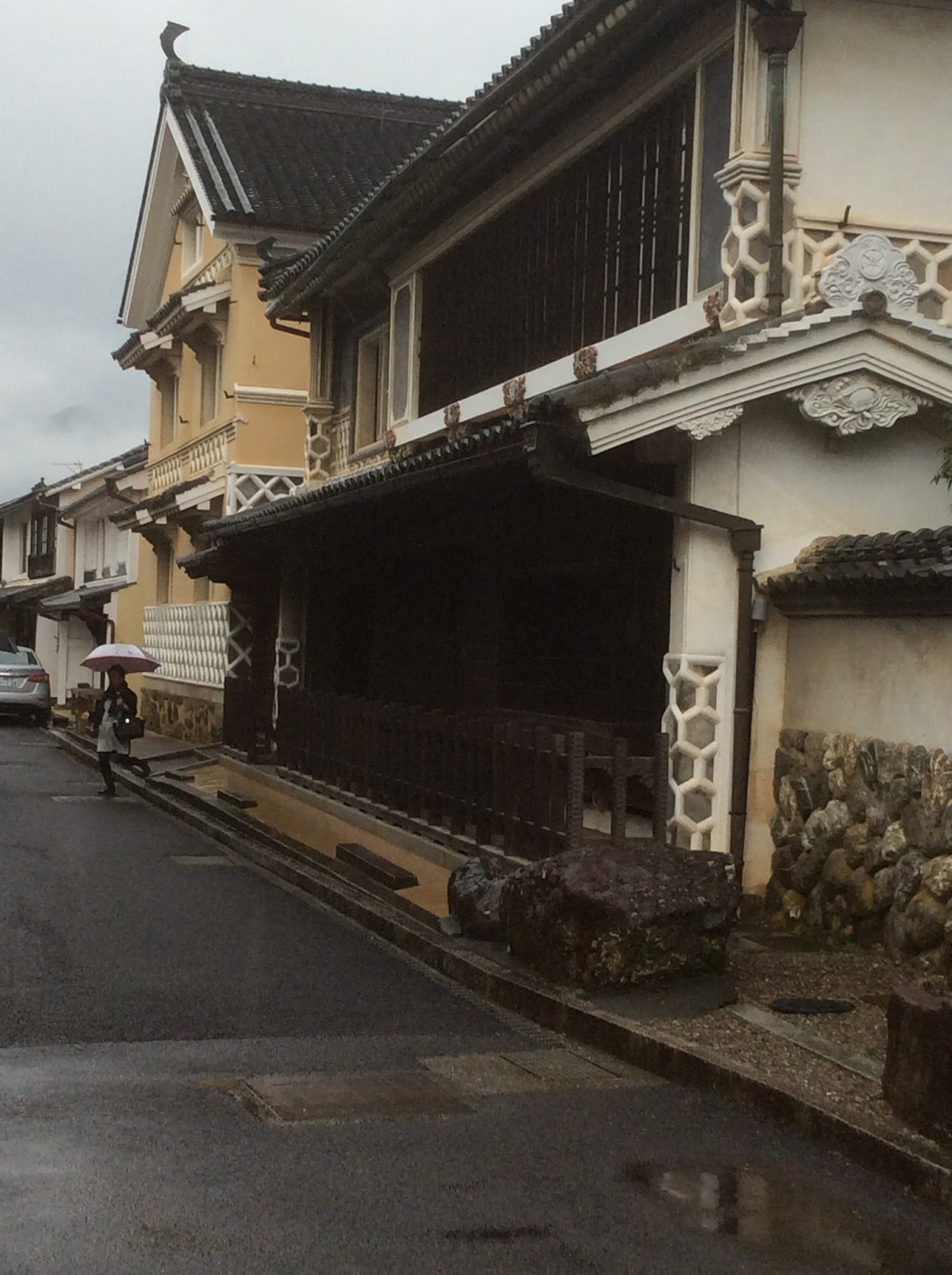
Uchiko City
One of the most memorable places we visited was Uchiko City or rather it's historical quarter known as Yokaichi Old Town. The elegant merchant houses lining this street were exactly as they were more than a century ago and the place gave us an inkling what life must have been like in the past. Although it was drizzling all the time we were there, our spirits were not dampened...
A memory shared by Soon Kuan...
"It was such a wet day. We braved the rain to walk through the charming old town of Uchiko with well preserved houses. After lunch we decided to rest our feet and set out to find a cafe to have coffee. We stumbled upon a small cafe run by a lady. She painstakingly brewed each a cup of coffee and a cup of hot chocolate for me. It was such a treat because each cup was made with tender loving care."
 |
| Uma gets ready to take a photograph |
 |
| Notice the splendid garden in the background... |
 |
A store selling hand-made bags made of bamboo. The traditional handicrafts
were expansive. We learnt later that the cheap stuff were made in China and
actual Japanese handicrafts were expansive. |
 |
| Streams and rivers flow through the town, unimpeded |
Apparently, the merchants of this town enjoyed a luxurious and elegant lifestyle from the production of wax and paper. The Kamihaga residence exemplifies this tradition. The main attraction to the city is apparently the Uchiko-ja, a full-scale Kabuki theatre.
Lunch was at a place called Mother's Cafe. The food was Western style and quite delicious and the plating was perfect. Unfortunately, the woman running the place (Mother?) had to work single-handed as cashier and waiter. She even turned away customers (two Japanese ladies) who came in later. However members of our group had no trouble getting tables. We really get the feeling that labour is in short supply in these small towns in Shikoku, most of the talented young people probably having migrated to Osaka or even Tokyo.
 |
| Mother's Cafe served a fusion French-Japanese cuisine |
 |
| Gladys had Japanese food at another home-run restaurant |
Dogo Onsen
After Uchiko, our next destination was the Dogo Onsen, located in the city of Matsuyama in Ehime Prefecture. This bath house is legendary and is said to be over a thousand years old. Dogo Onsen is mentioned in the
Man'yoshu (literally 'a thousand leaves'), reputedly the oldest collection of Japanese Poetry, compiled sometime after 759 AD. Ancient princes and poets are said to partake of this hot spring for inspiration and to ease the burdens of the day. A part of the onsen on the top floor, is reserved exclusively for the Imperial family.
 |
| The legendary Dogo Onsen. |
However, we have to confess that we did not actually partake of this legendary bathhouse. We were staying at the Toyogo Inn at Matsuyama and did not feel like carrying our bath towels around with us all over town. Instead we were quite contented exploring all the specialty food and handicraft stores in a covered walkway of the shopping arcade known as Dogo Haikara Dori. Of course, Chow Peng was appalled to hear this but an onsen is an onsen... Centuries ago, the onsen was probably an outdoor hot spring set among splendiferous nature. Today, the water is diverted into indoor bath houses and we were satisfied just looking at the magnificent building just from the outside.
When I saw the the main building of Dogo Onsen it reminded of the bath house/inn depicted in the famous anime,
Spirited Away, by Hayao Miyazaki. My suspicion was confirmed by Wikipedia.
 |
| The tea house/onsen in Spirited Away |
We also met Uma along the shopping arcade and decided to take the tram to the Toyogo Inn. In was convenient and really cheap...
 |
| A shop in the arcade which sold merchandise based on Miyazaki's movies |
 |
| Many of the shops sold traditional Japanese handicrafts |