Pages

Welcome! Selamat Datang! Bien Venue!

Dedicated to all those who are interested in world folklore, culture and nature. Comments and constructive criticisms are welcome!

Monday, December 28, 2015

Nine Days in Japan - 15 November 2016

Naruto Whirlpool

The tour proper started with a visit to view the Naruto Whirlpools. This is reputedly, the world largest whirlpool which appears on a regular basis at certain times of the day, during high tide and low tide. The name 'Naruto' intrigued those of us familiar with the manga and anime character, Naruto. According to Shona, it's a condiment used in ramen; I though it meant sweet potato !!!

Anyway, the walk over the sea on the Onaruto Bridge was quite an experience. In fact, 2015 was the 30th Anniversary of the bridge...


The island and lighthouse can be identified by the diagramme on the glass window


Ryozan-ji, Tokushima City

After the Naruto Whirlpool, we visited Ryozan-ji, temple no 1, in the historic 88 Temples Shikoku Henro pilgrimage route.


The altar at the main temple is lighted with lanterns. 
Ryozan-ji is also dedicated to children who lost their lives too soon...


Awa Odori, Tokushima City

The afternoon was spent in Tokushima City, where we were treated to an Awa Odori performance. Tokushima is famous for Awa Odori, said to be the largest dance festival in Japan. The dance may have originated from Bon Odori, the Japanese Buddhist 'Festival of the Dead' and also Kumi-Odori, a lively harvest dance.


There are two versions of the dance, a restrained daytime dance called Nagashi:


And a more frenzied night version called, Zomeki, purportedly to summon the spirit of the dead:

The dancers look quite creepy in the dim light...

Towards the end, the audience was asked to participate, and Pip Panasbodi (who was dubbed 'Pipa'  by the MC) won one of the prizes!


The rarely photographed Rich Yamasaki participates in the dance


Pip Panasbodi wears a white garland


Pip is one of three winners of the audience members

Nine Days in Japan - 14 November 2015

Wakayam Castle
The morning of 14 November was spent exploring the grounds and keep of Wakayama Castle. The three of us, led by Soon Kuan and Kim Wah set off on foot from the hotel to this famous place. At the entrance, we were lucky enough to meet a Japanese gentleman who volunteered to be our guide.


The straw wrapped around the tree is supposed to keep it from freezing in winter!
One of the interesting things he pointed out to us was a 400+ year old tree, which was in fact older than the castle itself.

400+ year old Camphor tree on the grounds of Wakayama Castle.
The tree was a sapling when the castle was first constructed.
The castle was built in 1585, under the aegis of Toyotomi Hideyoshi. Although fairly modest in size as castles go, it is historically important due to its close association with the Tokugawa clan.

Gladys, Shona, Tutu, KimWah, Soon Kuan and the Japanese Professor

Wakayama Castle was destroyed by bombs in World War II and most of the present building is a post-war reconstruction, made of modern building materials not the traditional stone.


The tower, (donjon) is now a museum exhibiting samurai weaponry and armor from the Edo period.


On the castle ground is the Momijidani Teien, a beautifully serene Autumn Garden, constructed by Yorinobu Tokugawa during the early 17th Century. I would have loved to linger in this wonderful place a little longer but we were short of time and had to rush off...


Awajishima Kyukamura Hotel, Shikoku
The entire group finally met on the bus in the afternoon of 14 November at Kansai Airport and Kobe. I was really surprised at how efficiently it all went - the bus driver did not miss a beat despite all the disparate locations involved...

Tania, Suan, Ann, Tze, Pip and Denny

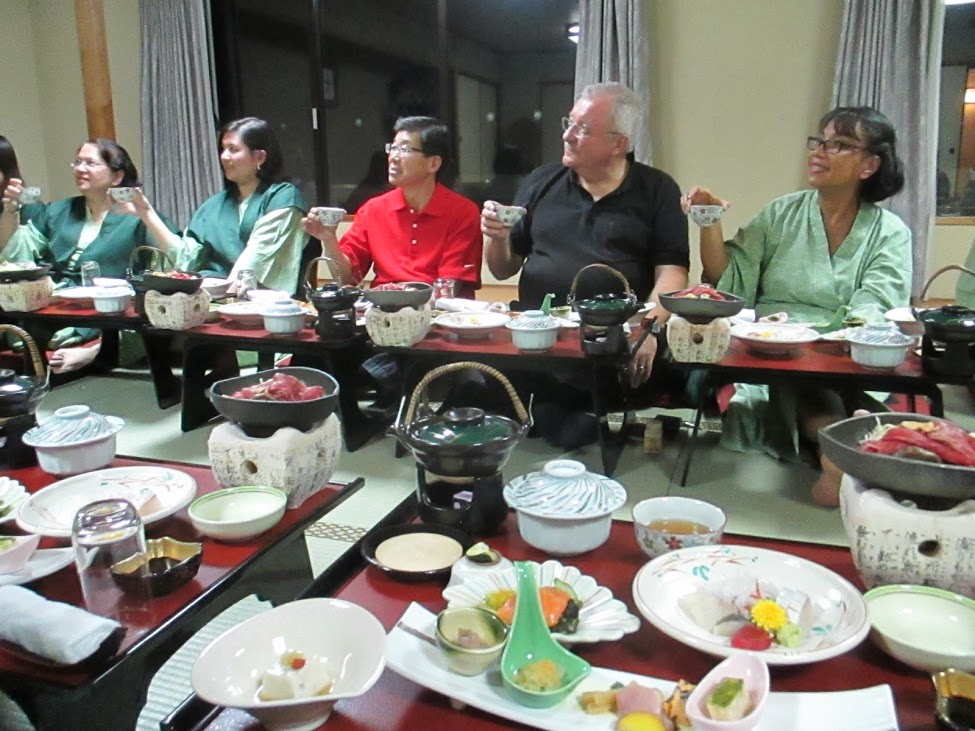
We found ourselves at the Minamiawaji Royal hotel, where the entire group met for a very traditional Japanese dinner: served on low tables while seated on tatami mats... not the most comfortable way to eat dinner when one has grown inflexible with age.


Nine Days in Japan - 13 November 2015

In 1978, 42 students from seven countries (Hong Kong, Indonesia, Malaysia, Philippines, Singapore, Thailand and USA) met in Tokyo, Japan for six weeks of immersion in Japanese culture. It was an eye-opening experience for all and life changing for some. After exchanging letters, they lost touch with one another until the advent of the Internet and most notably Google and Facebook. A reunion was held in Kuala Lumpur, Malaysia in 2008, organised by Lee Kwong Yan, one of the Malaysian students from 1978.

The group met again in Osaka and the Kansai region in 2010 and in New York in 2012.

The fourth reunion was held on the island of Shikoku, Japan, where we had a chance to experience the rural side of Japan. This initiative was organised by Chen Soon Kuan from Singapore, Rich Yamasaki from the USA and Motoharu Matsukura (Moto) from Japan. This time, the following members of the alumni were present: Denny Gerberding (Indonesia), Chen Soon Kuan (Singapore), Ho Chow Peng (Singapore), Pip Panasbodi (Thailand), Uma Trankasombat (Thailand), Rich Yamasaki (USA), Lee Kwong Yan (Malaysia) and me, of course.

The participants who were not members of the JAL 1978 were: Axel Gerberding, Lee Kim Wah, Chris Panasbodi, Roger Yamasaki, Tania Lee, cousins Gladys Yean and Shona Yean, Alfred Ang and his wife, Anne, and long time friends Tze Khoong Loh and Geok Suan.

Kuroshio Fish Market, Wakayama

Our first day in Japan started at Wakayama, a seaside resort and town on the southern shore of Honshu. Shona, Gladys and I decided to join Soon Kuan, Kim Wah and a few of Soon Kuan's friends at Wakayama before the reunion at Shikoku. It turned out to be a rather good place for food.


The first place we visited in Wakayama was the Kuroshio Fish Market, located within Wakayama Marina City. There we watched a a giant tuna being cut and filleted by a skillful young chef - the whole spectacle reminded me of Iron Chef! A stroll through the marina revealed that it was a place popular with courting young adults as well as the aged, who are driven there in special vans to take in the fresh sea air. There was also a fruit market nearby where I bought half a dozen, very delicious and cheap persimmons.


Dinner at Wakayama

The evening was spent in exploring Kintetsu Department Store, which had a very impressive display of Japanese food. Unfortunately, the place closed at 8pm sharp and we (Gladys, Shona and I) had to look for an alternative place to have dinner. We chanced upon a quirky restaurant which served 'small chops' and hesitantly descended into the basement where the main area of the restaurant was. We were delighted to find that the dining room was partitioned into little rooms and most of the clients were women.


Below was a sample of what we had:


The food was better than expected and we returned to the hotel, quite satisfied with our little soiree!

Tuesday, October 27, 2015

Halloween 2015 : The Langsuir

THE LANGSUIR

Variations: Langsuior, Langsuyar (Indonesia)


The Pontianak. Photo source unknown. 

It's Halloween again, so my contribution to this festival is a post on The Langsuir.

The Langsuir is a vampiric revenant in Malay folklore. According to Carol Laderman (Wives and Midwives: Childbirth and Nutrition in Rural Malaysia), "The langsuir or pontianak is a vampiric creature who was once a woman. She takes on a demonic form after dying from childbirth." The death could be due to a difficult childbirth or to the shock and heartbreak resulting from having a stillborn child.


In the past, women in rural Malay communities, who are about to give birth had to be protected from malevolent spirits such as the Jin Tanah (Djinn of the Land) and Jin Hitam (the Black Djinn). "They are attracted by the sweet blood of parturition, dripping through the floorboards to the ground below. The 'dirty' blood of menstruation does not appeal to hantu and small amounts of blood from wounds are beneath their notice, but a great deal of blood lost during childbirth... may prove irresistible."

Even more terrifying than these supernatural creatures are the once human revenants. If the proper rituals are not followed, forty days after death, the deceased will rise up as a langsuir or a pontianak. If the child died with her, then it too will come back in úndeath' as a blood sucking infant vampire called a toyol. According to information gleaned from the Internet, to prevent a woman from rising as a langsuir,  glass beads (glass marble?) must be placed in the corpse's mouth, a chicken egg placed under each armpit, and needles stuck into the palm of each hand. 

I tend to disagree about the interchangeability between the langsuir and the pontianak. I think the langsuir is created when an unmarried woman dies an unnatural death. Like the Yakshi of South India and the vampire in Western culture, she most likely took her own life or was murdered by a lover. 


Langsuir by ShadowFey  source: shadowfey.deviantart.com

The langsuir does not have fangs like all other types of vampires; instead, it drains the blood from its victims through a hole at the back of its neck, which is hidden by its long black hair.  One can only speculate that there must be a tube like structure which comes out of this hole! This creature has been described as having very long fingernails and commonly wears a green or white robe. By night, the langsuir shape-shifts into an owl and then flies out seeking its favorite prey, children (according to certain bloggers). Children are not easy prey to find because most of them will be indoors before sunset. Unless that is, they have a wicked stepmother who makes them draw water from a well after dark!

I rather think the langsuir is looking for men; it's the pontianak who seeks women about to give birth and their after-birth. These are vengeful spirits drawn to what they longed most in life - the langsuir wants to be wedded and the pontianak wants to be a mother. But their demonic nature and blood lust have twisted them.

As it flies, the langsuir occasionally lets out an eerie wail known as an ngilai; which will strike terror in the hearts of the bravest person. By day it can be found sitting in trees or by a river catching and eating fish (I also have doubts about this odd piece of information).

Here is an invocation to summon the Langsuir by R. O. Winstedt. 


(Thanks to Bert Tan, the Administrator of the Malaysian Heritage and History Club Facebook page, who brought this to my attention. The link to the MHHC page:
https://www.facebook.com/groups/malaysian.heritage.and.history.club/ )

Why would anyone want to summon a langsuir? According to folklore, the langsuir can be captured and domesticated.  And the 'tamed' langsuir makes for an incredibly beautiful wife and a devoted mother; this domesticated vampire wishing for nothing more than caring for her family. So there might be men out there who are arrogant and foolish or desperate enough to embark on such a course. 

However, they should beware, because if the langsuir is allowed to dance or show any signs of unbridled happiness, she will revert to her bloodthirsty and murderous ways. Once this happens, she must be re-captured. According to some modern bloggers, her hair and fingernails must be cut off and stuffed into the hole at the back of her neck. This will force the langsuir to change back into a mortal woman. This bit of information from the Internet is, of course, complete rubbish. I remember reading as a young adult that there is only one way of trapping a langsuir. Just like the yakshi, her weakness is iron. Placing an iron nail or spike at the back of her neck will change her into a mortal woman. Carol Laderman, mentions this as well. The best way to banish a langsuir is "piercing the demons neck with iron or steel while repeating the appropriate spell."

Like the yakshi and the pontianak, the langsuir is supposed to emit an overpoweringly sweet fragrance. The fragrance is due to her association with the Sundal tree - a tree which is named in Malay folklore as the abode of the pontianak. This tree could either be the Pala tree (Alstonia scholaris) or the Champaca tree (Michelia champaca). To find out more about this, refer to my previous blogpost, http://tutudutta.blogspot.com/2015/01/the-pala-and-sundal-tree.html 

According to folklore, one must never remark upon or mention this fragrance, should one come across a mysteriously sweet smell while walking in lonely places at night. Because this is tantamount to an invitation to a langsuir! The best thing to do is to leave the place as soon as possible!

Source: Laderman, Wives and Midwives, 126; Mc Hugh, Hantu-Hantu, 74; Skeat, Malay Magic, 325­28


Disclaimer: The administrator of this page is not responsible, should any harm befall anyone as a result from uttering this invocation out loud.

Friday, August 21, 2015

The Cost of Prejudice

Golda Mowe, the author of Iban Dream (Monsoon), Iban Journey (Monsoon) and The Nanobots (Oyez), guest blogs today...

The Cost of Prejudice
(or how a very, very, very bad movie turned me into a scrupulous author) 

By Golda Mowe

Golda Mowe - in the background is an antique pua kumbu,
one of the cloths which 'must not be named'
I remember the excitement in Kuching in the early 2000’s when an American crew came to Sarawak to film The Sleeping Dictionary (https://en.wikipedia.org/wiki/The_Sleeping_Dictionary).  The city was abuzz with activity and the few artistically inclined friend I had, talked about the project incessantly.  I wished that I was part of the excitement too but I had the responsibilities of a proper day job at the time.

The movie came out in 2003, but for some reason or other I did not get a chance to watch it at the cinemas. So how was it, I asked a Chinese-Sarawakian friend who had watched it. His eyes glazed over and he said, he did not know what to make of it. It seemed to be a love story, he said, but something was not quite right. I did not think much of it at that time, but when I came across the VCD a couple of years later those words came back to me.

I am still glad I watched the movie alone, because the level of cultural bias I saw first shocked then enraged me. Never mind that words used in the first few dialogues in so-called Iban was unrecognisable to me, but the portrayal of the Iban woman in the form of ‘Selima’ was all wrong.
First and foremost, no self-respecting Iban woman was going to ‘offer’ herself to a man at HIS HOME. The Iban lifestyle may be basic compared to the Western one, but we still have our etiquettes and taboos. The man must come to the woman first, in a practice called Ngayap

Jessica Alba plays the role of Selima in The Sleeping Dictionary
According to custom, the man would sneak into the bed of the woman he was interested in at night, to try to woe her, after everyone else had gone to sleep. In its simplest detail the practice may appear to go against the norms of Western values. Yet what few bothered to ask is, where was the rest of the family? In the same room with her. Even if a young woman were to sleep in the loft, away from her parents, she would never be sleeping alone. Hence if a man was to visit, there would be a ‘chaperone’ nearby, albeit one who pretended to be asleep to allow the couple some semblance of privacy.
Ngayap is practical in the close-knit longhouse community where harmony is critical to survival. This secret form of courtship meant that the man would not lose face if a woman was to reject him.  Only after she had consented to be wooed, would he send his family to meet with hers and ask for her hand.

Yet this movie did not appear to have considered anything else other than the point that a man can sneak into a woman’s bed. Since this was contrary to Western values, it was turned into some form of white man’s fantasy of having a child-like beautiful Eurasian woman come willingly into his bed. The Sleeping Dictionary continues to nettle me, even today.  It reminded me of all the derogatory accusations that had been flung my way because of my Iban heritage.

Admittedly, the Iban culture is confusing in many ways. On one hand we are careful about how we use words. It is not unusual to come across a piece of woven cloth or carving that ‘must-not-be-named’. Once the artist has passed on, the name as well as the meaning of the work is often lost to posterity. Yet when it is time to speak, to assert their rights, even the highest Iban leader must listen to the person who brought forward a charge, regardless of age, gender, or status. The late Temenggong Tun Jugah’s amazing memory for case details and points of application of Adat Law during such court sessions made him a legend among the Ibans to this day.

1.  Iban Dream (https://books.google.com.my/books?id=BcKJAAAAQBAJ&printsec=frontcover&source=gbs_ge_summary_r&hl=en#v=onepage&q&f=false
Among the Ibans, dreams are also treated as actual happenings and our legends are full of such occurrences. For example, Uyut anak Kalanang, is said to have dreamed of visiting a strange longhouse. In his dream, he was asked to choose a charm, and he selected one of the most powerful. The charm, he was told, would make him as well as his descendants into great war leaders. When he woke up, he found himself holding the charm in the palm of his hand. Uyut is famous for his decades long battles around the mouth of the Rajang Delta. His son, Linggir Mali Lebu, went on to become a terrible torn in James Brooke’s side until he joined the White Rajah in 1854. Linggir’s son-in-law, Garan, also became a famous war leader.

Pua Kumbu weavers sometimes get their ideas from dreams, but my great-grandmother (it is said) got hers directly from a spirit she met in the jungle. She won't talk about the spirit, but people suspected because she would leave the longhouse empty-handed then return two days later with her mouth all red from betel quid, as though she had been visiting. Right after that, she would start to tie her threads.


The hill myna is regarded as an omen-bird

Meetings with gods and powerful spirits are not just limited to dreams because animals are also considered to be spiritual messengers. For instance, between 1843 to 1861, the legendary warrior, Rentap (Libau) fought against the Brookes and their soldiers numerous times and won. However, in the third battle at Sadok Hill in 1861, a hill myna came to perch near Rentap and broke into song. Rentap then told his followers that the bird was the earthly form of the goddess Kumang and that she had come from Panggau Libau to warn them that they would not win this battle. Hence before the arrival of Charles Brooke and his soldiers, the Iban warriors under Rentap abandoned the Sadok fort.


Artistic rendition of  the Iban goddess, Kumang

The more I immersed myself in the legends of past Iban heroes, the more magical the jungle of Sarawak became. Each layer of leaves became like curtains hiding this world from the invisible world. A few more steps forward, and the sun bear would suddenly stand up on its hind legs and speak to you like a man. With her plaintive call, the greater coucal would invite you into her filthy home and ask you to eat from her table. Break a fern and a wave of fragrance will assail your nostrils. Do you not think it strange how fern could turn the rotting stench of composting matter into this fresh jungle perfume?

2.  Iban Journey (https://books.google.com.my/books?id=zPjnCQAAQBAJ&pg=PT2&source=gbs_selected_pages&cad=2#v=onepage&q&f=false). 
This was the jungle that my Iban grandparents had taught me to appreciate. And this is the jungle I eventually wrote into my books Iban Dream (http://www.gmowe.ws/IbanDream.html) and Iban Journey (http://www.gmowe.ws/IbanJourney.html). Many things have changed since the days of awe and wonder. Everything now is only appreciated based on their commercial value. Even the role of Iban women as child-bearers and seed-planters, which were once equal to men who were hunter gatherers, are now devalued. And maybe because of that, the practice of ngayap, which was once started to preserve the harmony of a community and at the same time give a woman the right to decline without peer pressure, is now used to condemn her and to portray her as a woman of low morals.

This is just one instance of prejudice caused by cultural misinterpretation. Imagine how many more there are in the world.

Author’s Bio

Golda Mowe is a writer from Sarawak who loves making up stories from across all genres.  Her novels Iban Dream (2013) and Iban Journey (2015) are published in paperback by Monsoon Books.  Two generations ago, she would have had to travel dozens of miles between longhouses to get her muse heard, but now she is more than happy to settle for http://www.gmowe.ws/stories.html.

Sunday, July 26, 2015

Phoenix Song to be published in September!


Phoenix Song will be published in early September 2015!  Many thanks to the dynamic duo at Lantana Publishing, Alice Curry and Caroline Godfrey, for making Phoenix Song possible!

To pre-order : http://www.lantanapublishing.com/books/phoenix-song

As both text and illustrations have been finalised, I'm finally allowed a share a few pages from the book. Enjoy!

Cover of the book. Illustrations are by Martina Peluso.
martinapelusoillustratrice.blogspot.com
A shout-out from Kevin Bathman, Administrator of The Chindian Diaries https://www.facebook.com/TheChindianDiaries :
"For Mums with young children from 4-8 years old, here's a wonderfully vibrant storybook called Phoenix Song by Lantana Publishing.
I'm a big fan of culturally diverse children's book, as I think its important that children can see themselves reflected in the stories they read." 


Summary: Arohan is desperate for a guitar. What eight year old boy isn’t? So when Arohan’s grandmother gives him a plain old bamboo flute for his birthday, he is understandably a little upset. But the xiao is no ordinary flute. An instrument steeped in the myths and legends of China, the xiao has its own special magic, as Arohan is soon to discover.

Notes: Notice the gorgeous Nyonya costume worn by the grandmother! What is a Nyonya? 
  1. The Nyonya or Baba-Nyonya are the descendants of Chinese immigrants who came to the Malay archipelago and British Malaya (now Peninsular Malaysia and Singapore) between the 15th and 17th centuries. Sometimes known as Straits-born Chinese (Straits refers to the Straits of Malacca), members of this community in Malaysia also call themselves "Peranakan." They practice a culture which is a fusion of Chinese and Malay - most obviously reflected in their dress and food.


When his brothers go missing on the slopes of the hill behind their home in Malaysia, Arohan must ensure they return safe and sound. But does he have what it takes to placate the guardian of the bamboo grove and summon the mythical phoenix? A touching and courageous story of a young boy’s love for his family and the magical things that can happen when you listen to your heart.


Reviews:
‘A wind of music and brotherly love takes us soaring through the pages of Phoenix Song. Children everywhere will see their own talents, disappointments, and heroes’ journeys mirrored in Arohan’s adventure.’
      – Mitali Perkins, author of Tiger Boy
‘An evocative ‘song’  that echoes in the heart.’
      – Mahtab Narsimhan, award-winning author of The Tiffin


Apart from Phoenix Song, Lantana Publishing will also be releasing Dragon Dancer by Joyce Chng and Jeremy Pailler, and Chicken in the Kitchen by Nnedi Okorafor and Mehrdokht Amini in September 2015. Both Joyce Chng (Singapore) and Nnedi Okorafor (Nigeria/USA) are Science Fiction & Fantasy writers.
Dragon Dancer by Joyce Chng and Jeremy Pailler
Summary
It is the eve of Chinese New Year.  Lanterns are hung in the shopping malls of Singapore and Yao is preparing to wake the ancient sky dragon, Shen Long, from his year-long sleep. From the moment Shen Long opens his great amber eyes and unfurls his silver-blue tail, Yao will be propelled on a magical journey through the skies of Singapore to battle the bad luck of the previous year and usher in the good. Will he succeed? Will his grandfather watch over him and protect him from harm? A beautiful story of a Chinese festival and its symbolism for Chinese communities everywhere, told from the perspective of Yao, the dragon dancer.

Dragon Dancer: Stunning illustration by Jeremy Pailler

I met Joyce briefly in Singapore in May, this year. She is an astonishingly prolific writer, considering the fact that she holds a full-time teaching job and is the mother of two young girls. I have an autographed copy of her book Rider, the first book of a trilogy.

https://www.facebook.com/SoutheastAsianSteampunk

Joyce mentioned a book she is editing with Jaymee Goh, gloriously entitled : The Sea is Ours: Tales of Steampunk Southeast Asia.  I wished I had heard of this project earlier, I would have loved to contribute... So what is Steampunk? It's a sub-genre within the larger Science Fiction genre, which I'm not going to attempt to define. It's easier to give examples of Steampunk anime and movies: Fullmetal Alchemist for one. If that doesn't ring a bell, how about Disney's Atlantis - the lost empire? And of course, Howl's Moving Castle.

Nnedi Okorafor is a rising star in the world of Science Fiction. Her latest sci-fi book is The Book of Phoenix. 

Chicken in the Kitchen by Nnedi Okorafor and Mehrdokht Amini
Summary
What would you do if you woke up one night to find the shadow of a giant chicken passing your bedroom door? Go and investigate of course! When Anyaugo follows a giant chicken into her kitchen one warm night in Nigeria, she embarks on a hilarious adventure where nothing is quite as it seems. Is the nature spirit that lives in the wooden walls of her house a help or a hindrance? Is the mischievous giant chicken a friend or a foe? Most importantly, will Anyaugo be able to save the food her aunties have cooked for the New Yam Festival the next day? World Fantasy Award-winning author Nnedi Okorafor provides us with a hugely entertaining look at the fascinating masquerade culture of West Africa, told from the perspective of a plucky young Nigerian girl who finds the courage to protect the traditions she loves.

It would be remiss of me not to mention Looking for Lord Ganesh by Mahtab Narsimhan and Sonja Wimmer (somewhat like not noticing the elephant in the room ;) )  Mahtab's book is the latest addition to Lantana's portfolio.  Looking for Lord Ganesh is scheduled for release in 2016.


Looking for Lord Ganesh by Mahtab Narsimhan and Sonja Wimmer

Summary
Anika has recently emigrated from India and is having a difficult time adjusting to life in a new country, not to mention life in a new school. Remembering the advice her grandmother gave her, she prays to Lord Ganesh, the Hindu elephant god. But Lord Ganesh is slow to respond and Anika takes to the internet to attract his attention. When her problems begin to resolve themselves, she can breathe a sigh of relief. But has Lord Ganesh truly been helping her, or has she been relying on her own inner wisdom all along? This is a sweet and witty story about staying true to one’s beliefs and finding strength in unlikely places.