Pages

Welcome! Selamat Datang! Bien Venue!

Dedicated to all those who are interested in world folklore, culture and nature. Comments and constructive criticisms are welcome!

Friday, July 17, 2015

Pua Kumbu - Spinning Yarn and Weaving Tales


An ancient metaphor: thought is a thread, and the raconteur is a spinner of yarns — but the true storyteller, the poet, is a weaver. The scribes made this old and audible abstraction into a new and visible fact. After long practice, their work took on such an even, flexible texture that they called the written page a textus, which means cloth. [Robert Bringhurst, The Elements of Typographic Style]

 Heritage pua kumbu pieces on display at the exhibition. Some of them are part of Welyne's personal collection.
Dayan De Silva and I attended the Pua Kumbu exhibition at the University of Malaya, on 12 July 2015. For those unfamiliar with the term, pua kumbu, is a traditional hand-dyed, hand woven ceremonial clothg, originating from the state of Sarawak (a part of Malaysian Borneo). Pua kumbu is created exclusively by the women of the Iban tribe, and the dyeing and weaving of this remarkable cloth is steeped in myths, rituals and taboos. About 10 of these women, who are master weavers, are recognised as 'living heritage' by UNESCO. 


Dayan having a chat with Welyne. Dayan is an editorial consultant, she undertakes
projects which are mainly non-fiction and academic in nature.
The Curator, Dr Welyne Jeffrey Jehom, walked us through the exhibition personally. It's not often that this happens, but we were impressed with absolutely everything: the beautiful pua kumbu pieces, the research behind the artefacts and the audio-visual presentations and the animation of the myths encoded the textiles. Being a writer myself, I've heard the terms 'weaving a story' or 'bringing the different strands/threads of a story together' often enough and in the case of pua kumbu, a story is literally woven into the cloth. 

Why is telling a story similar to weaving a cloth? Perhaps these expressions in English arose from the weaving of tapestries, which often served as a medium to record an event. The most famous textile art in history must be the 900 year old Bayeux Tapestry, which tells the story of the Norman invasion of Britain.

Excerpt from Wikipedia:


A small part of the Odo Bayeux Tapestry - royalty free image from Wikipedia.
The Bayeux Tapestry  is an embroidered cloth nearly 70 metres (230 ft) long and 50 centimetres (20 in) tall, which depicts the events leading up to the Norman conquest of England concerning William, Duke of Normandy, and Harold, Earl of Wessex, later King of England, and culminating in the Battle of Hastings.
The tapestry consists of some fifty scenes..., embroidered on linen with coloured woollen yarns. It is likely that it was commissioned by Bishop Odo, William's half-brother, and made in England—not Bayeux—in the 1070s. In 1729 the hanging was rediscovered by scholars at a time when it was being displayed annually in Bayeux Cathedral. The tapestry is now exhibited at the Musée de la Tapisserie de Bayeux in BayeuxNormandy, France (49.2744°N 0.7003°W).
The designs on the Bayeux Tapestry are embroidered rather than woven, so that it is not technically a tapestry.[2] Nevertheless, it is always referred to as such.

Close-up of the design of a beautiful yellow and blue pua kumbu
Back to the exhibition - Dr Welyne, who is from Sarawak, said that the exhibition was the culmination of three years of research among the Iban longhouses of Sarawak. One of her discoveries was that different pieces of pua kumbu made by different tribes may actually code different parts of a longer story i.e. the cloth from one village may have the beginning of a story, a weaver from another village may have the second part etc. She found out that the weavers themselves did not know this fact and she decided to piece together several myths based on her interpretation of various pieces of pua kumbu.  


A pua kumbu depicting the love story of the god Keling and the beautiful maiden called Kumang. We will have to
wait for Welyne's forthcoming book for the whole story!


Artistic rendition of Kumang in all her finery...

Dr Welyne explaining the story behind an intricately woven pua kumbu
 The other surprising piece of information from Welyne is the fact that pua kumbu has gender - some pieces are considered to be male and some are female.

These two pieces are 'female' pua kumbu.

Another interesting fact is that, every piece of pua kumbu must have a provenance. The weavers must know the story behind the cloth they are weaving; they would never attempt to weave a particular pattern if the weaver who first created it passed away without telling them the story behind it... Similarly, there are patterns which belong exclusively to longhouses with a head-hunting tradition and it is taboo for weavers who did not come from such a heritage to weave these patterns; however, longhouses which did not practice head-hunting in the past also have their own special heritage pua kumbu designs.


Artistic rendition of the Iban god, Keling. To find out more about him,
you may want to read Golda Mowe's book, Iban Dream and Iban Journey

So where do the inspiration for the pua kumbu designs and story come from? They come from dreams which sometimes visit these weavers. Which is why, they are also known as the weavers of dreams. I made a reference to this in the story of Santubong and Sejinjang, in my book, Eight Fortunes of the Qilin (also refer to the previous blogpost - The True Identity of Nakhoda Ragam.) 
And the reason why, people refer to telling a story as 'spinning a yarn' in the old days...


The metaphor is obvious; you tell a story like you make clothing. Repetition and pattern, moving the story along a path like a piece of thread you're spinning, putting large pieces together, crafting small pieces carefully, to get things put together right. It's art and it's craft and it's a valuable skill. Especially in a non-literate society.
So the metaphor theme Storytelling Is Weaving
as well as the fact that storytelling is lying
licenses these instantiations
  • loom of language, weave a story/spell, thread of discourse, warp and woof
including these, where the textile metaphor has an association of telling lies:
  • fabricating evidence, spin a yarn, tissue of lies, pull the wool over X’s eyes, out of whole cloth
  • http://english.stackexchange.com/questions/125614/thought-is-a-thread-and-the-raconteur-is-a-spinner-of-yarns/131268#131268
Invitations are already coming in for the pua kumbu exhibition to be shown in Australia, Canada, Taiwan, UK, US and maybe Paris, France...


These pictures taken at the Pua Kumbu Exhibition at the Art Gallery, Chancellery building, University of Malaya.

Comments about the post on Facebook:

Tuesday, June 23, 2015

The True Identity of Nakhoda Ragam... and the Princess of Mount Ledang

While researching Malay folklore about a decade ago - for my first collection of folktales, Eight Jewels of the Phoenix - I came across this fascinating character known as Nakhoda Ragam. This dashing seafarer, also known as the Singing Captain, is described as having long wavy hair, tied in a knot behind his head. Unfortunately there are absolutely no images of him on the World Wide Web, not a single one. All I got were pictures of a Malaysian naval ship named Nakhoda Ragam!

A gorgeous depiction of Lela Menchanai or
Chanai Lela by Yokinoshee.
http://yukinoshee.deviantart.com/art/Puteri-Lela-Menchanai-506532356
This larger than life personage was undoubtedly handsome as legend has it that he won the heart of an extraordinary beauty. However, there is some confusion about the exact identity of Nakhoda  Ragam and the woman he is supposed to have wedded. The first legend is that of Lela Menchanai or Chanai Lela. Nakhoda Ragam took her for his wife but their marriage was tragically short-lived. While sailing on his perahu, Lela Menchanai accidentally stabbed Nakhoda Ragam with a gold sewing needle and he bled to death. A few sources even claimed that the needle was poisoned or that it was cursed. This is nonsense, of course. Nakhoda Ragam, like Charles Perrault's Sleeping Beauty,  was cursed to die from the prick of a needle. The broken-hearted Lela Menchanai took her own life; by stabbing herself with a sword, according to some sources or by drowning when she jumped into the sea.


The Malay Archipelago, used to be known as the East Indies or the Spice Islands.
To this day, Nakhoda Ragam is associated with many places throughout the Malay Archipelago: Sumatra, Malacca, Johor, Singapore, Brunei, Sarawak, Sulawesi and Java but he is most closely associated with Penang, where every cove and island seemed to hold a memory of him...


Photo of Tanjung Tokong in Penang, probably taken in the early 20th Century

This excerpt taken from a Tourism Malaysia website:

In the early days, Malay seafarers were renowned for their adventures on the high seas. Great sailors, these virile young men sailed through uncharted territories to build their empires. One such man was Nakhoda Ragam, a nakhoda or sea captain famed for his sea exploits around the Malay Archipelago. Well-known for his musical abilities Nakhoda Ragam was often seen playing his set of musical instruments on his ship hence the nickname 'Singing Captain'.

It is believed Nakhoda Ragam was the first to give Penang its name while trading in the Straits of Malacca from Lingga to Kedah. As there was no higher or larger isolated island in his travels, he named it Pulau ke Satu directly translated as Single Island. He also gave names to other bays, rivers and points on the island.

At the mouth of the river that flows into the bay, he released a tame bird called Bayan, which led to the origins of Bayan Lepas. Similarly, while passing Pulau Betong on the western coast of Penang, he encountered a heavy gale. At one point, the storm grew fiercer and his wife's face turned pale with fear. From then on the place was referred to as Pucat Muka, which means "pale faced".


From left: Elliot Cowan (Gunner), Marama Corlett (Rina), Dimitry Leonidas (Anwar) and  Elliot Knight as SINBAD, a character quite similar to Nakhoda Ragam?
Some websites (mostly those from Brunei) claim that Nakhoda Ragam was in fact Sultan Bolkiah, another adventurous seafarer and the 5th Sultan of Brunei. However, this claim is highly improbable. For one thing, Nakhoda Ragam is mentioned in the Malay Annals as the son of Demam Lebar Daun, a personage associated with Sang Nila Utama, a prince of Sri Vijaya. According to legend, Sang Nila Utama founded Singapore and Demam Lebar Daun was his minister counselor. Sultan Bolkiah probably lived during the 16th Century -  three centuries after Nakhoda Ragam and Sang Nila Utama. The other stumbling block is that, Nakhoda Ragam died in his wife's arm, on their honeymoon and probably never had any children.

The President of the Philippines on the other hand, claims to be related to Lela Menchanai...

Also, the President Datin Gloria Macapagal-Arroyo confirmed her royal link with Brunei in an interview with the media, while visiting the country. 

Excerpt from report (it's in hardcopy) reads: 

...President Arroyo said: 

"It happened this way. During the 16th century, the first Sultan Bolkiah married a Filipina (Sulu Princess Lela Menchanai), whose grandson is Lakandula (a Manila nobleman), whose cousin went to Brunei in 1575, and whose grandchild is a Macapagal. 

The first Sultan Bolkiah, known as the Singing Captain or Nakohda Ragam, ruled during the golden age of Brunei when its territory reached the Philippines. 

His wife, Princess Lela Menchanai, the daughter of a Sulu ruler, has a school named after her in Kampong Ayer [Brunei], where one of the teachers is Filipina Jhonita Rivero, who has been teaching there for 16 years. 

"In our Pampango dialect, macapagal means something that is 'tiring'. So my cabinet members said it is tiring to work in Malacanang," she said.


Buy online from www.mphonline.com Description of the book: 
http://tutudutta.blogspot.com/2013/01/bibliophobia-eight-treasures-of-dragon.html

I tend to subscribe to the argument that Nakhoda Ragam was in fact Malim Dewa, a Sri Vijayan nobleman who was the son of Demam Lebar Daun (Notes and Queries, edited by W.E. Maxwell, MBRAS 1885 - 1887.) He helped Sang Nila Utama and his retinue, including his own father, Demam Lebar Daun, flee Sri Vijaya and brought them to safety to the island of Bintan. From there, they sailed to Temasik, the old name of Singapore. For the details of the story, read my book, Eight Treasures of the Dragon.

Santubong and Sejinjang an illustration from the children's book, 
Legendary Princesses of Malaysia, 
written by Raman and illustrated by Emila Yusof.

So what was the second adventure to befall Nakhoda Ragam/Malim Dewa? I made a huge leap in speculation and placed him on the island of Borneo where he became entangled in a love triangle with two sisters, Princess Santubong and Princess Sejinjang. He did not know of course that they were sisters, since they were as unlike to each other as night is to day. In my story (in Eight Fortunes of the Qilin) I made Santubong a powerful shaman who could summon the rice spirit and Sejinjang, the magical weaver of dreams. I saw them as archetypes - Santubong represented Day, nature and fertility; Senjinjang represented Night, art and dreams. I also reversed their traditional roles - Santubong pounded padi while Sejinjang weaved cloths. I have a reason for this - Santubong was slashed in the face - this could only have been done by a sharp spindle (which meant Sejinjang wielded the spindle), while Sejinjang had her head smashed (this could have only been done with a heavy object such as a wooden pole,) so Santubong wielded the heavy rice pestle.

The other thing Nakhoda Ragam did not know was that their father was a faerie lord. Nakhoda Ragam sailed away, unaware of the heartbreak and tragedy he left in his wake because the two sisters ended up killing each other. Naturally, the only outcome is a curse.


The third episode in the life of Nakhoda Ragam occurred after he espoused the fabulous Faerie Princess of Mount Ledang or Puteri Gunung Ledang. This story is uncannily similar to that of Lela Menchanai - while sailing in his perahu, Nakhoda Ragam surprised his wife with an embrace while she was sewing his garment and she accidentally stabbed him with a gold needle. He collapsed and died in her arms. The princess was naturally, horrified and heartbroken. At the same time, she was terrified that his crew would discover his death. They were fiercely loyal to him and she feared that they would do her harm. She hid in the cabin with the dead body of her husband and waited for night to fall. Then she quietly went up to the deck, donned her faerie robes and flew to Mount Ledang; vowing never to marry again... this little vignette came from Notes and Queries, edited by W.E. Maxwell, MBRAS 1885 - 1887.


In my version of the story of the Princess of Mount Ledang (in Eight Jewels of the Phoenix), the attempt by the Sultan of Malacca, to win her hand in marriage in order to acquire "a wife who would outshine all the wives of the princes of the world" took place centuries after the death of Nakhoda Ragam. We all know that the Sultan failed miserably to win over the morose beauty. Read an online account of this quest here: http://www.sabrizain.org/malaya/melaka3.htm

As for the princess, according to legend, "To this day, the princess is said to reside in a magical cave in Gunung Ledang, where she transforms from a beautiful young girl in the morning to an old hag at night." (parts in quotation came from an article by Joane le Roux, In pursuit of a were-tiger, which appeared in the Nov 2, 2014 issue of the New Sunday Times.)

Puteri Gunung Ledang/Princess of Mount Ledang. Photo by Yaman Ibrahim. National Geographic Your Shot.
Of course, we are now faced with the tantalising clue: Is Lela Menchanai the fabled Princess of Mount Ledang? I put forward this question to Salliza Sideni, a folklore enthusiast from Sarawak, but she didn't think so. I mentioned Salliza because she was the one who pointed out the story of Lela Menchanai to me.


Monday, June 8, 2015

Singapore's Garden by the Bay

After admiring all the photos on the Internet of Singapore's Garden by the Bay, Shona and I decided to take a look for ourselves when we visited the city state, last week. The 18 'Supertrees' were spectacular and so were the two massive glass domed conservatories. 


The award winning supertrees of the Garden by the Bay
The Garden by the Bay opened to the public in 2012 and is reputed to be one of the most costly projects undertaken by the Singapore Government. It sprawls over 101 hectares of reclaimed land.

I'm not surprised this Garden won so many awards - it's not just an architectural show piece or an amusement park,  the Garden and its man-made  'supertrees' serve a function in urban climate modification. These trees collect rainwater, generate electricity via solar cells and they also maintain the micro climate inside two massive glass domes by dispersing heat. Excess water collected by the supertrees are drained into a man-made lake called the Dragonfly lake.


 Dragonfly Lake helps to store excess water collected by the supertrees

The Garden by the Bay also provides recreational activities and is fast becoming a tourist attraction. The ultimate aim is to attract 5 million visitors a year (!!!) which I suppose would make it self-sustaining, financially. Besides the visual feast, the park is positively educational and provides an opportunity to exercise both your brains as well as your muscles. The dizzying sky walks will take your breath away. 


Take a walk in the sky! In the background is the equally spectacular Marina Bay Sands Hotel.
All pictures taken by Tutu Dutta, using an Olympus camera as I disdain camera phones.
There are three heritage gardens on the grounds: a typical Malay garden, a Chinese garden and an Indian garden. There are bamboo groves in the Chinese garden but we did not find them all that impressive. What is a Chinese garden without a a small lake surrounded by weeping willows and of course a pergola... perhaps a lotus pond and a little temple for the Indian garden? There was a Banyan tree and numerous frangipani trees but a few parijata and pala trees might add to its charm. The kampong house in the Malay garden was underwhelming...


Moon Gate entrance to the Chinese Garden. Note the fake-looking concrete coloured rocks.
The Garden by the Way is barely a decade old - the project probably started at around 2006. Gardens, especially gardens especially park-like gardens with trees may take a few decades to reach full maturity. So we should expect to see the Heritage Gardens in all their glory in a couple of years...
What were truly impressive were the two glass domed conservatories: a tall narrow one which simulated a hill housed the Cloud Forest and a long low one, which housed the Flower Garden. 


The Flower Dome as seen from a distance

 The interior of these domes are climate controlled- the mountain like Cloud Forest is chilly and moist while the Flower Dome replicates the cool and dry of the Mediterranean and cool semi arid regions such as South Africa. The roof gardens are in the Cloud Forest.

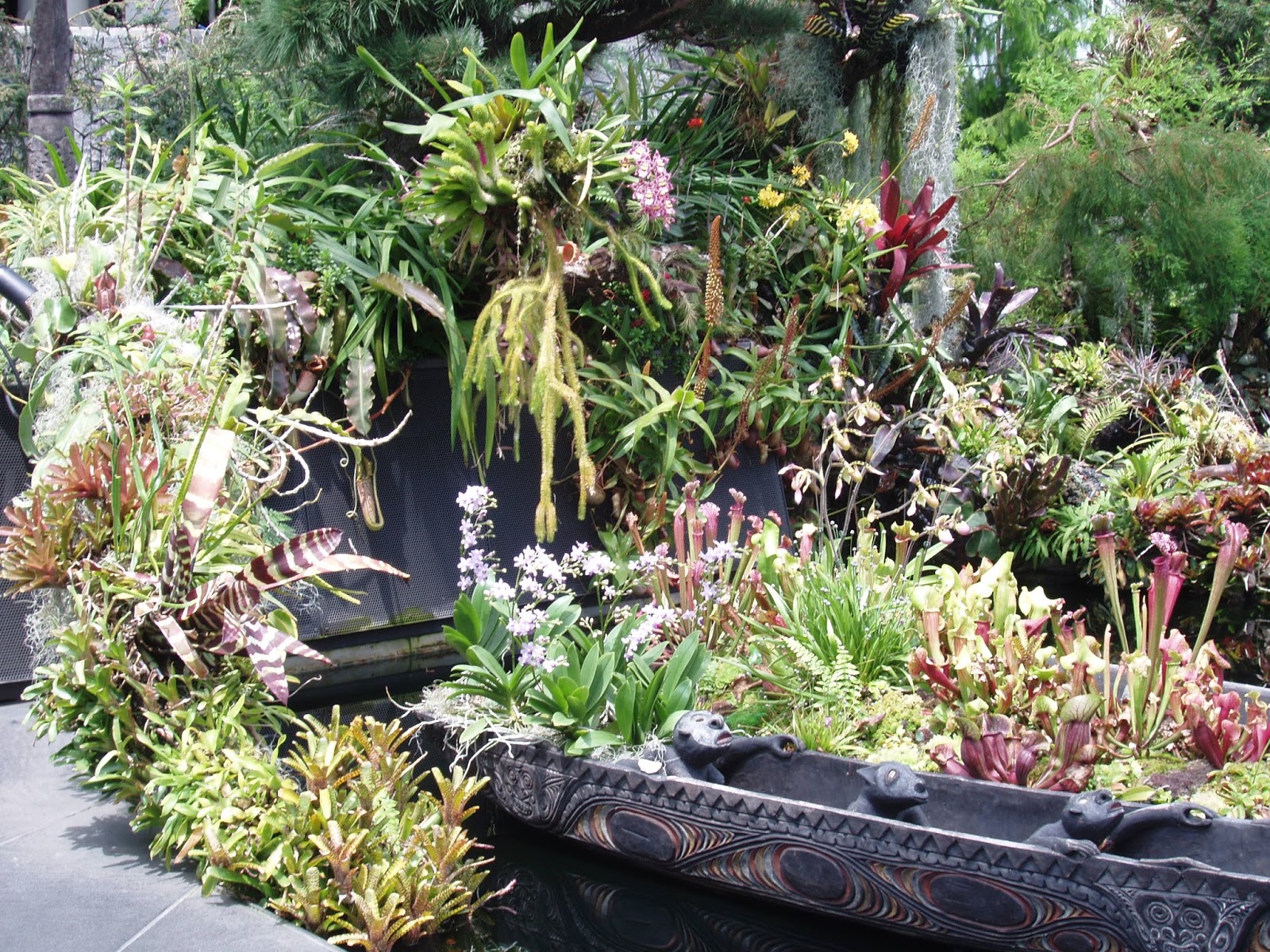
As the entrance fees were quite expensive, we decided to only visit one of the domes. We love flowers but we chose the 'Cloud Forests' because of its more interesting ecology. The pictures speak for themselves...


The cloud forest has a towering indoor waterfall...
The first thing we noticed when we entered the dome was the cool air, in fact it was positively chilly inside. A huge relief to escape from the sweltering heat outside and we decided to take our time exploring this dome. An impressive waterfall added to the allure of the cloud forest.


Metal walkways circle the dome at a few levels...


Shona had to conquer her fear of heights to traverse these walkways...


Insect eating pitcher plants up close...
 Pitcher plants grow on nitrogen poor soil so they depend on insects for nitrogen. But I didn't see any insects in the dome, so I suppose the gardeners just give them nitrogen supplements wink emoticon

Plant diversity on a man-made mountain. 


This is a remarkable project which one hopes will serve as a model for future parks and tourist attractions. Instead of the multitude of theme parks with roller coasters, fake cliffs, caves and castles which only serve to entertain, perhaps we will have parks which serve a biological and educational purpose.